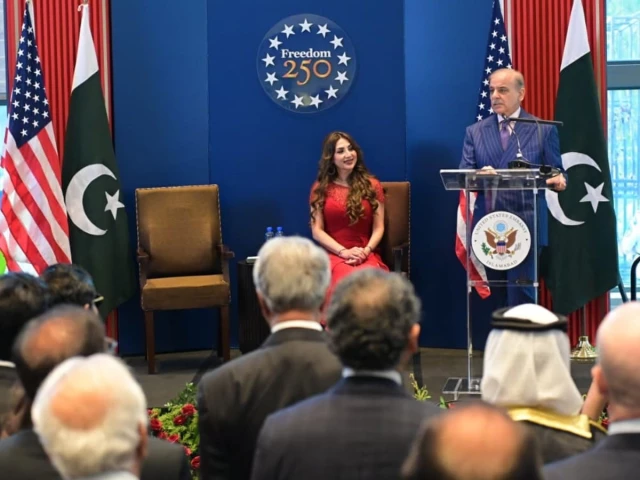
Prime Minister Shehbaz Sharif addresses a ceremony at US embassy to celebrate the 250th Independence day of the United States of America. Photo: PID
Prime Minister Shehbaz Sharif on Thursday lauded longstanding Pakistan-United States ties spanning over eight decades, describing them as a “true and special relationship”, at an occasion marking the latter’s 250th anniversary of independence.
The event was held at the US Embassy in Islamabad.
Addressing the ceremony, which was also attended by US Chargé d’Affaires Natalie Baker, the prime minister congratulated the US people and leadership on the 250th anniversary and lauded the Pakistan-US partnership spanning over eight decades.
Read: Trump says US to remove Iran’s high-level enriched uranium in ‘near future’
He said that as Pakistan marked two and a half centuries of the US, it was also time to celebrate the longstanding partnership between them.
“Ours is a true and special relationship spanning nearly eight decades,” he said, adding that it encompassed not only security and counterterrorism cooperation, but also trade, investment, agriculture, science, education, health, energy and people-to-people exchanges.
Prime Minister Muhammad Shehbaz Sharif addresses at a ceremony celebrating 250th Independence anniversary of the United States of America (4 June, 2026). pic.twitter.com/BjcGU3oT9V
— Prime Minister’s Office (@PakPMO) June 4, 2026
“The US was among the first nations to recognise Pakistan upon independence when Harry Truman wrote a congratulatory letter to Quaid-e-Azam Muhammad Ali Jinnah, welcoming Pakistan into the community of nations,” he said, while also praising US support for Pakistan’s Green Revolution and in the fields of development and education.
The prime minister said the story of the US was one of hope and optimism, rooted in enduring beliefs that could shape a better tomorrow through hard work and perseverance today.
“Today, under the bold and visionary leadership of President Trump, the US continues to inspire confidence and optimism while advancing peace, progress, and prosperity,” he said.
“We are all here to celebrate the 250th anniversary of the independence of the United States of America and on behalf of the people of Pakistan and my government, I extend our warmest felicitations to President Donald Trump, the US administration and the American people on this… pic.twitter.com/9M9F7mL4Mz
— Government of Pakistan (@GovtofPakistan) June 4, 2026
The prime minister commended the US corporate sector for continued investment in Pakistan, noting that around 80 major US companies were operating in the country.
He said Pakistan was poised to expand its IT exports, supported by one of the largest freelance workforces in the world, adding that the US remained a key destination in this regard.
Referring to the long-standing partnership between the two countries, he said Pakistan and the United States had worked closely during some of the most consequential moments in history, including the Soviet invasion of Afghanistan in the 1980s and the post-9/11 period from 2001 to 2021.
He once again praised President Trump for his role in securing a ceasefire between India and Pakistan following what he described as India’s unprovoked actions last year after the Pahalgam incident.
“We fondly remember American support in advancing our Green Revolution through UC Davis, in the construction of the Tarbela Dam, in building centers of excellence like LUMS at Lahore and in financing critical infrastructure around the country that continue to serve the Pakistani… pic.twitter.com/YMQLDz96KJ
— Government of Pakistan (@GovtofPakistan) June 4, 2026
“It is President Trump’s timely and most decisive interventions that resulted in a ceasefire between Pakistan and India on May 10,” he said, adding that Pakistan would remain forever grateful for his role in restoring peace in South Asia and saving millions of lives.
“In this context, he will always be remembered as the man of peace,” he added.
Referring to Pakistan’s mediation efforts regarding Iran and the US, he said Pakistan was “proudly but humbly playing a sincere role” as a facilitator between the two countries. “We are grateful for the trust reposed in Pakistan by both these countries,” he added.
“Natalie Baker, you have been an excellent representative of the United States in Pakistan. Through your energetic, passionate and sincere engagement, you have helped bring our two countries even closer together. I also wish to commend the dedicated team at the U.S. Embassy and… pic.twitter.com/4NePoMVqHq
— Government of Pakistan (@GovtofPakistan) June 4, 2026
He also praised Field Marshal Asim Munir for advancing Pakistan’s efforts for regional peace and stability, saying these efforts continued with the support of Iran and the US, and prayed for lasting peace.
Concluding his remarks, the prime minister lauded Baker, calling her an excellent representative of the US in Pakistan, saying her “energetic engagement and active diplomacy” had helped bring the two countries closer.
Pakistan-US ties entering new chapter: Baker
Earlier, US Chargé d’Affaires Natalie Baker thanked Prime Minister Shehbaz Sharif for attending the ceremony, describing the Pakistan-United States partnership as stronger than ever and rooted in friendship and shared interests.
Addressing guests at the event marking the 250th anniversary of US independence, Baker said the occasion came at a significant moment in the history of bilateral relations.
“Tonight, standing here in Islamabad, I feel the weight and the wonder of that moment. And I feel something more: profound gratitude – for the United States, for Pakistan, for our people, and for a partnership that gives those ideals new meaning, and new life, in the twenty-first century,” she said.
She said that over the past two years, under the leadership of President Trump and PM Shehbaz, the United States and Pakistan had embraced one another as strategic partners based on mutual respect, aligned interests and a shared vision for security and prosperity.
Baker said President Trump’s engagement with Pakistan had been “direct, personal, and consequential”, adding that his administration viewed ties with Islamabad through the lens of results and cooperation.
Referring to the May 2025 ceasefire between Pakistan and India, she said the US President had credited PM Shehbaz and Field Marshal Asim Munir for helping secure the truce.
“President Trump credited Prime Minister Sharif’s and Field Marshal Munir’s leadership with securing the May 2025 ceasefire, calling it a major contribution to preventing war between nuclear-armed neighbours. The statesmanship of Pakistan’s leaders – your willingness to de-escalate and stabilise a dangerous confrontation – is not forgotten in Washington. It is admired. And it opened a new chapter,” she said.
The US envoy said bilateral relations deepened further when President Trump hosted the prime minister and Field Marshal Munir at the White House, describing it as evidence of the trust and personal ties between the two governments.
U.S. Marks 250th Independence Day in Islamabad; Envoy Hails “Strongest Ever” Pakistan-U.S. Partnership
Islamabad, June 4, 2026
The United States Embassy in Islamabad hosted its largest-ever Independence Day reception Wednesday evening, marking America’s 250th anniversary with… pic.twitter.com/meQUUhi40A— Voice of Germany (@NewsVOG) June 4, 2026
“I have been honoured to witness and to support this transformation,” she added, describing Pakistan as an extraordinary host.
Baker said both President Trump and Secretary of State Marco Rubio highly valued the partnership with Pakistan, adding that Washington viewed a strong Pakistan as being in America’s interest.
She also highlighted the role of the US diplomatic mission in Pakistan, saying embassy and consular staff had worked extensively over the past year on visas, trade and investment, security cooperation, support for US citizens and high-level diplomatic engagements.
Turning to regional diplomacy, Baker said Islamabad had hosted high-level talks between the United States and Iran in April, describing them as the most senior contacts between the two countries since 1979.
“Pakistan – by having good ties with both Tehran and Washington, and by playing no part in the conflict – was uniquely positioned to bring two adversaries together. Even many Pakistanis said it felt surreal. It was Pakistan’s moment, and Pakistan rose to it,” she said.
She praised Pakistan’s role during the negotiations and commended Pakistani authorities for their professionalism and cooperation.
“The professionalism and quiet determination of our Pakistani partners during those days was nothing short of extraordinary. I am proud to have served alongside you,” she said.
“Pakistan-US relations are stronger than ever and represent the very best of partnership,” says Natalie Baker, US Chargé d’Affaires, at a ceremony marking the 250th anniversary of US independence at the US Embassy. She said the two countries, under President Trump and Prime… pic.twitter.com/JhqEJHsVf0
— Pakistan TV (@PakTVGlobal) June 4, 2026
Discussing sports diplomacy, she highlighted the upcoming 2026 FIFA World Cup in the United States, Canada and Mexico, and noted Pakistan’s contribution to the event through the manufacture of footballs.
“Pakistan is at the heart of it: this country manufactures world-class footballs that will be used on pitches from New York to Los Angeles, from Toronto to Mexico City,” she said.
She added that President Trump regarded both PM Shehbaz and Field Marshal Munir among Washington’s most trusted partners regionally and globally.
Concluding her remarks, Baker thanked the people of Pakistan for their hospitality and described the relationship between the two countries as one built on trust, results and shared interests.
US-Pakistan ties
Relations between the United States and Pakistan have seen a sudden shift after nearly a decade of ties since President Trump assumed office for a second term.
Relations between the two countries hit rock bottom in 2011 after the US raid in Abbottabad that killed Al Qaeda chief Osama bin Laden. They improved somewhat in 2020, when the US acknowledged Pakistan’s role in facilitating the Doha Agreement with the Afghan Taliban.
However, with President Joe Biden’s arrival in 2021, ties entered a diplomatic freeze once again. They were relegated to the sidelines for much of his term as the Biden administration leaned on India to counter China’s growing influence in the region.
Relations between the two countries have reached a new high under President Trump’s second term. In March 2025 — weeks after Trump’s second inauguration — Pakistan arrested and extradited to the US an Islamic State-Khorasan (IS-K) operative, Mohammad Sharifullah, who was accused of helping plan the 2021 suicide bombing outside Kabul airport that killed 13 American soldiers.
That prompted Trump to praise Pakistan at the start of his second term. “I want to thank especially the government of Pakistan for helping arrest this monster,” Trump said in his first address to Congress during his second term.
Diplomatic engagement between the United States and Pakistan reached new heights after Trump helped broker a ceasefire between Pakistan and India during their brief war.
Since then, leaders from both countries have exchanged cordial gestures and praised each other’s leadership on international platforms. PM Shehbaz even nominated President Trump for the Nobel Peace Prize in recognition of his mediation efforts.
Trump, in turn, has frequently praised PM Shehbaz and Pakistan’s military leadership, notably describing CDF Munir as his “favourite field marshal”.
Building on this positive momentum, Islamabad now seeks to translate the goodwill into tangible economic benefits by pursuing a more favourable trade agreement with Washington, including tariff concessions and expanded market access for Pakistani exports.
Most recently, after a war broke out between the US and Iran in February this year, Pakistan emerged on the international stage as a peace broker. Islamabad brokered a two-week ceasefire between the United States and Iran on April 8, followed by critical talks in Islamabad attended by senior delegations from both countries on April 11 and 12. However, neither side was able to reach an agreement to bring the conflict to an end.
Since then, the two sides have exchanged proposals and counter-proposals in an effort to find common ground and resume a second round of direct talks aimed at ending the conflict.