





ISLAMABAD:
The year was 2019, and Pakistan found itself trapped in one of the most delicate diplomatic balancing acts in its recent history. Two of its closest strategic partners Saudi Arabia and Turkiye had drifted onto opposite sides of an expanding geopolitical divide.
Islamabad ultimately withdrew from the Kuala Lumpur Summit after Riyadh viewed the gathering as an attempt to establish a parallel Islamic bloc outside the Organisation of Islamic Cooperation (OIC).
Turkish President Recep Tayyip Erdogan would later publicly reveal that Pakistan had pulled out under Saudi pressure, warning that refusal could have carried serious economic consequences.
Seven years later, the geopolitical landscape looks dramatically different.
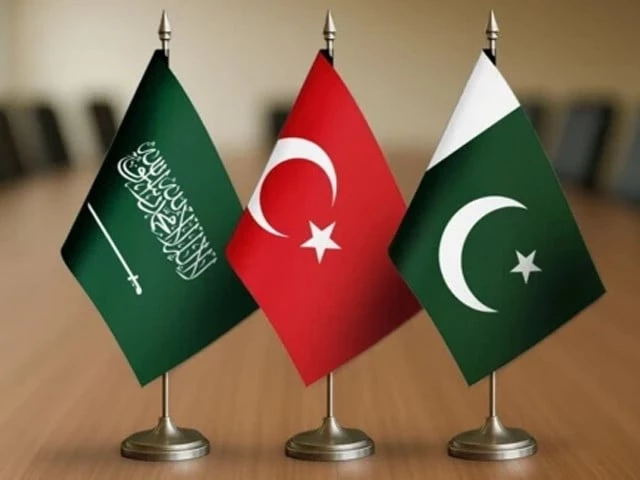
On Friday, Saudi Crown Prince Mohammed bin Salman, Turkish President Recep Tayyip Erdogan and Prime Minister Shehbaz Sharif formally signed the Makkah Joint Defence Agreement, establishing a trilateral security framework that commits the three countries to collective defence while significantly expanding military cooperation.
The accord builds on the Pakistan-Saudi Strategic Mutual Defence Agreement signed in September 2025, under which an attack on one member is regarded as an attack on all.
The symbolism could hardly be more striking.
The same countries that only a few years ago were competing for leadership and influence across the Muslim world have now chosen strategic cooperation over rivalry. While ideological differences and regional competition once defined their relationship, shifting geopolitical realities have compelled them to think collectively about their security.
Diplomatic sources say the trilateral pact did not emerge overnight. Discussions on expanding the Pakistan-Saudi defence arrangement had been underway for months.
Turkiye formally expressed interest in joining soon after the bilateral accord between Islamabad and Riyadh was concluded last year, according to officials familiar with the negotiations. Earlier reports had also indicated Ankara was exploring participation in the evolving security framework.
Initially, Turkish policymakers were cautious. Ankara did not want the arrangement to be interpreted as a military alliance directed against any particular country. But the strategic environment changed dramatically over the past few months.
The Iran-US confrontation, repeated threats to maritime security, the growing use of drones and missiles across the Middle East, and uncertainty surrounding the future regional order convinced all three capitals that closer defence coordination was becoming a strategic necessity rather than a political choice.
Officials insist the pact is defensive in nature.
“It is not aimed at any particular country,” one diplomatic source explained. “Its objective is deterrence and regional stability.”
That distinction is important. Unlike traditional military alliances created to counter a specific adversary, the Makkah agreement is being presented as a collective security arrangement designed to discourage aggression while preserving strategic flexibility. Saudi officials have similarly described it as an inclusive framework that does not undermine existing partnerships or seek confrontation.
Each of the three countries contributes a distinct strategic advantage.
Pakistan brings one of the Muslim world’s most experienced militaries, extensive operational expertise and nuclear deterrence. Turkiye contributes a rapidly expanding indigenous defence industry, ranging from combat drones and naval platforms to advanced electronics and missile technologies. Saudi Arabia, meanwhile, provides financial resources, investment capacity and growing influence in regional diplomacy.
Together, they create a combination that is far stronger than the sum of its individual parts.
For Pakistan, the agreement reinforces its longstanding role as a key security partner in the Gulf while opening new opportunities for defence industrial cooperation with Turkiye and Saudi Arabia.
For Riyadh, it broadens its security partnerships at a time when Gulf states are increasingly seeking greater strategic autonomy. For Ankara, the pact offers deeper engagement with both South Asia and the Gulf while expanding markets for its defence technology.
Beyond military cooperation, the agreement could accelerate joint production of defence equipment, intelligence sharing, coordinated military exercises, cybersecurity collaboration and integrated air and missile defence initiatives.
Perhaps the most significant aspect of the agreement, however, lies in what it may become rather than what it is today.
Diplomatic sources suggest the framework has deliberately been designed to remain open to additional members. Officials avoid naming potential candidates, but several Muslim countries have reportedly shown interest in enhanced security cooperation under the new mechanism.
That makes the Makkah agreement potentially far more consequential than a simple trilateral pact.
If the arrangement gradually expands to include other like-minded states, it could evolve into the first genuinely institutionalised Muslim security framework based on shared strategic interests rather than ideological alignment. Unlike previous attempts at military cooperation within the Islamic world, this initiative is built around practical defence collaboration, interoperability and collective deterrence.
Its success, of course, will depend on implementation. Translating political declarations into operational mechanisms, integrated command structures, defence industrial projects and sustained military coordination will require significant political commitment and resources.
Nevertheless, Friday’s signing represents more than another defence agreement.
It marks the closing of one chapter in Middle Eastern politics and the beginning of another. The divisions that once forced Pakistan to choose between friends have given way to a shared strategic vision among three influential regional powers.
The Makkah Joint Defence Agreement is therefore unlikely to be remembered simply as a trilateral pact.
It may instead be seen as the foundation stone of a broader security architecture, one that could eventually extend beyond Pakistan, Saudi Arabia and Turkiye. If current diplomatic momentum continues, observers think this agreement will not be seen as the culmination of a process, but as the beginning of a new regional order.