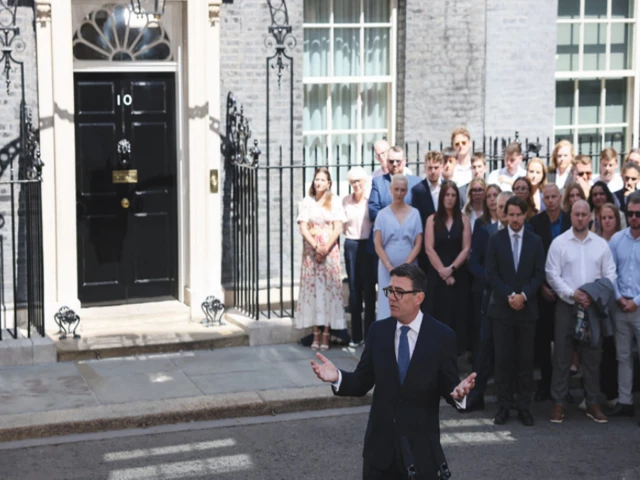
OFFICIAL BUSINESS: PM Andy Burnham delivers a speech outside 10 Downing Street in London. PHOTO: REUTE
LONDON:
Andy Burnham became Britain’s seventh prime minister in a decade on Monday, pledging to reshape its politics to deliver a new economic model and revive a nation “fed up” with a revolving door of leaders.
In front of dozens of supporters outside his new office and residence at 10 Downing Street, Burnham said politicians had failed to bring the stability needed to raise living standards, something he said he would change, with both immediate measures and a longer-term plan to be drawn up later this year.
Speaking without notes, Burnham delivered a domestic-focused speech aimed at offering hope to a nation that has, like many European countries, struggled for years with soaring prices and anaemic economic growth. He did not touch on foreign affairs.
“I know people at home are fed up with politics. I hear you, and I want to be honest with you, we have not been good enough and we need to be better,” he said, dispensing with the lectern that prime ministers generally use.
Burnham pledged to use his premiership as a “circuit-breaker for Britain”, arguing that a new model was needed to rebuild the country, which has been in political turmoil since voting in 2016 to leave the European Union.
Just over an hour after his predecessor and Labour colleague Keir Starmer had made his farewell speech to say “My work is done”, the 56-year-old former Greater Manchester mayor entered Downing Street, where he said his team would tackle his first priority: to end rough sleeping.
The major challenges will then lie ahead.
Burnham must first unveil his cabinet – already the subject of much debate in the Labour Party – and then tackle a long list of problems ranging from high levels of illegal immigration to underperforming utility firms.
Starmer, ousted by his own lawmakers a month ago, said his work as prime minister was “the privilege of my life” and that he wished Burnham every success, with “my full support”.
Burnham did not refer to Starmer in his speech, instead focusing on how he will bring change. But he acknowledged that some of his programme would take time.
In his short address, thin on policy detail, Burnham said he would release a long-term plan for the next decade within months and repeated his pledge to build more public housing and to help bring down welfare spending to fund higher defence investment. Opposition parties suggested he would need to win a national election to get a mandate to implement it.
But he promised to unveil more immediate measures on Tuesday to ease everyday pressures on Britons, and explain how he will pay for them.
Speaking to reporters later on Monday, Burnham said he was finalising the details of those measures which he described as “things that people will feel and feel quite quickly”. Reuters
Source link