





Trump repeatedly issued threats to escalate war on Iran in late February, only to allow more time for talks
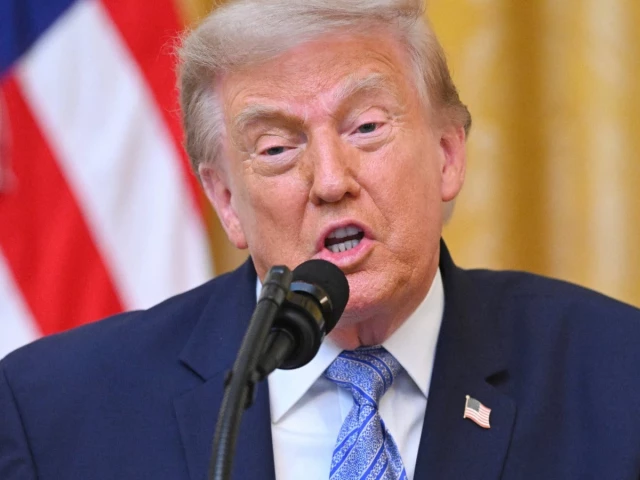
US President Donald Trump speaks about election security during an address to the nation from the East Room of the White House in Washington, DC, US, July 16, 2026. PHOTO: REUTERS
US President Donald Trump said on Sunday that talks with Iran will begin Monday afternoon, expressing optimism that an agreement on the Strait of Hormuz and Iran’s “denuclearization” could soon be reached.
Speaking to reporters aboard Air Force One en route to Joint Base Andrews in Maryland, Trump said conversations with Saudi Arabia, the United Arab Emirates, Qatar and Iran had prompted him to cancel a “massive attack” on Friday.
“We were asked by the three primary groups. We were also asked by Iran very strongly,” he said. “They said we’d like to make a deal.”
He said the planned military operation was called off after Iran and neighbouring countries urged Washington to hold back.
“It was going to be a massive attack. They asked us not to do it. They said: ‘Please don’t do it.’ Their neighbours said that too. We are just going to see whether or not we can make a deal,” he said.
“They didn’t want us to do it, and frankly, Saudi Arabia didn’t want it either. They thought that a deal is imminent … having to do with the Hormuz Strait and also ultimately denuclearisation,” he added.
Asked whether Iran had a deadline to reach an agreement, Trump said there was no set timeline.
“We’ll just see,” he said, while emphasising that the US remained prepared to use military force if necessary.
“We’re ready to go anytime we want. Would I rather make a deal? I’m not looking to kill people because people die, a lot of people die, and we don’t want that,” he said.
He said the planned operation would have been “disastrous” for Iran and claimed it would have taken the country “many, many years” to rebuild.
Asked whether the operation would have targeted Iran’s energy infrastructure, Trump declined to elaborate.
Iran executes two accused of spying
Iranian news outlet ISNA said on Monday that two Israeli “mercenaries” who were caught sending “coordinates, images, and information on military and security centers to Mossad officers and communication channels affiliated with this espionage service” were executed.
قوه قضاییه: امید بهزاد و پوریا صفوت، ۲ مزدور اسرائیل که در جریان جنگ رمضان و جنگ ۱۲ روزه با ارسال مختصات، تصاویر و اطلاعات مراکز نظامی و امنیتی برای افسران موساد و کانالهای ارتباطی وابسته به این سرویس جاسوسی کمک شایانی به آنها در رسیدن به اهداف خود کرده بودند اعدام شدند
— خبرگزاری ایسنا (@isna_farsi) August 3, 2026
Explosion reported near tanker off Oman: UK maritime agency
An explosion was reported early on Monday near a tanker off the coast of Oman, the UK Maritime Trade Operations (UKMTO) centre said.
The agency said it received a report of an incident about 20 nautical miles northeast of the town of Khasab after the master of the tanker reported hearing an explosion in close proximity to the vessel.
The vessel and its crew were reported safe while authorities launched an investigation into the incident, UKMTO said.
The agency also advised vessels transiting the area to exercise caution and report any suspicious activity.
Trump’s threats
Trump has repeatedly issued threats that he would escalate the war on Iran he launched along with Israel in late February, only to allow more time for talks, which have so far not led to a comprehensive deal.
Read: Negotiations between Iran and Oman over Hormuz in final stages, Tehran says
Trump’s apparent de-escalation after days of threats of new attacks from each side was the latest twist in the war. Attacks have spread across the Gulf to the Red Sea and even a Mediterranean facility in Egypt.
Iran has largely closed the Strait of Hormuz, a conduit for 20% of the world’s oil and liquefied natural gas, before the start of the war, causing energy prices to rise and stoking broader inflation.
The US president has argued that his stated goal of keeping Iran from gaining nuclear weapons justifies higher fuel costs in the near term, but the economic pain has put political pressure on him to find a way to end the conflict.
Oil prices were down more than 4% in early trading on Monday.
Iranian diplomacy
Iran’s Foreign Minister Abbas Araghchi held phone calls with his Saudi counterpart Prince Faisal bin Farhan and Chief of Defence Forces Field Marshal Asim Munir to discuss diplomatic efforts, Iran’s state media reported on Sunday.
The official Iranian news agency IRNA reported earlier that negotiations between Tehran and Oman over the Strait of Hormuz were in their final stages, citing Iran’s Foreign Minister Abbas Araghchi.
Iranian Foreign Ministry spokesperson Esmaeil Baghaei said negotiations were focused on agreeing a new route through the strait, adding that it had “no link to the Strait of Hormuz being opened or closed. That is a separate discussion.”
Last month Iran publicly rejected an Omani proposal, backed by Gulf states, to manage the strait they share. People familiar with the matter had told Reuters the plan included the collection of voluntary fees for using the strait.
Eli Cohen, Israel’s energy minister and a member of Prime Minister Benjamin Netanyahu’s security cabinet, said there was close security and intelligence coordination between Israel and the US on everything happening in the region.
But he added: “With or without an agreement, and regardless of any external commitments, if Iran attempts to renew its nuclear program or advance its ballistic missile industries, we will be there. We will take action, and we will strike.”
Trump and Netanyahu met on Tuesday in Washington, with an Israeli official saying they had explored all possible paths to curb Iran’s nuclear program, including diplomacy, economic pressure and force. Tehran denies it is seeking a nuclear weapon.