
Signals acceptance of 20-year halt to enrichment
Araghchi says Pakistan’s mediation process facing difficulties
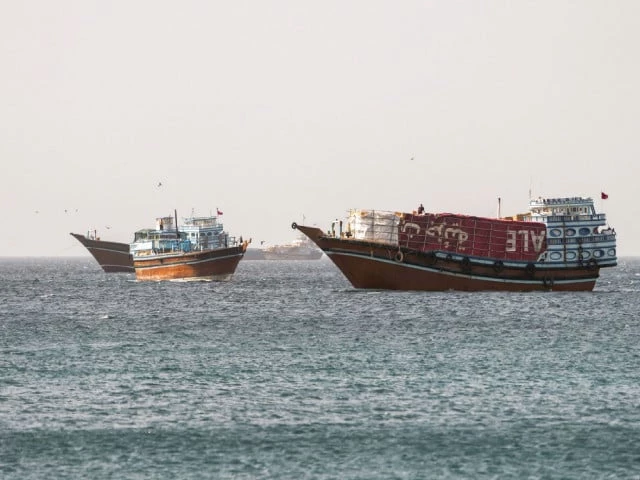
Vessels are seen in the Strait of Hormuz off Musandam, Oman. Photo: REUTERS
DUBAI/
ABOARD AIR FORCE ONE:
United States President Donald Trump said on Friday that indicated that he could accept a 20-year halt to Iran’s nuclear activity while dismissing the latest proposal from Iran as “unacceptable”.
As he flew back from Beijing on Friday after two days of talks with Chinese President Xi Jinping, the president also said that the ceasefire with Iran was made as a “favour” to Pakistan and at the request of other countries.
“We really did the ceasefire at the request of other nations, I would not have been in favour of it. We did it as a favour to Pakistan, they are terrific people, the field marshal, the prime minister,” he said while talking to reporters aboard Air Force One on his return trip from a state visit to China.
He said his patience with Iran was running out and that Chinese President Xi Jinping had agreed Tehran must reopen the Strait of Hormuz, but China gave no indication it would weigh in.
Iranian Foreign Minister Abbas Araghchi said Pakistan’s mediation efforts regarding regional tensions had “not failed” but were currently facing difficulties. He added that Tehran would welcome any constructive role played by China to help ease the situation and support diplomatic progress.
Speaking at the Iranian Embassy in New Delhi, Araghchi said Iran was attempting to preserve the current ceasefire in order to give diplomacy an opportunity to move forward. He added that Tehran has “no trust” in the US and is interested in negotiating with Washington only if it is serious. Iran is trying to keep the ceasefire to give diplomacy a chance, he told reporters during a press conference.
“The mediation process by Pakistan has not failed yet, but it is in a very difficult course, mostly because of the Americans’ behaviour and the mistrust which exists between us,” Araghchi said.
“Contradictory messages” have made us reluctant about the real intention of the Americans in negotiations, Araghchi added. He also acknowledged the impact of US sanctions on Tehran, saying Iran fully understood the consequences of the restrictions imposed by Washington.
In comments carried by Iran’s IRIB broadcaster, he said Iran is not to blame for disruptions in the Strait of Hormuz, and that Tehran did not initiate the war and is only defending itself. He reiterated Iran’s position that the strait is now open to vessels of “friendly countries”, as long as they coordinate with Iranian officials, and only closed to Iran’s “enemies”.
Araghchi also confirmed he has spoken with Russian officials about Moscow’s offer to store Iran’s enriched uranium and expressed appreciation for the country’s “intention to help”. He said Iran plans to postpone the issue of its enriched uranium to later stages of negotiations with the US, but may consider Russia’s proposal at an appropriate time.
“When we come to that stage, obviously we will have more consultations with Russia and see if the Russian offer can help or not,” he said. “This is not something at the time being”.
Addressing concerns over maritime security, Araghchi described the situation around the Strait of Hormuz as “very complicated”, saying Iran was attempting to help maintain stability in the strategic waterway. He said all vessels would be allowed to pass through the strait except those belonging to countries “at war with Iran”, adding that ships seeking passage should coordinate with the Iranian navy.
Trump said he was considering whether to lift US sanctions on Chinese oil companies buying Iranian oil. China is the biggest buyer of Iranian oil.
His comments shed no light on whether Beijing might use its influence with Tehran to end a conflict it said should never have started.
“I’m not asking for any favors because, when you ask for favors, you have to do favors in return,” Trump said, when asked by a reporter on board his plane whether Xi had made a firm commitment to put pressure on the Iranians to reopen the strait, a key waterway for oil shipments.
Xi did not comment on his discussions with Trump about Iran, although China’s foreign ministry issued a blunt statement outlining Beijing’s frustration with the Iran war.
“This conflict, which should never have happened, has no reason to continue,” the ministry said.
Iran effectively shut the strait to most shipping in response to U.S.-Israeli attacks that began on February 28, causing an unprecedented disruption to global energy supplies.
The US paused its attacks on Iran last month but began a port blockade. Tehran said it would not unblock the strait until the U.S. ended its blockade. Trump has threatened to attack Iran again if it does not agree to a deal.
“We don’t want them to have a nuclear weapon, we want the straits open,” Trump had said in Beijing, sitting alongside Xi.
Iranian Foreign Minister Abbas Araqchi said Tehran had received messages from the US indicating Washington was willing to continue talks.
“We hope that, with the advancement of negotiations, we will reach a good conclusion so that the Strait of Hormuz can be completely secured and we can expedite the normalisation of traffic through the strait,” he told reporters in New Delhi.
Iran, which has long denied that it intends to build a nuclear weapon, has refused to end nuclear research or relinquish its hidden stockpile of enriched uranium, to Trump’s frustration.
“I am not going to be much more patient. They should make a deal,” Trump said in an interview aired on Thursday night on Fox News’ “Hannity” program, suggesting the enriched uranium needed to be secured by the U.S. for “public relations” rather than practical necessity.
Oil prices rose around 3% to around $109 a barrel on concerns over a lack of progress in resolving the conflict.
US Treasury yields hit their highest in around a year as traders anticipated the Federal Reserve might need to hike rates to rein in inflationary pressures from the blockade.
After talks between Trump and Xi on Thursday, the White House said Xi had made clear China’s opposition to any Iranian effort to charge a toll for use of the strait.
Trump said Xi also promised not to send Iran military equipment. “That’s a big statement,” Trump said on “Hannity”.
Asked about US sanctions on Chinese oil refineries buying Iranian oil, Trump told reporters on his plane: “We talked about that and I’m going to make a decision over the next few days.”
China has dismissed reports it had plans to supply weapons to Iran as “groundless smears”, but analysts doubt Xi will want to push Iran hard or end support for its military, given its value as a strategic counterweight to the US
Talks on ending the war, which has become a liability for Trump ahead of US congressional elections in November, have been on hold since last week when Iran and the US each rejected the other’s most recent proposals.
Iran would welcome Chinese input, Araqchi said on Friday, adding that Tehran was trying to give diplomacy a chance but did not trust the US, which has curtailed previous rounds of talks by launching air strikes.
Iran is prepared for a resumption of fighting as well as for diplomatic solutions, Araqchi said, reiterating that vessels not linked to states attacking his country could traverse the Strait of Hormuz if they coordinated with Iran.
Iran state media said on Friday that more than 31 million Iranians had signed up for a campaign to demonstrate public readiness to defend the country in a conflict, as the country started weapons courses for pro-government volunteers.
Before the war, about a fifth of global oil and liquefied natural gas as well as fertiliser and other vital supplies passed through the strait. Attacks on shipping have prevented almost all traffic.
The UAE said it would speed up building a new pipeline to its port in Fujairah just outside the strait, after a vessel heading to it was sunk this week and another was boarded and redirected to Iran.
Thousands of Iranians were killed during the US and Israeli air strikes, and thousands have been killed in Lebanon in renewed fighting there between Israel and the Iran-backed group Hezbollah.
The US State Department announced on Friday that Israel and Lebanon had agreed to a 45-day extension of a fragile ceasefire, which had been due to expire on Sunday.
Hezbollah opposes the talks, in which Israel is insisting on the group’s disarmament.

