Pakistan’s finance ministry had projected inflation would remain within a 5% to 6% range in January. PHOTO:FILE
KARACHI:
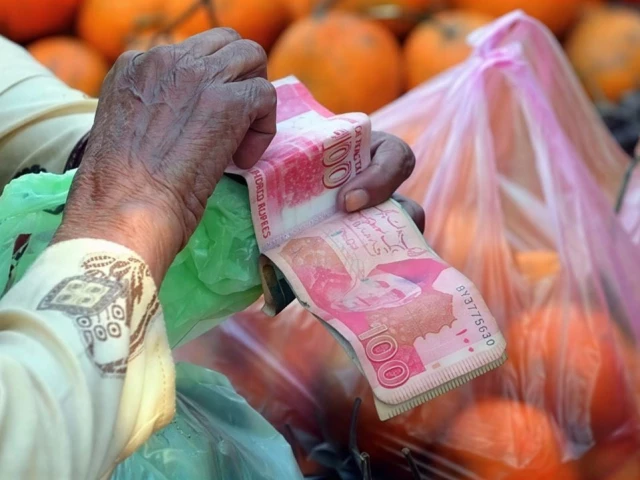
Pakistan’s weekly inflation surged to a 75-week high, with the Sensitive Price Indicator (SPI) rising 12.16% year-on-year (YoY) for the week ended April 16, 2026, signalling intense price pressure despite a temporary week-on-week (WoW) decline, according to data released by the Pakistan Bureau of Statistics (PBS) and estimates from Topline Research.
The latest reading marks the highest annual increase in over a year, underscoring that underlying inflationary momentum remains strong even as short-term price movements show signs of easing. On a WoW basis, the SPI declined by 0.69%, snapping a six-week rising streak, primarily due to a sharp drop in fuel and select food prices.
The YoY surge was largely driven by steep increases in energy and essential food items. Liquefied petroleum gas (LPG) prices soared by over 60% compared to the same period of last year, while petrol and diesel rose by 44.10% and 49.22%, respectively.
Among food items, tomatoes recorded an exceptional increase of 69.35%, followed by onions (42.67%) and wheat flour (28.80%), reflecting continued supply-side pressure and cost pass-through effects.
Meat prices also remained elevated, with mutton and beef registering double-digit increases of 14.67% and 13.27%, respectively. Other key household items, such as powdered milk and garlic, also posted notable gains, contributing to the broad-based rise in inflation.
Despite the sharp annual increase, the weekly decline provided some respite to consumers. The WoW drop was mainly led by a significant reduction in fuel prices, particularly diesel, which fell by 25.77%. Prices of chicken declined by 10.07%, while onions, wheat flour, and petrol also recorded notable decreases of 6.63%, 3.34%, and 3.10%, respectively. Bananas and garlic further contributed to the downward trend.
However, the relief was partially offset by increases in perishable food items. Tomato prices rose by 6.27% during the week, while bread and eggs increased by 3.27% and 2.09%, respectively, highlighting continued volatility in food markets.
A breakdown across consumption groups indicates that inflationary pressure remains widespread. The lowest income group experienced a 9.82% YoY increase, while the highest quintile saw inflation at 12.02%, suggesting that price pressure is not confined to any single income segment.
It is pertinent to mention that the Consumer Price Index (CPI) increased by 7.3% YoY in March 2026 as compared to a rise of 7% in the previous month and 0.7% in March 2025. On a month-on-month basis, it rose by 1.2% in March 2026 as compared to an increase of 0.3% in the previous month and an increase of 0.9% in March 2025.
The urban CPI inflation spiked 7.4% YoY in March 2026 as compared to an increase of 6.8% in the previous month and a rise of 1.2% in March 2025. Month-on-month, it went up by 1.3% in March 2026 as compared to 0.3% in the previous month and 0.8% in March 2025.
Source link