Tougher penalties passed for abuse of domestic workers, unauthorised LPG decanting, wrongful detention of dead bodies
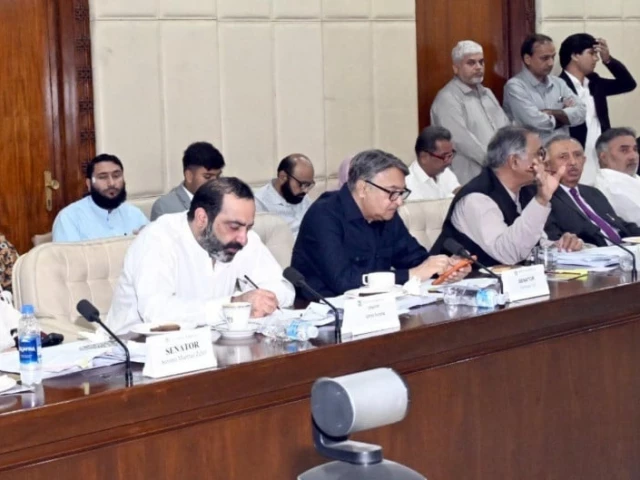
The Senate Standing Committee on Interior passes a series of bills, including one proposing the death penalty for perpetrators of acid attacks on Monday. PHOTO VIA X
ISLAMABAD:
The Senate Standing Committee on Interior on Monday approved a series of criminal law amendments, including a proposal to make acid attacks punishable by death, along with measures to criminalise the abuse of domestic workers, unauthorised liquefied petroleum gas (LPG) decanting and the wrongful detention of dead bodies by hospitals.
Chaired by Senator Faisal Saleem Rehman, the committee considered several private members’ bills concerning acid attacks, domestic workers, LPG safety, anti-rape legislation and consumer protection.
The bills were passed despite opposition from Minister of State for Interior Talal Chaudhry, while Pakistan Peoples Party (PPP) lawmakers also voted in favour.
The Criminal Law (Amendment) Bill, moved by Senator Muhammad Abdul Qadir, seeking amendments to Section 336-B of the Pakistan Penal Code (PPC) concerning hurt caused by corrosive substances, was passed in the mover’s absence.
The bill, citing the recent acid attack on a lady doctor in Quetta, said that despite an amendment made in 2011, acid attacks continued to cause lifelong disfigurement and trauma. It proposed punishment of “death or imprisonment for life or imprisonment of not less than 14 years and a fine of Rs2 million” as a strong deterrent against the crime.
Read: Suspect killed in encounter after acid attack on female doctor in Quetta
The committee also unanimously passed the Criminal Laws (Amendment) Bill moved by Senator Sarmad Ali, seeking to criminalise the abuse of domestic workers.
Its “Statement of Objects and Reasons” said domestic workers constituted one of the most vulnerable segments of society and were often subjected to physical violence, sexual abuse, forced labour and other forms of mistreatment by employers.
It said existing legal provisions did not specifically address abuse arising from the dependency and control inherent in domestic work settings.
The proposed provision covers physical violence, sexual harassment, threats, forced labour, wage theft, confiscation of identity documents, denial of food or medical care and humiliating treatment.
It proposes imprisonment for up to 10 years and a fine of up to Rs100,000, while offences resulting in serious injury or death would carry imprisonment for life and a fine of up to Rs500,000.
The bill would also make employers liable if members of their household committed abuse, unless they had taken reasonable steps to prevent such abuse.
Read More: Households continue to exploit child labour in Punjab
Schedule II of the Code of Criminal Procedure would also be amended to make the offence non-bailable and triable by a court of session.
The committee also approved the Criminal Laws (Amendment) Act moved by Senator Shahadat Awan, seeking to amend Sections 286 and 286-A of the PPC to criminalise the unauthorised transfer of LPG into smaller cylinders.
The bill noted that LPG decanting in residential areas and roadside setups without proper safety measures posed severe risks to public life and property.
It proposed increasing the punishment under Section 286 from six months to two years and raising the fine from Rs1,000 to Rs100,000. Under Section 286-A, the proposed punishment would increase from two to five years, while the fine would rise from Rs10,000 to Rs500,000.
The “Statement of Objects and Reasons” said the decanting of LPG from larger cylinders into smaller domestic cylinders without proper safety measures had become widespread in many parts of Pakistan. Such unauthorised operations, it added, were often conducted in residential areas, workshops and roadside setups without adherence to safety standards.
“The proposed amendments aim to deter negligent and reckless conduct in the handling of explosive and hazardous substances, ensuring greater public safety and accountability,” the statement said.
The committee unanimously passed another Criminal Laws (Amendment) Bill, moved by Senator Samina Mumtaz Zehri, proposing the insertion of a new Section 338CA to make the “wrongful detention of a dead body” a punishable offence.
Parliament’s responsibility is to turn the concerns of our people into meaningful legislation and action. Today, the Senate Standing Committee on Interior and Narcotics Control took up important matters concerning public safety, justice, legislation and institutional… pic.twitter.com/tpxqssePts
— Samina Mumtaz Zehri (@SenatorMumtaz) September 7, 2026
The “Statement of Objects and Reasons” highlighted reports of private hospitals and clinics detaining the bodies of deceased patients until their families settled outstanding medical bills.
It cited instances in which hospitals allegedly demanded exorbitant advance deposits, sometimes as high as Rs2 million to Rs4 million, and withheld bodies even when outstanding dues were as low as Rs100,000.
The statement said such practices caused immense psychological harm to grieving families and denied the deceased the right to timely burial and dignified last rites, which it described as a fundamental religious obligation in Islam and other religions. It also maintained that the inviolability of human dignity did not cease upon death.
Also Read: Hospitals barred from retaining bodies over unpaid bills
The proposed provision carries a punishment of up to two years’ imprisonment and/or a fine of Rs500,000 for a first offence. A second offence, or detention of a body beyond 24 hours, would carry imprisonment of up to three years and/or a fine of Rs1 million. Exceptions have been provided for autopsies and police investigations, while the offence has been made compoundable by the legal heirs.
The Anti-Rape (Investigation and Trial) (Amendment) Bill, moved by Senator Bushra Anjum Butt, was also passed. The committee observed that legislation aimed at strengthening the legal framework against rape should receive appropriate government support.
On consumer protection, the committee passed the Islamabad Consumers Protection (Amendment) Bill, also moved by Senator Zehri, seeking to bring private healthcare under the ambit of the 1995 Act.
The proposed legislation targets undisclosed fees, non-itemised billing and demands for advance deposits before emergency treatment. It would also require hospitals to publicly display their fee schedules and provide itemised bills.
Separately, the committee expressed serious concern over reports that former parliamentarians were being required to obtain a no-objection certificate (NOC) from the Interior Ministry for the issuance of official passports and that the validity of such passports had been reduced from five years to one year.
Chaudhry told the committee that only the internal approval procedure had been changed.
The chairman directed that existing law must not be violated and that official passports should be issued with five-year validity in accordance with the law. Further deliberation on the matter was deferred.
The Interior Ministry also briefed the committee on concerns surrounding the unregulated use of social media by minors, saying that a high-powered committee was working on proposals to regulate children’s use of social media.