








PUBLISHED
June 14, 2026
For Ubaid Javed, a private-sector employee, the month begins with a message from the bank and ends almost at the same moment. The salary lands in his account, but the sense of relief does not last. Before the month has properly started, there is rent to be set aside, school fees to be paid, the electricity bill to be checked, groceries to be bought, fuel to be filled, and the credit card payment waiting in line. If there are medicines needed at home, they must be worked in too. By then, the salary has already started thinning out.
“The salary comes and goes before you even feel that it has arrived,” said Javed.
For Javed, the first cut is the one he never even gets to touch. Income tax is deducted before the salary reaches his account. What remains then runs into the second pressure: prices that keep moving in one direction. He says that after tax, inflation meets him from every side, not as a headline or a policy term, but in the ordinary things a household cannot avoid.
Over the last six months, his monthly expenses have gone up by around 15%. Much of that, he says, comes back to fuel. When fuel prices rise, transport becomes costlier, deliveries become costlier, and soon the effect appears on the shop shelf as well. The trouble, as he sees it, is that when fuel prices come down, the prices of those same items rarely return to where they were. The increase stays behind, folded quietly into the next month’s spending.
That is why cutting back does not do as much as it once did. A household may try to be careful with groceries, a family may use less electricity, but the bill still returns carrying higher rates, adjustments and other charges. What looks manageable on paper regains its weight by the time it reaches the doorstep.
In Javed’s case, most of the salary is claimed by the same fixed list every month. “The biggest expense is house rent. Then comes the electricity bill, credit card payment for groceries already purchased, school fees and fuel. By the time these are paid, there is hardly anything left. Sometimes the salary is finished before the month properly begins,” he said.
He does not feel the government does anything meaningful for salaried people, even though theirs is among the few incomes taxed regularly and without delay. For employees like Javed, the federal budget is not judged by the speech that introduces it. It is judged later, at home, by what is left after deductions and bills.
The class that cannot hide
For people like Javed, the unfairness begins with a simple fact: a salaried income cannot be disguised. It is recorded before it is spent, taxed before it is touched, and made visible to the state in a way that much of Pakistan’s economy is not. The salary slip does not just show what a person earns. It also shows how easy that person is to reach.
“We pay first, and then try to manage whatever is left.”
That line carries much of what salaried workers mean when they talk about being treated differently. The complaint is not about taxation itself. It is about the certainty of who pays, when they pay, and how little room they have to absorb the pressure afterwards. For a private-sector employee, the tax is deducted before the salary reaches the account. There is no scope to delay it, understate it, or rearrange it in the hope of easing the month.
Javed measures that unfairness not in theory, but in comparison with the way other incomes work. People earning through rent often have agreements that allow annual increases. Those increases may come more regularly than salary increments do. A salaried employee, meanwhile, has no guarantee that pay will rise in step with rent, let alone with school fees, electricity bills or fuel costs. Sometimes the increment is too small to matter. Sometimes it is swallowed before it is felt.
The difference, as he sees it, is that others often have ways of protecting themselves from rising costs. A business can increase prices. A trader can pass on the burden to the customer. A person working largely in cash may have more room to underreport income or remain partly outside formal scrutiny. A salaried worker does not have that flexibility.
“Others may have ways to adjust, hide or pass on their costs, but salaried people have no such option.”
That sense of imbalance extends beyond one household. Dr Ikramul Haq, a tax laws specialist, said the pressure is likely to return to those who are already easiest to document and collect from. “The burden is likely to fall, once again, on the already documented, including salaried persons, compliant businesses, importers, exporters, petroleum consumers, electricity users and formal-sector taxpayers.”
The same concern appears in the formal sector’s view of the tax system. Dr Zeelaf Munir, Chairperson of the Pakistan Business Council, said, “Pakistan has repeatedly gone back to the same documented base because it is easier to collect from those who are already visible. Salaried individuals are visible. Formal businesses are visible. Their taxes are deducted, recorded and reconciled. But this creates an imbalance when large parts of the economy remain undocumented or under-taxed.”
This is the core of the grievance. It is not that salaried people should be exempt. It is that the same documented class keeps being asked to carry a burden that is spread unevenly across the wider economy. That pattern becomes clearer when the last three budgets are read side by side.
Three budgets, one squeeze
Over the last three budgets, Pakistan’s salaried class has lived through three different kinds of pressure. First came the year when inflation did much of the damage. Then came the year when the tax hit became harder to miss. After that came some relief, but not enough to restore what had already been lost. Read only through tax slabs, the story can look mixed. Read through household life, it feels much more consistent.
In FY2023-24, the main pressure was inflation. Even where tax liabilities did not yet produce the sharpest shock, the value of a monthly salary was already weakening. Rent had moved, food bills had moved, electricity had become more unpredictable, and fuel had pushed up the cost of almost everything else. For many households, the question was no longer whether income covered comfort, but whether it still covered routine.
Then FY2024-25 made the tax burden far more visible. For a salaried person earning Rs200,000 a month, annual income tax was around Rs165,000 in FY2023-24. In FY2024-25, on that same monthly salary, it rose to around Rs230,000. That was not a small adjustment at the margins. It was a noticeable cut into money that would otherwise have gone towards school fees, groceries, fuel, electricity or debt repayments.
The jump showed up not only in individual payslips, but in the state’s own collection. The Revenue Division Year Book 2024-25 reported salary withholding tax collection of Rs391.4 billion in FY2023-24. In FY2024-25, that rose to Rs605.6 billion. That is an increase of about Rs214.2 billion, or roughly 54.7%. The numbers tell their own story: when the state needs dependable revenue, salaried income remains one of the easiest places to collect it from.
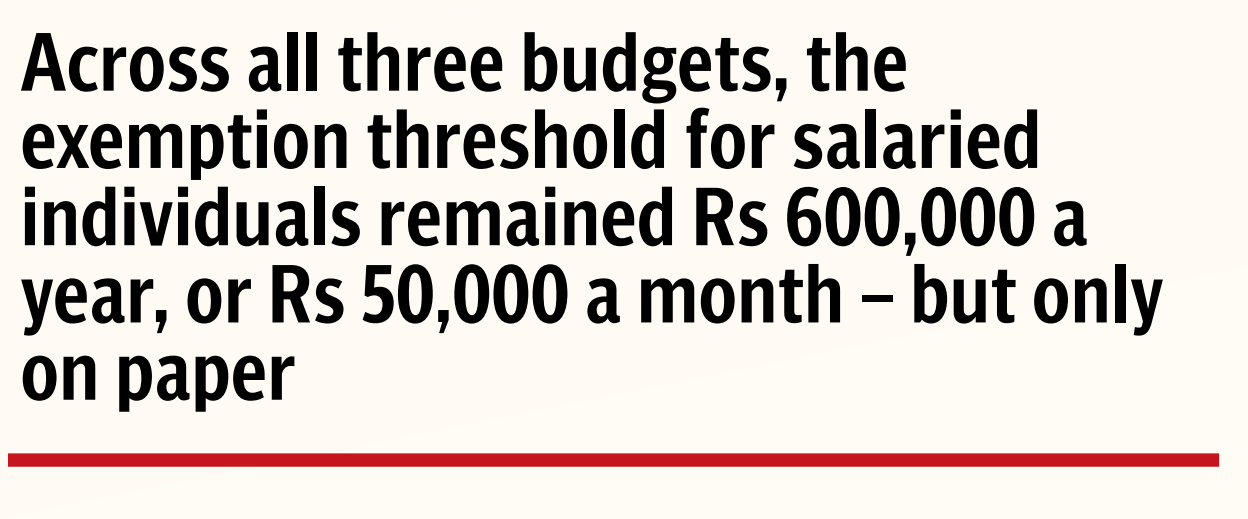
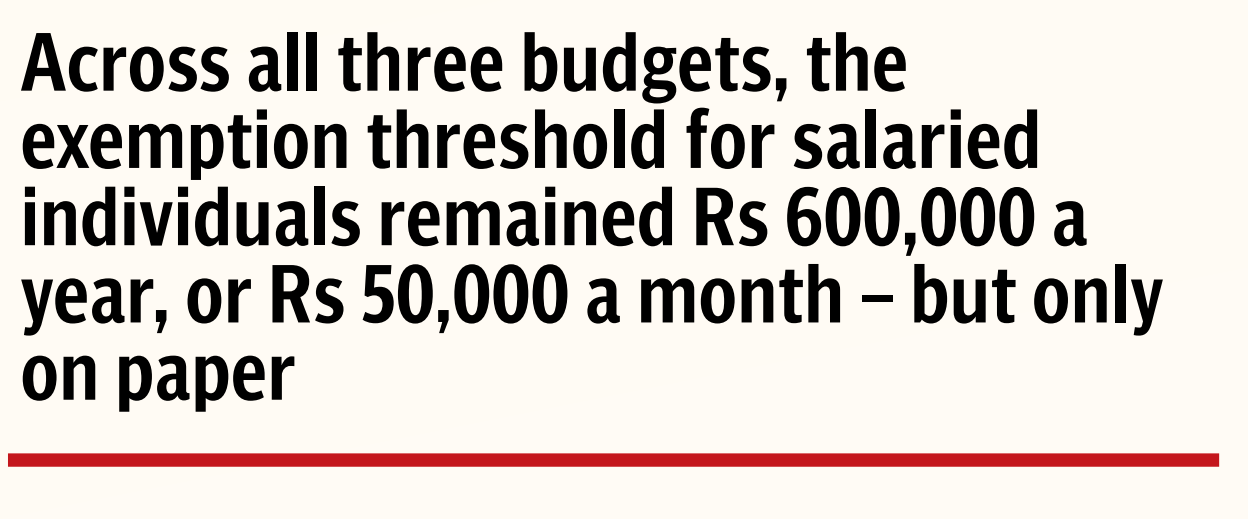
The unchanged exemption threshold matters more than it may first appear. Across all three budgets, the basic exemption level for salaried individuals remained Rs600,000 a year, or Rs50,000 a month. On paper, that looks stable. In real life, inflation changes what that money means. A threshold that stays still while prices move is not neutral. It quietly pulls more pressure into the same income structure.
Dr Ikram argues that the problem is not just the amount of tax, but also how the tax structure works. “The tax that has been increased so much on the salaried person has two disadvantages. One is that the slabs that have been made are not correct. When income moves into the next slab, the tax rate increases sharply. The concept of marginal relief in salary has not been taken care of at all.”
That helps explain why FY2025-26 did not feel like a reset, even though it brought some relief compared to FY2024-25. For that same Rs200,000 monthly salary, annual tax came down to around Rs162,000. But households were not returning to the old position. By then, rent, school fees, electricity, fuel and groceries had already settled at higher levels. Official inflation had fallen sharply from the peak years, but salaried families were still comparing today’s bills with what the same salary could buy three years ago.
As Javed put it, “Even when there is an increment, you cannot really be happy about it because it is already absorbed by rising expenses.” That is what links the last three budgets together. For salaried households, the real question is not only how much tax changed on paper. It is whether the raise, relief or adjustment survives the next electricity bill, school fee voucher and grocery run.
The raise that inflation swallowed
A raise used to suggest movement. It meant a little room, a little relief, perhaps even the feeling that a household was getting somewhere. That meaning has thinned out. For many salaried families now, an increment does not feel like progress. It feels like a delayed response to costs that have already gone up.
Javed says it plainly, “The last increment did not feel like a raise. It felt more like a small adjustment against inflation, and even that was not enough.”
Around that one sentence sits the routine many households know too well. School fees do not wait. Rent does not pause. Utility bills rise whether a company gives an increment or not. Fuel and groceries keep shifting upwards, and transport follows close behind. In that setting, a salary increase does not necessarily improve life. More often, it helps a family hold its place a little longer.
That is also why a bigger number on paper can still leave no visible comfort at home. Gross income may rise, but the household meets that rise with bills that have already moved first. By the time the month settles, the increment has often been quietly absorbed.
The same feeling appears in the public sector. Irfan Sheikh, a federal government employee, describing the pattern with little drama and no exaggeration, said, “It helped only for a short time. Whenever salaries were increased, there was some relief in the beginning, but very quickly it was absorbed by inflation and household expenses. By the time electricity bills, grocery bills, transport costs and children’s education expenses were paid, the increase did not feel like an actual improvement.”
That is what makes inflation so difficult to explain through salary figures alone. Tax appears clearly on a payslip. Inflation does not. It leaves no line, no deduction label, no formal notice. But it reduces income all the same, narrowing what remains after the essentials have been paid for.
Dr Ikram captures that in a line that sounds severe only because it is so recognisable. “Inflation is actually taxation without legislation,” he said.
For salaried households, this is now the shape of a raise. It arrives as hope, appears briefly as relief, and then disappears into electricity bills, school fee vouchers, transport costs and the kitchen budget. Official inflation may have slowed, but families are not measuring life against last month’s statistic. They are measuring it against what the same salary could do a few years ago.
That is why budget-season increases, especially in government service, are no longer read simply as good news. They are weighed against the month’s bills first. In many homes, the question is no longer whether a raise has come, but whether it can survive long enough to feel like one.
Relief or adjustment for government employees
Government employees approach the budget a little differently from private-sector workers. The expectation is more direct. There is usually some hope attached to the speech itself, a salary increase, a revision in allowances, perhaps some pension relief. But that expectation has changed in character. It is no longer tied so much to the idea of getting ahead. More often, it is tied to the hope of not slipping further behind.
Sheikh said, “As a government employee, the first expectation is always that there should be some salary increase, but honestly, now the bigger need is a lower cost of living. If salaries are increased but electricity, fuel, groceries and school fees keep rising, then that increase does not really change anything at home.”
That distinction matters. A budget increase may still arrive as welcome news, but many households now read it against the month’s bills rather than against any larger ambition. The raise is measured less by what it adds and more by what it prevents from collapsing.
There is also the specifically public-sector question of allowances. In government service, the salary structure is not just about the basic pay. House rent, medical and conveyance allowances form part of how employees think about relief. But many of those amounts now seem to belong to an older price world.
As Sheikh says, “Allowance revision would also help because many allowances are not in line with today’s expenses. House rent, medical and conveyance allowances especially feel outdated now. A salary increase gives temporary relief, but if the cost of living is not controlled, the pressure comes back within a few months.”
That sense of erosion appears even more sharply in Hasnain Kazmi’s account. He describes a public sector shaped less by comfort than by restraint. “Working within the public sector, the prevailing atmosphere is one of strict austerity. While a substantial salary increase is desperately needed, the pattern of recent years tempers our expectations. If you calculate our wages against the dollar over the last decade, our real income has severely depreciated-even after accounting for standard promotions and routine government allowances. The buying power for entry-level positions has plummeted.”
The squeeze becomes clearer when he describes his household arithmetic. “The absolute biggest pressure points are electricity bills and early education school fees for my daughters. These two expenses alone consume at least 50% of our monthly salary. Another 30% is strictly allocated to groceries, 10% goes to transportation, and the final 10% barely covers basic house maintenance. There is simply zero room for error.”
That is the point where the difference between public and private employment begins to narrow. One may come with more formal job protection than the other, but the monthly pressures now look increasingly alike. Sheikh says, “Government employees may have more job security compared to private-sector employees, and that is definitely a relief. But when it comes to monthly expenses, the pressure is now very similar for everyone. Groceries, electricity, school fees, rent and fuel do not become cheaper because someone works in the government.”
Kazmi adds another layer to the idea of security itself. “There is a major misconception about public sector security. Many governments professionals-especially those of us managing highly specialized, technical operations-are locked into niche roles that don’t directly translate to the private sector. We cannot simply switch to a corporate competitor for a higher paycheck. The reality is living paycheck to paycheck, forcing us to heavily compromise on simple comforts like running the air conditioner, traveling, or hosting social gatherings.”
So, the budget still matters deeply to government employees. It is watched closely, discussed in offices and carried home in expectation. But the meaning of relief has narrowed. It is no longer judged by the size of the announcement alone. It is judged later, in the same way it is judged in private-sector homes: by whether it survives the next cycle of electricity bills, school fees, groceries, rent and transport.
Tax relief versus actual purchasing power
The first question after any budget is not whether a rate changed on paper. It is whether life feels different after the salary arrives. For salaried households, relief is not read only through a slab table. It is read at the point where rent is due, the electricity bill arrives, school fees are paid, groceries are bought and the fuel tank needs filling again.
Javed puts that standard clearly, saying, “Real relief would mean that a salaried person can pay rent, bills, school fees and groceries without feeling completely finished by the middle of the month.”
That is a useful test because it moves the discussion away from announcement and towards purchasing power. A lower tax deduction would certainly help first. It would mean a little more money reaching the account. But for many households, that is only one part of the pressure. Inflation, utility costs and transport expenses continue working on the same salary even after the tax has been deducted. Electricity bills remain a particular source of stress because they are not only high; they are also difficult to predict, especially when fuel adjustment charges and other additions push the total upwards again.
This is where Dr Ikram’s line becomes less rhetorical and more descriptive. “Inflation is actually taxation without legislation.”
The phrase works because inflation behaves like a deduction without appearing as one. It does not show up on the payslip, yet it cuts into income all the same. A household may receive some salary tax relief in the budget, but if electricity tariffs rise, fuel becomes costlier, or indirect taxes feed into transport and groceries, the gain can disappear before the month is over.
Dr Ikram makes the larger point directly, he says, “Higher withholding taxes, advance tax collection, petroleum levies, customs duties and indirect taxation may improve revenues on paper, but they deepen inequality, suppress demand and increase business costs.”
That takes the issue beyond tax on salaries alone. A salaried person may benefit from a small reduction in direct tax, yet lose that benefit through petroleum levies, customs-related costs passed into prices, and electricity or fuel-linked charges that affect nearly every household expense. Relief in one column can be cancelled out by pressure in another.
Dr Zeelaf frames the same question in practical terms. “Salary tax relief is meaningful only if it improves disposable income in real terms. If relief in one area is offset by higher costs elsewhere, households may not feel the benefit,” she said.
And when households do not feel that benefit, the effects travel outward. “When salaried households have less disposable income, consumption slows, savings are reduced and businesses also feel the impact,” she added.
So this is not only a domestic budgeting problem. It is also a demand problem. When families cut back, they postpone purchases, reduce discretionary spending and enter the next month more cautiously than before. A budget can describe relief in percentages, but the economy feels it through behaviour.
Government employees judge it in much the same way. Sheikh says, “Real budget relief would mean that after paying bills, school fees, groceries and transport, something is still left at the end of the month. It would mean not having to cut one expense to manage another.”
That may be the simplest way to read the budget’s effect on the salaried class. The real measure is not only whether the slab moved, or the deduction fell. It is whether disposable income genuinely improved once bills, levies, inflation and daily costs had all taken their turn. In the end, the budget is judged not by the table it prints, but by whether the salary lasts longer than it did before.
The formal economy’s burden
The squeeze on the salaried class does not stop at the household door. It travels back into the office as well. When take-home pay loses ground, the pressure does not disappear. It reappears in salary discussions, in requests for allowances, in questions about bonuses, and in the quiet drop in morale that comes when formal employment no longer seems to improve life in a meaningful way.
That matters not only to workers, but to employers trying to hold on to skilled people. If a professional salary no longer covers rising living costs with any sense of stability, the problem is no longer just personal budgeting. It becomes a question of whether formal work still feels worth committing to.
Dr Zeelaf puts it directly, saying, “Relief for the salaried class should not be seen only as individual tax relief. It is also talent-retention policy. If skilled professionals feel that formal employment is not improving their quality of life, they either look for informal earning options or look outside Pakistan. That is a loss for businesses and for the economy.”
That is the wider consequence of the squeeze. A business may document salaries, deduct taxes, comply with reporting rules and absorb its own operating pressures, only to find that the people it depends on are still slipping financially. When that happens, employers are pushed to do more through salary adjustments, benefits or retention measures, even as they face high energy costs, taxation and uncertainty of their own.
The effect is not limited to the workplace either. A salaried household with less disposable income buys less, postpones more and saves less often. That weakens demand across the same formal economy that is already carrying a large share of visible compliance. In that sense, the burden on salaried workers and the burden on formal business are connected. Both sit inside the documented part of the economy, where incomes, transactions and obligations are easiest to see and easiest to tax.
Dr Zeelaf argues that the answer is not preferential treatment, but a fairer and more stable system. “A fairer approach would protect compliant taxpayers while bringing undocumented and under-taxed segments into the system. Pakistan cannot keep changing tax policy every year and expect businesses to invest, hire and plan. The private sector does not need special treatment. It needs predictable treatment,” shares Zeelaf.
That word – predictable – matters. Households need it, because monthly life cannot be built on constant adjustment. Businesses need it, because hiring and investment are decisions made over time, not from one budget speech to the next. When the visible economy is asked to absorb repeated pressure while large parts of the wider economy remain lightly taxed or outside the net, the imbalance begins to shape behaviour.
As Dr Zeelaf has said elsewhere in the same conversation, “The documented economy cannot continue carrying the undocumented economy.”
The salaried class has no lobby
Before a budget is announced, many parts of the economy have already had their turn in the room. Traders have associations. Exporters have councils. Builders, retailers and industry groups have chambers, delegations and forums through which they can press for relief, resist new burdens or ask for incentives. Salaried people usually enter the story later. They do not help shape the budget in the same organised way. They mostly experience it after it is announced.
That is part of what makes them easy to tax and hard to hear. Their income is documented, their employer is known, and their tax is deducted at source. They cannot underreport earnings in the same way some informal or cash-based sectors can. They cannot pass on costs to a customer. They cannot negotiate through a chamber or a trade body that speaks in one voice.
As Javed put it, “Salaried people have no such option.”
The result is a class that is individually visible but collectively weak. Large enough to matter in revenue terms, it remains poorly placed when it comes to bargaining power. The issue is not whether salaried people should pay tax. It is whether the same documented base should keep carrying the burden while other parts of the economy remain under-taxed, under-documented or politically harder to confront.
Dr Ikram reads the pattern bluntly. “It shows that the target of our tax policy is poor people, middle-class people or those who have fixed incomes, such as salaried people,” he said.
That is where the difference between reform and repeated extraction becomes important. A budget can use the language of broadening the base, but if collection continues to come mainly from those already in the system, then the structure has not really changed. As Dr Ikram puts it, “What is likely is not reform but coercive collection.”
The fairness question widens quickly beyond salaries. Abid Suleri, Executive Director of the Sustainable Development Policy Institute, says, “Without taxing agriculture, real estate and retail, the fiscal deficit may narrow, but the trust deficit between citizens and the state will widen.”
That idea runs through much of the debate around this budget. “This budget should be judged by one basic test. Does it widen the tax net or does it once again rely on those already paying?” says Dr Zeelaf.
And even that test, she suggests, depends on what happens after the speech. “The real issue is implementation. If the budget only signals reform but collection continues to come from the same documented taxpayers, then the imbalance remains,” she added
For salaried taxpayers, then, the question is no longer only how much they pay. It is whether the state is finally willing to ask the same, with equal seriousness, from those who have long remained outside the net.
What is left by the second week
After the slabs, the speeches, the relief claims and the talk of widening the tax net, the budget returns to a simpler place: the household ledger. That is where its meaning settles. Not in the language of the announcement, but in the order of the month’s payments and in the question that follows them – what is left?
As Sheikh had said it earlier, “Groceries, electricity, school fees, rent and fuel do not become cheaper because someone works in the government.”
For Javed, in his home, the salary does not disappear all at once. It goes in a familiar order. Rent comes first, because it has to. Then the electricity bill. Then the credit card payment, often covering groceries already bought. School fees wait in their turn. Fuel has to be managed too. By the time these are dealt with, the month’s income has already been reduced to calculation.
“Saving has been out of my dictionary for the last three years. Every month is just about survival,” says Javed. There is no drama in the way he says it, which is perhaps why it stays with you. He earns enough to know what a decent salary once meant, and now finds himself wondering how households earning Rs60,000 or Rs100,000 are managing at all. That thought sits behind his own monthly routine. If this is what the squeeze feels like in one salaried home, what does it look like further down the ladder?
“Sometimes the salary is finished before the month properly begins,” shares Javed. That, in the end, is the measure that matters more than any single budget line. For the salaried class, the federal budget is not judged only by speeches in parliament, revised slabs or the promise of relief. It is judged later, more quietly, by whether the salary lasts longer than it did before, and whether something remains in the account after the bills have taken their turn.
“Right now, the budget feels less like planning for the future and more like figuring out how to survive the next 30 days,” said Javed.