Says Pakistan will have to make sufficient progress on human rights and governance reforms
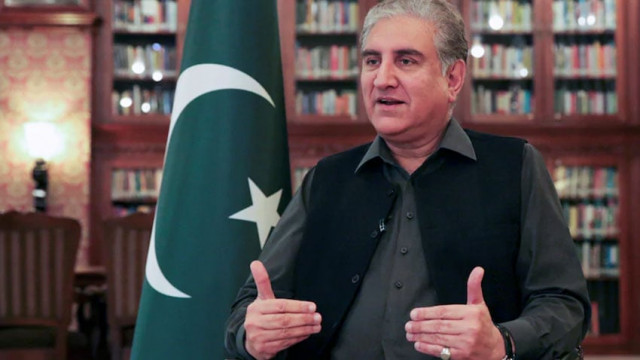
Foreign Minister Shah Mehmood Qureshi thanked China for its role in helping Pakistan combat Covid-19. PHOTO: RADIO PAKISTAN
LAHORE:
Pakistan Tehreek-e-Insaf leader Shah Mahmood Qureshi warned that Pakistan could risk losing the European Union’s (EU) GSP+ trade status if sufficient progress was not made on human rights, labour rights and governance reforms.
The EU’s GSP+ offers developing countries preferential access to European markets in return for commitments on sustainable development and good governance. Under the scheme, eligible countries are required to implement 27 international conventions covering human rights, labour rights, environmental protection, and good governance. In exchange, the EU reduces import duties to zero on more than two-thirds of the tariff lines applied to its exports. Pakistan is currently one of eight countries that benefit from this scheme.
In a statement issued from Kot Lakhpat Jail through his counsel, Rana Mudassar Umar, on Sunday, Qureshi said the EU continued to closely monitor Pakistan’s compliance with commitments relating to human rights, workers’ rights, freedom of expression and democratic governance.
He noted that Pakistan exported goods worth €8.7 billion to the EU in 2025, of which approximately €7 billion were exported under the GSP plus scheme, highlighting the facility’s critical importance for the country’s economy and export sector.
Qureshi said the current GSP+ arrangement would expire in 2027, and Pakistan would have to meet stricter conditions to qualify for the next phase of the preferential trade scheme. He stressed that securing GSP+ status was not an easy task and required extensive diplomatic efforts at the international level.
Read: PTI alleges electoral rigging in G-B polls
He recalled that lobbying was undertaken in European capitals to build support for Pakistan’s inclusion in the scheme, adding that former US Secretary of State Hillary Clinton was also approached to advocate Pakistan’s case with European countries.
The former foreign minister credited former Punjab governor Chaudhry Sarwar and Pakistani textile exporters for playing an important role in helping Pakistan obtain GSP+ status.
Qureshi said concerns expressed by the European Union regarding freedom of expression should be taken seriously. He noted that European circles remain concerned over journalists’ organisations describing the PECA law as a “black law.”
He further said that petitions relating to judicial independence pending before the constitutional court had also attracted the attention of the EU.
According to Qureshi, issues including enforced disappearances and weak governance remain under scrutiny by European institutions and could influence future assessments of Pakistan’s eligibility for continued GSP+ benefits.
In March, Kasim Khan, son of Imran Khan, addressed the UN Human Rights Council and referred to Pakistan’s obligations under the EU’s GSP+ framework on human rights. He alleged violations, including his father’s detention, solitary confinement, lack of medical care, restricted family access, and trials of civilians in military courts, saying these breach international commitments.
The Federation of Pakistan Chambers of Commerce and Industry (FPCCI) and Information Minister Attaullah Tarar strongly criticised the remarks, saying no one would be allowed to “conspire” on such a sensitive issue. Tarar had accused PTI and Imran’s sons of acting against Pakistan’s national and economic interests.
EU High Representative for Foreign Affairs and Security Policy Kalla Kajas, during her recent visit to Pakistan, highlighted that the EU and Pakistan had seen “strong momentum” in trade relations, stressing that the EU remained Pakistan’s largest export destination, “larger than China and the US combined.”
However, Kaja noted that Pakistan’s position as the world’s leading beneficiary of the EU’s GSP+ scheme depends on progress in implementing international conventions, including governance standards, environmental protection, and labour and human rights commitments.
Source link