




LAHORE:
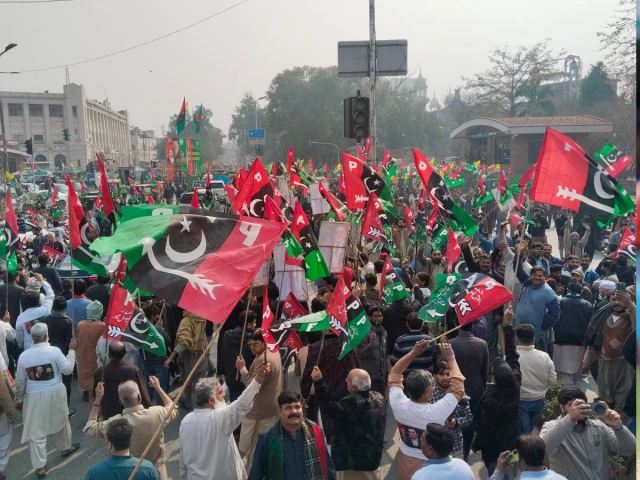
As hopes of forming the next government in Islamabad fade, the PPP continues its policy of fence-sitting, according to party leaders, who fear that the party’s inability to take necessary policy decisions could further alienate potential voters who would like to see it fill the political vacuum left by the embattled PTI.
Party leaders in Punjab said the lack of a clear political direction is making it difficult for them to pave the way for a comeback in the province, two office-bearers told The Express Tribune.
One leader, speaking on condition of anonymity, said sarcastically that the party appears to be banking on the establishment to secure its position in the next general elections, depending on whatever understanding is eventually reached over seats and power sharing. “Our hands are tied and our lips are sealed; we cannot say anything against the PML-N’s dominance in Punjab,” he remarked.
He added that those who even consider taking a strong stance against government decisions are discouraged from doing so within the party.
Another leader said there was a growing sense of demoralisation within the party after being largely excluded from key political and mediation-related meetings in Islamabad.
He said any advantage the party might have gained from Chairman Bilawal Bhutto Zardari’s tenure as foreign minister was no longer relevant, adding that Foreign Minister Ishaq Dar had “outperformed all his predecessors in every way”.
He lamented that the party was not formally consulted in the process. “Despite holding important offices, including the presidency, PPP only had front-row seats in the stands; we were never invited into the arena,” he said, adding, “We should have taken the foreign ministry when we had the chance, instead of asking for the moon”.
The leaders said that even now, when it is increasingly evident that PPP’s cautious approach towards the establishment may not yield electoral gains, the party is not recalibrating its political narrative.
“Our aversion to risk will prove costly,” one leader warned, adding that the current policy is essentially aimed at appeasing powerful stakeholders. “People expect us to hold up a mirror to the government inside and outside parliament, but we only fire broadsides when the central leadership wants to build pressure as a bargaining chip.”
They added that PPP would struggle to strengthen its position in Punjab despite the perceived political vacuum. While the party may bring in a few electables and notables, they said, it would still be unable to challenge the PML-N’s dominance without building its own vote bank.
Several PPP leaders were approached for on-the-record comments but declined. Party spokesperson Nadeem Afzal Chan was also contacted multiple times but was not available for comment.