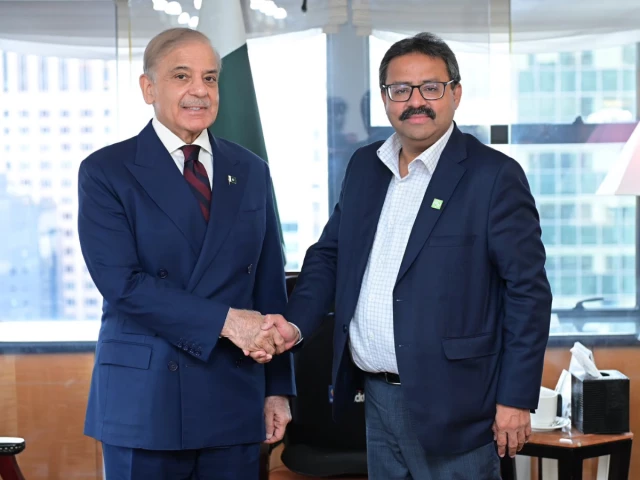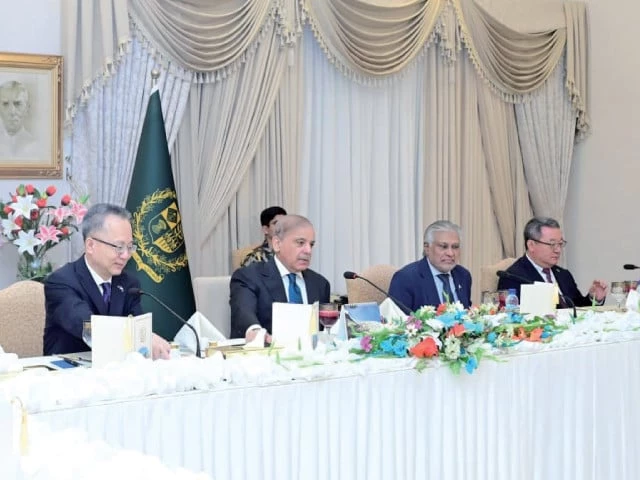
Prime Minister Shehbaz Sharif speaks during a meeting with ADB Vice President Yinming Yang. Photo: APP
ISLAMABAD:
Prime Minister Shehbaz Sharif on Friday stressed the need for the early groundbreaking of the Main Line-1 (ML-1) railway project, saying the Karachi-Peshawar corridor was vital to modernising freight transport and strengthening regional trade connectivity, the Prime Minister’s Office (PMO) said.
According to the PMO, the matter was discussed during a breakfast meeting between the prime minister and Asian Development Bank (ADB) Vice President for South, Central and West Asia Yingming Yang in Islamabad on Friday.
Prime Minister Shehbaz said upgrading ML-1 was “essential for modernising freight logistics, strengthening regional trade connectivity and supporting major industrial initiatives”.
The meeting also discussed the need for the “early groundbreaking of ML-1”, which the PMO described as vital to infrastructure development and modernising connectivity.
The two sides reviewed the multi-decade development partnership and charted priority interventions under the new Country Partnership Strategy (CPS) 20262030, the PMO said.
Welcoming Yang on his first official visit to Pakistan as ADB vice president, PM Shehbaz praised the bank’s “consistent professionalism and responsiveness” in delivering transformative urban infrastructure, transport, and public service projects in the country.
The prime minister also said Pakistan had successfully navigated a difficult economic recovery through “rigorous fiscal, structural, and governance reforms”.
“These corrective actions have restored macroeconomic stability, reinforced investor confidence, and earned stable outlook upgrades from major international credit rating agencies including Fitch, Moody’s, and S&P,” he said.
PM Shehbaz reaffirmed the government’s commitment to long-term economic transformation and “stressed that the administrative bottlenecks are being actively dismantled through dedicated execution task forces.”
The meeting also explored ways to expand cooperation in several sectors, including support for the private sector, energy security and food security.
“Expanding cooperation in various sectors, the meeting explored collaborative avenues in support for private sector, energy security, food security, enhancing support in export competitiveness, Artificial Intelligence and Information Technology,” the PMO said.
The meeting concluded with a “mutual pledge to translate the strategic priorities of the CPS 20262030 into concrete, high-impact results”. The PMO said the partnership was aimed at driving sustainable growth and “visibly enhance the standard of living for the people of Pakistan”.
In a meeting with ADB on Thursday, Minister for Economic Affairs Ahad Cheema called ML-1 a “flagship project of national significance and a key priority for Pakistan”, as the government pushed to accelerate work on the long-delayed railway corridor. The ADB welcomed progress on the project and agreed to help establish a joint working group on reforms in Pakistan Railways.
The Main Line-1 (ML-1) is a planned 1,733-kilometre upgrade of Pakistan’s main railway corridor, linking Karachi with Peshawar through major cities including Lahore and Rawalpindi. The project also covers the Taxila-Havelian section. Much of the existing railway track dated back to the British era and had deteriorated over decades, making major rehabilitation and expansion necessary.
The project was designed to upgrade and double-track the railway corridor, with trains expected to eventually travel at speeds of up to 160km/h, compared with around 80km/h at the time. It was also aimed at improving passenger and freight services, reducing transport costs and strengthening Pakistan’s trade and logistics network.
ML-1 was a major component of the China-Pakistan Economic Corridor (CPEC), but its implementation had faced repeated delays. The roughly $2.5 billion project had remained stalled for years because of funding constraints, bureaucratic delays and an unfavourable economic and international financing environment.
The government had sought to revive the project by starting procedural work on an elevated 480km section between Karachi and Rohri. The first phase is estimated to cost around Rs450 billion and is expected to be financed by Chinese banks alongside other international lenders.
Despite the renewed momentum, securing financing and bringing in the required engineering expertise remained major challenges. The government had also faced pressure to ensure that ML-1 did not become another long-delayed infrastructure project, with physical work targeted to resume from the beginning of 2027.
The scale of the project meant its impact would extend beyond Pakistan Railways. A modern railway network was expected to improve the movement of goods and passengers across the country, strengthen regional trade links, and connect Pakistan more effectively with wider rail and economic connectivity projects.
Source link