
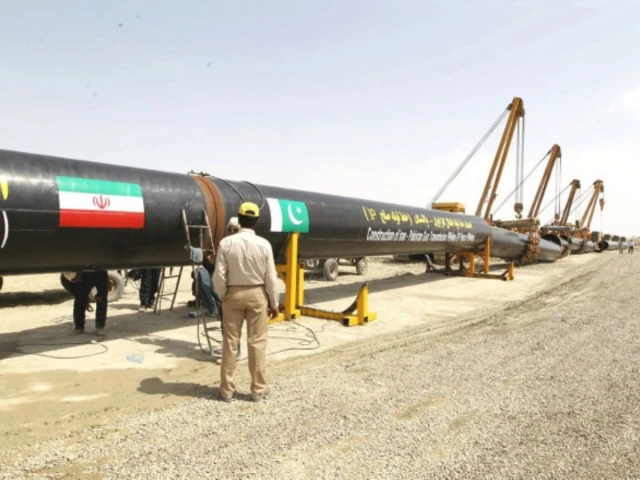
The leadership of both countries engaging in efforts to resolve dispute amicably, petroleum minister tells Senate
Petroleum Minister Ali Pervaiz Malik told the Senate on Tuesday that Prime Minister Shehbaz Sharif had constituted a high-level committee to work out a mutually acceptable solution to the long-stalled Pak-Iran gas pipeline project, balancing Pakistan’s potential financial liability arising from arbitration with its future energy requirements,
Responding to a calling attention notice moved by Senator Talha Mahmood, the minister said the committee was examining the legal, financial and energy dimensions of the project to determine a way forward in Pakistan’s national interest.
He said Iran was a “brotherly country” and the leadership of the two countries remained engaged in efforts to reach an amicable settlement acceptable to both sides.
Malik said Iran had already made substantial physical progress on its side of the project, bringing gas from the South Pars field to a major Iranian city near the Pakistani border.
Read: Pakistan seeks 50% price cut for Iran gas
The minister said the matter had gone into arbitration in Paris, making it necessary for Pakistan to assess the potential financial liability associated with the project carefully.
He said the government wanted to avoid further complications arising from litigation and was therefore pursuing a negotiated settlement with Iran.
“The committee is looking at the potential liability facing Pakistan, the implications of litigation and the country’s future energy requirements,” Malik said, adding that these factors would help determine the way forward on the project.
Responding to concerns over gas-related issues in Balochistan, the petroleum minister said the premier had directed him to engage with provincial stakeholders.
He said another high-level committee, headed by Deputy Prime Minister and Foreign Minister Ishaq Dar, was examining Balochistan’s gas-related problems, including technical and payment issues.
On August 14, Pakistan called on Iran to slash the price of gas by half for it to be supplied through the Iran-Pakistan (IP) pipeline project. It also asked it to lower the gas volume after different sectors in the country showed lack of interest in buying energy supplies at higher prices.
At present, the local distribution companies are providing gas to fertiliser plants and domestic consumers at Rs1,500, or $5.7, per million British thermal units (mmBtu) and Rs1,000, or $3.57, per mmBtu, respectively.
Power producers have expressed their inability to buy imported gas at a price of over Rs2,000/mmBtu, which in dollar terms stands at $7.14. The government has established it as a commercially sustainable market benchmark for the IP gas pipeline.
Moreover, authorities said they would push ahead with the project if US President Donald Trump gives a waiver to Iran.
The Iran-Pakistan gas pipeline, also known as the Peace Pipeline, was conceived to bring Iranian natural gas to Pakistan to help meet the country’s growing energy needs. Iran has already built part of the pipeline inside its territory, while Pakistan failed to complete the project by December 2014. The project has remained stalled for more than a decade, with Pakistan unable to complete its portion of the pipeline. US sanctions on Iran, financing difficulties and broader geopolitical concerns have also been major obstacles.
In 2024, Iran had filed an international arbitration case in Paris over project delays.

