





Brent crude drops $1.78 to $102.09 a barrel; WTI fell $1.97 to $98.33 a barrel by 11:55am PKT
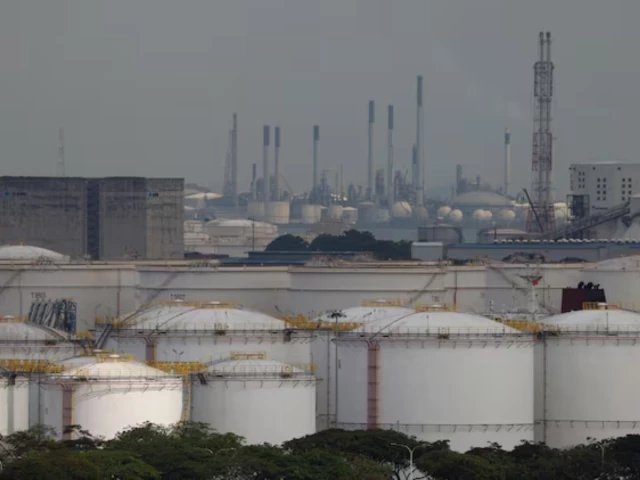
Storage tanks and oil refineries in Jurong Island, Singapore, March 24, 2026. PHOTO: REUTERS
Oil prices slid to their lowest in more than a week on Monday as investors hoped for diplomatic progress on the Iran war due to this week’s UN meeting and eyed a partial recovery in shipments from Saudi Arabia despite ongoing attacks by Yemen’s Houthis.
Brent crude futures and US West Texas Intermediate crude touched their lowest since September 10 earlier on Monday. The Brent contract for November was at $102.09 a barrel at 0655 GMT, down $1.78, or 1.71%, after settling 0.91% lower on Friday.
The WTI October contract that is expiring on Tuesday fell $1.97, or 1.96%, to $98.33 a barrel following a 1.58% drop in the previous session.
“It seems that a degree of risk premium is being removed from oil prices on hopes that a diplomatic path to de-escalate the US-Iran war may arrive this week,” said Tim Waterer, chief market analyst at KCM Trade.
“Whether that hope proves to be warranted or not is another question. Time will tell.”
Read: Stocks gain over 218 points as oil prices ease
WTI broke a key psychological support at $100 a barrel while some investors may have rolled over their positions in the October contract a day ahead of expiry to November, a Singapore-based broker said.
Iran and the US exchanged new threats on Sunday, although US President Donald Trump said he would be open to meeting Iranian President Masoud Pezeshkian, who is expected to be in New York this week for the United Nations General Assembly.
Iran has conveyed its conditions to mediators for re-engaging in negotiations aimed at ending the war with the US, Al Jazeera cited Iran’s security chief, Mohsen Rezaei, as saying in an interview on Saturday.
However, tensions in the Middle East remained elevated as Yemen’s Houthis said they attacked “sensitive” sites in the Saudi capital of Riyadh on Saturday with missiles and drones, as well as an Aramco facility in the Red Sea city of Yanbu, a key oil export hub.
On Monday, a spokesman for the Revolutionary Guards, Hossein Mohebbi, said Iran would use new weapons and target locations not previously attacked if the US launched a new offensive against it, according to the Fars news agency.
China has asked Iran to help rein in the Houthis after an appeal to Beijing by Saudi Arabia following the attacks, according to three Iranian sources familiar with the matter.
The attacks by the Houthis on Saudi Aramco’s East-West pipeline have prompted the state energy firm to increase exports through the Strait of Hormuz this month and next after halting some shipments via Yanbu.
“Middle East oil flows remain surprisingly strong despite the disruption to Saudi Arabia’s East-West pipeline,” JPMorgan analysts said in a September 18 note, adding that the total oil flows averaged 17.1 million bpd in the past 10 days, just 6.1 million bpd below the 2025 average.
“The most notable pivot has come from Saudi Arabia,” the analysts said, as satellite data indicated Saudi oil moving through the Strait of Hormuz averaged 2.9 million bpd over the past six days, up from just 700,000 bpd in August.