


.
LONDON:
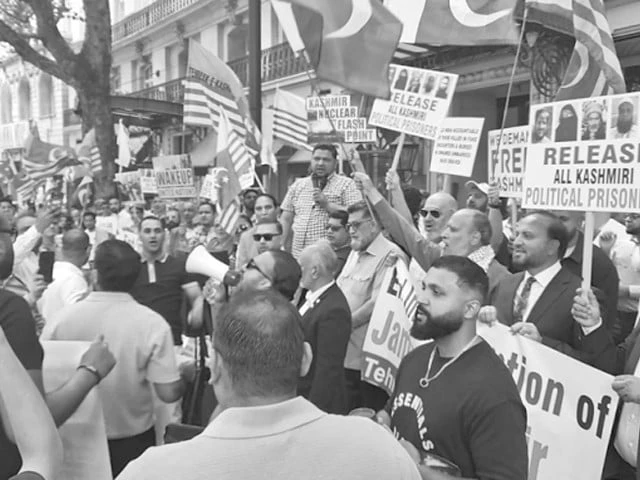
Hundreds of members of the British Kashmiri diaspora and political activists gathered outside the Indian High Commission to mark the seventh anniversary of India’s decision to revoke the special constitutional status of Indian Illegally Occupied Jammu and Kashmir (IIOJK), with speakers describing the move as a violation of the Kashmiri people’s right to self-determination and urging the international community to press for a peaceful resolution of the decades-old dispute.
The demonstration, organised by Tehreek-e-Kashmir (TeK UK) was held to commemorate August 5, 2019 when the Indian government revoked Articles 370 and 35A of its Constitution ended the region’s semi-autonomous status and reorganised the former state into two federally administered Union Territories.
Carrying banners and placards, protesters raised slogans in support of the Kashmiri cause and called for the implementation of United Nations resolutions on the disputed territory. Organisers said the protest was intended to remind the international community that, despite constitutional changes introduced by New Delhi, the political status of Jammu and Kashmir remains disputed.
Addressing the gathering TeK UK President Fahim Kayani said the constitutional changes made by India could not replace what he described as the internationally recognised right of the Kashmiri people to determine their political future.
“The only inherent right Kashmiris are fighting for is the right to determine their own future through a free and fair vote, free from Indian rule in occupied Jammu and Kashmir,” Kayani said.
He argued that Kashmiris did not accept the constitutional changes introduced by India and maintained that the dispute should be resolved in accordance with the wishes of the people through a UN-backed process.
Referring to India’s decision in August 2019 Kayani said New Delhi had revoked constitutional provisions that granted special status to Jammu and Kashmir, removed safeguards relating to land ownership and permanent residency, and placed the territory under direct federal administration.
He further alleged that the move disregarded India’s international obligations and bilateral commitments, saying that the constitutional changes could not alter the internationally disputed nature of the territory.
“The unresolved status of Jammu and Kashmir requires a peaceful settlement in accordance with the relevant United Nations resolutions,” he said.
Kayani also outlined what he described as the objectives of the Kashmiri movement, stating that it sought the complete withdrawal of Indian forces and administration from the territory.
“Our goal is the complete and unconditional withdrawal of Indian forces and assets from Jammu and Kashmir,” he said.
Expressing concern over demographic changes in the region, Kayani alleged that policies introduced after the revocation of the special status were aimed at permanently altering the demographic composition of the territory. He described the changes as a form of settler colonialism and warned that they could have lasting consequences for future generations.
He also called on world powers and international human rights organisations to play a more active role in addressing the Kashmir dispute, saying that prolonged inaction risked increasing tensions between Pakistan and India, both nuclear-armed neighbours.
“We have repeatedly called for the implementation of the UN mandate to allow the people of Jammu and Kashmir to exercise their right to a free and fair plebiscite,” he said.
Among those who addressed the gathering were Tehreek-e-Kashmir Europe President Muhammad Ghalib, GPKSC Chairman Raja Sikandar Khan, senior Hurriyat Conference leader Professor Shahid Iqbal youth representatives Shaista Safi, Zafar Qureshi and Muzzamil Ayub Thakur, Councillor Sheryar Kayani, and community leaders Mohsin Bari, Abdul Hameed, Chaudhry Sharif and Chaudhry Ikram-ul-Haq.
The protest formed part of events organised by Kashmiri diaspora groups in several countries to mark the anniversary of India’s constitutional changes of August 5, 2019. Pakistan continues to reject those measures, maintaining that Jammu and Kashmir is an internationally recognised disputed territory whose final status should be determined in accordance with relevant United Nations Security Council resolutions and the aspirations of its people. India, however, maintains that Jammu and Kashmir is an integral part of the country and has defended the constitutional changes as an internal matter aimed at improving governance and promoting development in the region.
The status of IIoJK remains one of the principal issues between Pakistan and India, with both countries continuing to hold sharply differing positions on the dispute.