JI says hundreds of Karachi markets and petrol pumps shut as traders, lawyers back strike
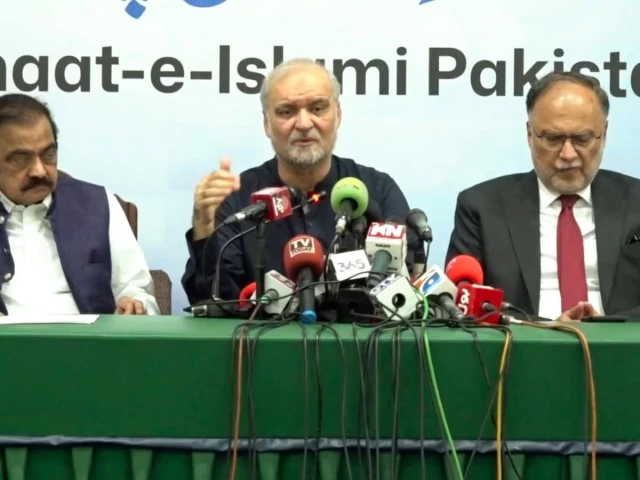
Adviser to the Prime Minister Rana Sanaullah, JI chief Hafiz Naeemur Rehman and Planning Minister Ahsan Iqbal during a press conference in Lahore on September 3, 2026. PHOTO: EXPRESS
RAWALPINDI/
PESHAWAR/
LAHORE/
KARACHI:
The government and Jamaat-e-Islami (JI) on Thursday agreed to hold technical-level talks to explore ways to provide relief to consumers by reducing petroleum prices and the petroleum levy, while the party made it clear that its ongoing sit-ins would continue during the negotiations.
The government invited the JI to nominate experts to work with its technical team and identify a feasible mechanism for reducing the levy. Formal discussions between the two sides are expected to begin on Monday, with the government hoping that a workable solution can be developed within two weeks.
The development came after a meeting between JI leaders and a government delegation at Mansoorah in Lahore. The government team comprised Federal Minister for Planning Ahsan Iqbal, Prime Minister’s Adviser on Political Affairs Rana Sanaullah and Punjab Minister Khawaja Salman Rafiq. JI chief Hafiz Naeemur Rehman led his party’s delegation.
Ahsan Iqbal said the government delegation had visited Mansoorah on the instructions of Prime Minister Shehbaz Sharif and that the government also wanted petroleum prices to be reduced and relief provided to the public.
He said the government had proposed forming a committee to identify a practical mechanism for providing relief through the petroleum levy. He invited the JI to nominate experts so that both sides could work out a viable solution, adding that the government would consider implementing any feasible proposal.
Ahsan stressed that the national interest was paramount and said the government did not want unrest in the country. He noted that Pakistan was also fighting terrorism and warned that hostile elements could exploit instability.
He said political and economic stability was essential for attracting investment and that Prime Minister Shehbaz was making efforts to provide maximum relief to the public.
The federal minister said Pakistan had been moving towards economic recovery after 2016 but the impact of the previous four years had not been fully overcome, leaving the country dependent on International Monetary Fund (IMF) programmes.
He said abandoning the IMF programme also carried a cost, adding that Pakistan’s consumption exceeded its income and forced it to seek assistance from the IMF and friendly countries. He stressed the need to reduce imports and increase exports, saying political and economic stability would help boost exports.
Ahsan warned that unnecessary protests and disorder could discourage investors from investing in Pakistan. He said technical-level discussions with the JI would begin on Monday and expressed hope that the experts would develop a workable solution within two weeks.
Rana Sanaullah thanked the JI leadership for the talks, describing the discussion as positive. He said both sides wanted to provide relief to the public.
He attributed some of the current economic difficulties to the US-Iran war and said the JI had presented proposals that could provide relief to consumers. He added that relief measures in the power sector had also been worked out following consultations with the JI.
Sanaullah said technical teams from both sides could jointly develop a better solution, adding that the essence of democracy was dialogue despite political differences.
He said officials from the Ministry of Finance, Petroleum Ministry and other relevant departments should sit with the JI team to examine the proposals.
JI to continue sit-ins
Hafiz Naeemur Rehman said the meeting with the government delegation was held in a positive atmosphere but made it clear that the JI’s sit-ins would continue alongside the negotiations. “Today is the 19th day of our protests,” he said, adding that demonstrations that had initially started at three locations had now expanded to 15-20 locations, with participation increasing.
He said the protests were not being held for political or personal interests but over issues affecting the public, particularly rising inflation. “This is our agenda. Along with the big issues, there are also the everyday issues, such as inflation. Every man, woman and child is suffering from it,” he said.
Hafiz Naeem said the JI had already constituted its technical team and was ready to begin talks with the government. The team is led by Liaquat Baloch and includes Naveed Ali Baig, Ziauddin Ansari, Nasrullah Randhawa and Faisal Shah.
According to Hafiz Naeem, around Rs131 per litre of the current petrol price comprises various taxes and the government could substantially reduce the burden on consumers by cutting them.
He said the JI’s demand to bring the petrol price down to Rs225 per litre was justified. According to him, the petroleum levy was originally introduced to improve refinery and storage capacity and reduce the country’s import bill, while more than Rs8 trillion had been collected through it since its introduction.
Hafiz Naeem also criticised the continued collection of the petroleum levy from consumers during wartime conditions.
He raised concerns over capacity payments to independent power producers, saying consumers were being charged even when some plants were not generating electricity. He also questioned payments linked to regasification plants when gas was not being received.
The JI chief said the party wanted the government to reduce the petroleum levy and fuel prices, resume negotiations with more IPPs and make roti available to poorer people at Rs10. “These are our serious demands. But primarily, we think that levy for petroleum should also be stopped. And the price should also be reduced,” he said.
Hafiz Naeem also referred to the government’s decision to reduce the price of diesel by Rs30 following discussions in Karachi, saying the JI would present its findings on petroleum pricing.
He said the party wanted the government to restart negotiations with more IPPs, arguing that earlier agreements had been renegotiated and had helped reduce electricity prices.
The JI chief maintained that the party understood the country’s economic, law and order and international situation but insisted that its demands were aimed at providing relief to the public rather than securing electoral or political gains.
Citing a government report, he said more than 40% of the population was living below the poverty line and stressed that providing relief to the people was therefore essential.
Hafiz Naeem said the protests and strikes were continuing in several cities and thanked citizens and traders for supporting the JI’s call. “In many cities, Alhamdulillah, there was a complete strike. I thank the Pakistani citizens and merchants for this,” he said.
Strike shuts hundreds of markets in Karachi
A strike called by JI against the petroleum levy shut hundreds of markets and petrol pumps across Karachi on Thursday, while private schools and lawyers also supported the shutdown, JI Karachi Amir Monem Zafar Khan said.
Speaking at Regal Chowk in Saddar, Zafar said the traders’ strike in Karachi and across Pakistan had been “very successful”.
“Today, hundreds of markets and bazaars across Karachi are closed,” he said, adding that more than 300 small and large markets and petrol pumps had shut in response to the strike. He said the lawyers’ community had also supported the strike and private schools were closed.
Criticising the petroleum levy, Zafar said, “Rs130 per litre as a levy tax is oppression. The levy in the name of tax is not acceptable.”
He said inflation was rising while business centres were facing 12 to 18 hours of power outages.
“Unjust load-shedding should end,” Zafar said, adding that rulers were provided free electricity, gas and petrol while levies were being imposed on the public.
He also called on the police and administration to stop what he described as improper actions and demanded the release of JI workers arrested in Lyari and Korangi.
Zafar said some disruptive elements had set tyres on fire but maintained that the strike across Pakistan remained peaceful. He said the sit-in was continuing and described the strike as “very successful”.
He added that the option of a long march towards Rawalpindi and Islamabad remained open, while the JI emir would announce the party’s future course of action.
Markets remain closed
In Karachi, most major markets and commercial centres observed a shutter-down strike.
Jodia Bazar observed a partial strike, while all mobile phone markets and electronics shops in Saddar were closed. Markets along MA Jinnah Road, Light House and Bolton Market were also shut.
Chemical Market, Timber Market and Steel Market remained closed, while partial strikes were reported in Orangi Town, Liaquatabad, Federal B Area, Nazimabad and Gulshan-e-Iqbal.
Gulbahar Sanitary Market was completely closed, while markets in Pak Colony and Qayyumabad, as well as marble and furniture markets, were also shut.
A partial strike was observed in Bohri Bazaar, Saddar and around Empress Market, while markets on Zaibunnisa Street and in Zainab Market were closed.
Around 10 to 15 per cent of petrol pumps in the city that had closed in the morning later reopened. Private and commercial traffic remained lower than normal.
In Islamabad, the capital’s business and commercial centres were partially closed following an appeal by the JI chief. Most shops in Super Market, Aabpara, G-8 and G-9, among other areas, remained closed as traders supported JI’s campaign against the petroleum levy.
In Rawalpindi, commercial activity continued in the city and cantonment areas, although some shops were reported closed in certain areas. The All Pakistan Traders Association had also announced its support for the strike.
In Lahore, business centres including Queens Road, Abid Market, Hall Road, Mall Road, Nisbat Road Market, Ferozepur Road and Brandreth Road were closed following the strike call.
JI also held a motorcycle rally from its sit-in site at Charing Cross. The rally passed through Railway Station, Brandreth Road, McLeod Road and Hall Road before returning to Charing Cross.
In Khyber-Pakhtunkhwa (K-P), a strike against the petroleum levy, inflation, unemployment and unrest was also underway.
JI staged a protest on Ashraf Road in Peshawar against increases in petroleum product prices, with local traders also taking part. Protesters chanted slogans against the government and rejected the levy on petrol and diesel.
However, implementation of the strike in Peshawar was partial, with shops open in most markets, including Qissa Khwani Bazaar, Saddar and University Road.
Lawyers across K-P also boycotted courts following a call by the provincial bar council. Lawyers did not appear before courts, including the Peshawar High Court, saying food and petroleum product prices were continuously increasing.
Source link