








Europe, the fastest-warming continent, faces record heat and wildfires, with France and Spain worst hit
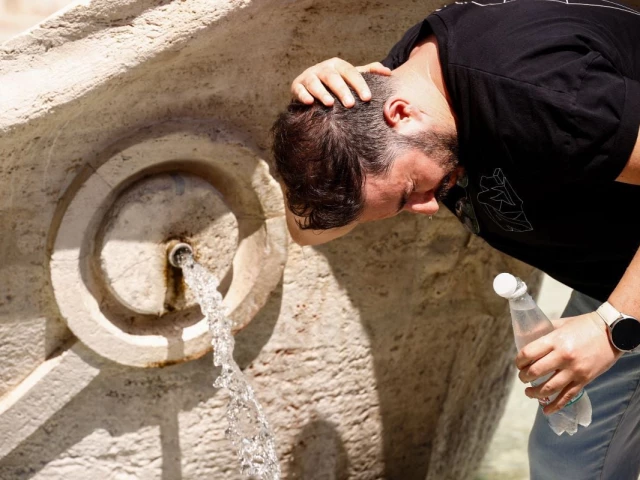
A man cools himself with water from the Fontana della Barcaccia during a heatwave in Rome, Italy, August 6, 2026. REUTERS/Claudia Chieppa
Italy placed all major cities under the highest heat alert on Thursday as a severe heatwave gripped large parts of Europe, while Hungary switched off lighting at state institutions to save energy.
Europe, the world’s fastest-warming continent, has faced record-breaking temperatures and destructive wildfires this summer, with France and Spain among the worst affected in recent weeks.
The European Union will push member states to increase spending on measures to reduce wildfire risks, the bloc’s environment commissioner told Reuters, as experts estimated the economic cost of this summer’s fires had already exceeded 15 billion euros ($17.3 billion).
Bulgaria became the latest EU country hit by wildfires. The main Trakia highway was closed in both directions on Thursday after strong winds carried flames from a major fire about 70 km (45 miles) southeast of Sofia, the NOVA news portal reported.
Italy issues nationwide heat alert
Italy, accustomed to hot summers, issued its highest-level red alert from Palermo in Sicily to Bolzano in the mountainous north.
The Health Ministry warned that prolonged high temperatures posed a serious health risk to the entire population.
Pilgrims attending an event in the hilltop town of Assisi were sprayed with water to cool down as Pope Leo visited to mark the 800th anniversary of the death of St Francis.
Tourists in Rome used umbrellas to shield themselves from the sun and cooled off by dipping their hands in city fountains.
Temperatures exceeded 40 degrees Celsius (104°F) in several parts of northern Emilia-Romagna, reaching 42.8°C (109°F) in Bagnacavallo near Ravenna.
Low water levels hit energy supplies
Hungary switched off decorative and non-essential lighting at state institutions, including its parliament, Buda Castle and Chain Bridge, during the night to save energy.
Read More: Heat without protection
Record-low water levels on the Danube forced Hungary to largely shut down its only nuclear power plant, which relies on the river for cooling, putting pressure on electricity supplies.
Romania prepared to sink four rock-filled barges into the Danube to divert water towards its only operating reactor and extend its operation.
Authorities in Bucharest reduced street lighting intensity by one-third and switched off night lighting at landmark buildings and museums.
Low water levels also disrupted shipping on Germany’s Rhine River, where vessels can operate only with partial loads, increasing freight costs for commodities including grains, minerals, coal and oil products.
Tourists escape heat in cool cave
In Bosnia and Herzegovina, tourists sought relief from 40°C temperatures inside the UNESCO-listed Vjetrenica cave, where temperatures remain around 11°C (51.8°F) year-round.
Located in the country’s south, about 25 km north of the Adriatic town of Dubrovnik, the cave has become a refuge for both biodiversity and visitors seeking protection from extreme heat.