








Israeli Premier Netanyahu had led Israel into ‘serious political defeat,’ says political analyst Ben Caspit
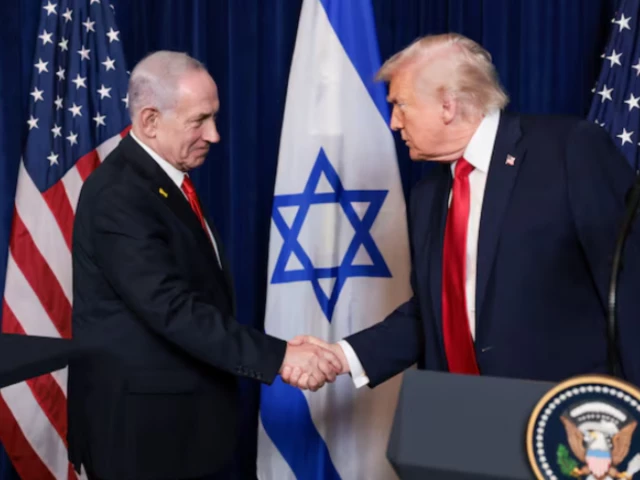
US President Donald Trump and Israeli Prime Minister Benjamin Netanyahu hold a press conference after meeting at Trump’s Mar-a-Lago club in Palm Beach, Florida, US, December 29, 2025. PHOTO: REUTERS
Israeli political analysts have described a US-Iran agreement as a “political victory” for Tehran, accusing Israeli Prime Minister Benjamin Netanyahu of making Israel “hostage” to US President Donald Trump.
Trump announced Sunday that an agreement with Iran had been finalised and said he was authorising the reopening of the Strait of Hormuz and the removal of a US naval blockade.
In reports released before the deal’s announcement and reviewed by Anadolu, Israeli commentators said the agreement would leave key Israeli concerns unresolved, including Iran’s ballistic missile program and Tehran’s support for regional allies.
Writing in the Israeli daily Israel Hayom, columnist Ben-Dror Yemini said any possible agreement would effectively amount to US recognition of “a stronger and more radical Iranian regime.”
Yemini argued that the agreement would be seen in Iran as a “political victory” because it gives the regime international recognition without substantially addressing its ballistic missile program or its links with regional allies.
He said Iran would continue to pose a regional threat and that Israel would still face a ballistic missile threat, adding that the Lebanese group Hezbollah, the Yemeni Houthi group, Shia militias in Iraq, and the Palestinian group Hamas would continue to operate with Iranian funding.
“Hamas was not defeated after a war that lasted two years, and Iran was not defeated after 40 days of bombing,” Yemini noted.
On the Netanyahu-Trump relationship, Yemini said many Israelis had hoped it would produce unprecedented coordination.
While there had been tactical cooperation, including joint strikes on Iran, he said it had not translated into a strategic achievement.
‘Serious political defeat’
In the Israeli daily Maariv, political analyst Ben Caspit said that despite Israel’s military achievements against Hamas, Hezbollah, and Iran, Netanyahu had led Israel into a “serious political defeat.”
Caspit wrote that Israel’s defeat was reflected in its dependence on Trump, missed opportunities, and unresolved threats.
“The political defeat is greater than the military victories,” he said, arguing that Netanyahu had made himself hostage to Trump and had dragged Israel along with him.
On Iran, Caspit said Tehran had no intention of giving up its nuclear project or uranium, adding that “the danger posed by the Iranian regime now is far greater than it was a year ago.”
‘Iran is the biggest winner’
Also writing in Maariv, analyst Avi Ashkenazi said Israel was not a party to the agreement but was effectively included in it because the deal determines what Israel will and will not do.
He said Israel had failed because its political leadership was unable to influence the content of the agreement, adding that Iran’s nuclear project had not ended and that enriched uranium would remain partly or wholly in Iranian hands.
Ashkenazi also voiced concern that the Houthis, Hamas, and Hezbollah could receive what he described as “resuscitation doses” after large amounts of frozen Iranian funds are released.
He argued that Iran would resume large-scale oil exports, and said Israel had miscalculated badly after its war against Iran.
“The failure is enormous, the collapse is real, and Iran is the biggest winner,” he wrote.
‘Bad agreement’
In Haaretz, political analyst Zvi Bar’el wrote under the headline “Iran is not satisfied with survival and seeks superpower status,” warning that it would be better to have no agreement than to sign a bad one.
Bar’el said the document under discussion was not a final deal but a working paper outlining principles and measures that would form the basis of negotiations.
He said Iran’s ballistic missile program — a central issue in promises made by Trump and Secretary of State Marco Rubio — was not expected to be discussed at any stage.
The same applies to Iran’s ties with and support for its allies in Iraq, Lebanon, and Yemen, he claimed.