Most nations consider Israeli settlements there to be illegal under international law
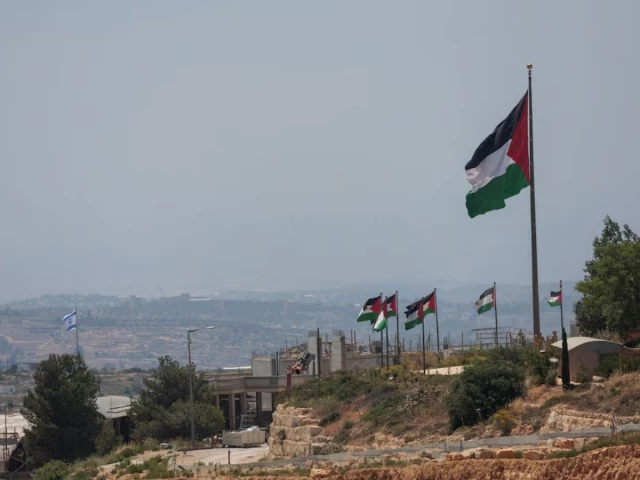
An Israeli flag flutters at a new Israeli settlement, behind Palestinians flags near Ramallah, in the Israeli-occupied West Bank, Jun 1, 2026. Photo: Reuters
Israel’s hardline finance minister announced on Wednesday a major expansion by more than 2,000 homes of three Jewish settlements in the occupied West Bank that Palestinians hope will be part of a future independent state.
Most nations consider Israeli settlements there to be illegal under international law and a major obstacle to a two-state solution for long-term peace.
Bezalel Smotrich, who held authority over parts of Israel’s civilian administration in the West Bank, said a planning committee approved the construction of 2,162 new Jewish homes.
They include 1,006 units in a new settlement near Jerusalem, 922 near the Palestinian city of Nablus and 234 near Hebron.
“We are continuing to build the Land of Israel in practice,” said Smotrich, an ultranationalist sanctioned by Britain, France and others who accuse him of inciting violence against Palestinians.
Read More: Israeli occupiers storm Al-Aqsa Mosque under police protection
Smotrich has denounced the sanctions against him, saying the measures would not change Israeli policy.
The new homes would “strengthen our hold on the land, reinforce Israel’s security, and establish clear facts on the ground that prevent the creation of an Arab terror state in the heart of the country”, Smotrich said in a statement, without specifying when construction would begin.
Since becoming a minister three years ago, Smotrich has sought to tighten Israel’s control and presence in the West Bank while advocating against the idea of a Palestinian state.
Prime Minister Benjamin Netanyahu’s right-wing government has overseen the significant expansion of Jewish settlements in the West Bank and the establishment of new settlements.
Palestinians want the West Bank as part of a future independent state that includes East Jerusalem and Gaza.
Around half a million Israelis live in the West Bank among about three million Palestinians.
US President Donald Trump’s administration has been far less critical of the fast-expanding Israeli settlements.
Also Read: Israeli forces kill four Palestinians in West Bank, Palestinian health authorities say
However, Trump did say last September that he would not allow Israel to annex the West Bank, angering some right-wing Israeli lawmakers. The United Arab Emirates, one of the few Arab states to have official ties with Israel, has also publicly warned the Israeli government against annexation.
Condemning Wednesday’s announcement, Palestinian President Mahmoud Abbas’ office warned that Israel’s “provocative” policies were pushing the region towards more rounds of violence and called on the US to stop the Israeli “madness”.
Smotrich, on May 19, said he would wage “war” on the Palestinian Authority (PA), which exercised limited civic rule in the West Bank, after he said he was told the International Criminal Court (ICC) prosecutor had sought a confidential arrest warrant against him. The ICC has not confirmed that.
The PA condemned Israel’s decision. “All settlement activity is illegal under international law and does not confer legitimacy to anyone,” the authority said in a statement carried by the official news agency Wafa.
It said the Israeli decision constitutes a “blatant challenge to international law and UN resolutions”, particularly UN Security Council Resolution 2334, which affirms the illegality of the Israeli settlements in all occupied Palestinian territories, including East Jerusalem.
It held the Israeli authorities responsible for the “serious consequences” of the settlement policies, warning that they would push the region toward “further cycles of violence and escalation”.
The authority called on the US administration to intervene immediately “to stop the Israeli madness if it genuinely seeks to promote security and stability in the region and globally”.
It stressed that the Palestinian people would remain “steadfast on their land and committed to their legitimate national rights”, saying the illegal settlement plans would not deter them from continuing their struggle to establish an independent Palestinian state on the June 4, 1967 borders with East Jerusalem as its capital.
Source link