Iran says Hormuz transit understanding with Oman contingent on US fulfilling commitments

Iran’s parliament speaker rejects US Treasury chief’s claims over economic pressure
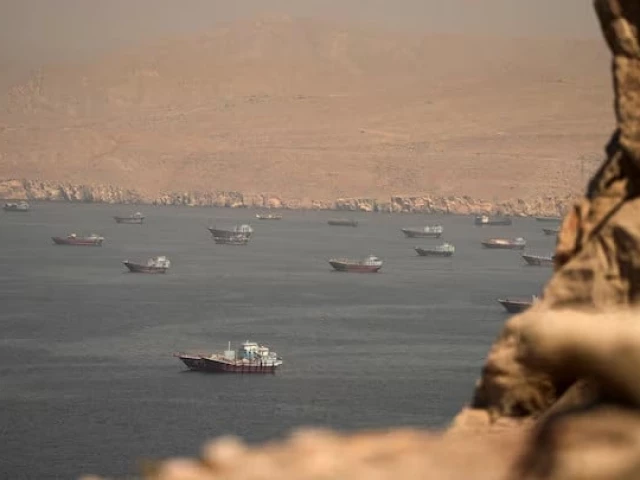
Vessels at the Strait of Hormuz, as seen from Musandam, Oman, June 18, 2026—REUTERS
Iran has reached an understanding with Oman on transit arrangements through the Strait of Hormuz, but its implementation is contingent on the US fulfilling its commitments, a senior Iranian diplomat said on Saturday.
“This understanding will not automatically enter the implementation stage,” Deputy Foreign Minister for Legal and International Affairs Kazem Gharibabadi said, according to Tasnim news agency.
“Implementing this understanding requires the other side, particularly the US, to fulfill its commitments. Whenever these commitments are implemented, Iran will also take its measures,” he said.
Gharibabadi said Iran was in no hurry to reopen the strait and would continue its “defensive measures” and efforts to “counter threats.”
“These measures are not new, and if Washington is interested in returning to the path of diplomacy, it must accept responsibility for its past actions,” he added.
He said the necessary arrangements regarding the strait had been made with the Omani government, but responsibility for meeting the requirements rested with the other side.
“Whenever these commitments are fulfilled, Iran will take the necessary action. The Strait of Hormuz remains closed, and if any vessel passes through this route, it will be with the coordination and authorization of the Islamic Republic of Iran,” he said.
Gharibabadi added that Iran’s armed forces maintain “full oversight” of movements in the strait, rejecting claims that vessels were passing through without coordination with Tehran.
He said Iran’s meetings and contacts with Qatar and Pakistan were held in light of the two countries’ roles as mediators in the talks.
“Qatar and Pakistan sought to examine whether it was possible to resume implementation of the commitments under the Islamabad understanding,” he said.
Read: Iran signals no retreat amid US sanctions
Tensions between Tehran and Washington have remained high since the war began with strikes on Iran in late February. Iran retaliated by targeting US military positions and assets in Arab countries aligned with Washington.
With Pakistani and Qatari mediation, they reached a ceasefire in April and later signed a memorandum of understanding in Islamabad in June to negotiate a lasting peace agreement.
Before the war, there was free passage through the strait, a critical export route for Gulf oil and gas, but Iran insists on retaining control and charging fees, something the US rejects.
Escalatory strikes between the US and Iran in July caused the US to reimpose a naval blockade of Iranian ports and revoke a waiver that allowed Iran to export oil, with the conflict now appearing to have reached a stalemate.
Iran’s parliament speaker rejects US Treasury chief’s claims over economic pressure
Iranian Parliament Speaker Mohammad Bagher Qalibaf on Saturday rejected US Treasury Secretary Scott Bessent’s claims that Washington’s blockade and economic measures would crush the Iranian economy.
“Liar, liar, pants on fire,” Qalibaf said in a post on the US social media company X, responding to Bessent’s assertion that Washington had brought 130 million barrels of oil onto the market over the past 14 days.
Referring to what he described as the “real 130s,” Qalibaf urged Bessent to ask his staff to review Moody’s figures that he said showed more than $130 billion in war-related costs.
Read more: ‘US is not talking with Iran’ as economic war in focus
He claimed US trading firm Jane Street had lost more than $130 million by betting on lower oil prices during a single rollover of futures contracts.
“Liar, liar, yields on fire,” Qalibaf added, sharing an article by economist Paul Krugman titled “Scott Bessent Fails to Gaslight the Market.”
Bessent earlier said “the blockade and Operation Economic Outcast will crush the failing Iranian economy,” claiming the US guided 130 million barrels of oil onto the market over the previous two weeks.
Egypt’s Banque Misr reviews US Iran sanctions notice, UAE central bank launches urgent examination
Egypt’s Banque Misr said on Saturday it was reviewing a US Treasury notice to cut off its UAE branches from dollar transactions over their dealings with Iran, while the UAE central bank said it had launched an urgent examination of the branches following the U.S. action.
The U.S. imposed Iran-related sanctions on an Egyptian bank as part of Treasury Secretary Scott Bessent’s campaign to increase economic pressure to try to break a stalemate six months into Washington’s war with Iran.
Banque Misr said its branch in the UAE continues to provide banking services to its customers in accordance with the applicable rules and procedures.
The UAE central bank said later on Saturday it had decided to conduct a “special and urgent examination” of Banque Misr’s branches in the country, including “a forensic/in-depth lookback covering the period referred to in the statement issued by the US authorities”.
“The Central Bank expects banks licensed in the UAE not to expose the UAE’s financial system to reputational risks, to respect the laws and regulations of the countries whose financial institutions are used in conducting transactions, and not to misuse the advanced financial infrastructure of the UAE,” it added in a statement.
US military families ride “roller coaster of emotions” over six months of Iran war
Since the United States went to war with Iran six months ago, Courtney Sanders has been helping soldiers’ families fill the gaps left by their loved ones.
There are school pickups to coordinate, lost incomes to supplement — and the ever-present separation anxiety.
“It’s like being on pins and needles all of the time,” Sanders said.
She leads the Chicagoland chapter of Blue Star Families, the nation’s largest nonprofit serving military families, and her own daughters are in the US Navy. They have served in various overseas locations over the past six months, including the Middle East.
The US has more than 50,000 troops stationed across the region and has deployed thousands of additional Marines and sailors to support the war effort. Eighteen US service members have been killed in the conflict and more than 750 wounded.
Also read: Iran vows to retaliate after US widens sanctions
During the war’s on-and-off fighting, shuttle diplomacy and failed peace talks, military families have experienced a “roller coaster of emotions,” Sanders said. “The moment that you feel you’re able to take a breath, you get gut-punched again.”
These are familiar pressures for the partners and children, mothers and fathers, of American troops. But the suddenness of the Iranian conflict, and its fitful pace, have had a compounding effect, relatives told Reuters.
In a Blue Star Families poll of some 200 active-duty military families in early March, 81% reported elevated stress from the Iran conflict.
The group has responded by stepping up its programming, creating online resource hubs, hosting webinars and in-person meet-ups, and matching military spouses going through a deployment for the first time with those who have been through it before.
Many service members’ deployments have been extended unexpectedly.
The USS Abraham Lincoln aircraft carrier went more than 200 days without a port call — a modern-day record, according to Democratic lawmakers — and military outlets reported suicide attempts and declining morale among its 5,000 sailors and Marines. US Defence Secretary Pete Hegseth said the reports “completely misrepresented” the conditions on board.
Some military families find themselves in financial straits.
National Guard members, for example, often work regular jobs when they are not deployed. The sudden loss of their main paycheck can make it hard for those left behind to keep food on the table, Sanders said.
“There is a huge misconception in the civilian world that if you are in the military, all of your bills are taken care of,” she said. “And that is just frankly not true.”
In a statement, the Pentagon said: “We see these families (and) we hear their concerns. We will do whatever is necessary to provide the resources, assistance, and stability they need and deserve during these challenging times.”
“A lot of emotions”
Shannon, an Army spouse and mother of three in North Carolina who requested Reuters use only her first name for security reasons, tries to tune out the news and the political debate surrounding the war.
In February, her husband deployed to the region with five days’ notice and could only contact her sporadically for the first several months.
Although they have maintained near-daily communication since June, “there are a lot of emotions,” Shannon said, “especially when people are dying over there.”
Her children started therapy over the summer. She tries to be strong in front of them, but cries sometimes when they’re not around.
Soon after her husband’s deployment, Shannon joined an Army-sponsored soldier-and-family “readiness group” within her husband’s unit, helping organize meal trains and other support for family members in need.
“Every day is not going to be a great day, but you’ve gotta just keep going and keep yourself busy,” she said.
In Virginia, Pat, a Navy spouse who also asked to be identified by her first name for security reasons, has tried to keep life as normal as possible for her children, who are in middle and high school.
Since her husband deployed about five months ago, Pat said, her neighbors have been “amazing” about helping with kid pickups and other chores.
Her family wears red on Fridays — a show of support for deployed service members — and so do many of her children’s classmates, even those without military connections.
Pat’s husband has deployed before. She was pleasantly surprised this time to discover his ship had Wi-Fi, making communication easier.
Still, her family is grappling with the uncertainty of when he will return.
“Having older kids and knowing that dad wasn’t there to see those sporting events, some of that’s been a little emotional,” she said. “But my kids are very resilient.”
Source link