Spokesperson says India’s maps, unilateral claims of sovereignty have no bearing on status of disputed territory
Pakistan on Monday rejected India’s position on the disputed status of Jammu and Kashmir, saying India’s claims had “no bearing on the status of the disputed territory,” the Ministry of Foreign Affairs said.
In a statement on X, Foreign Office spokesperson Ambassador Sajjad Haider Khan said, “Pakistan categorically rejects India’s baseless assertions regarding the status of Jammu and Kashmir which are contrary to internationally recognised facts.”
He added that India’s “unilateral actions and continued illegal occupation” could not alter the internationally recognised status of Jammu and Kashmir.
The spokesperson said the Jammu and Kashmir dispute remained “one of the oldest unresolved, internationally recognised disputes” on the agenda of the United Nations Security Council.
According to Khan, the relevant UN resolutions stipulated that the final status of the region “must be made in accordance with the relevant Security Council resolutions and the will of the Kashmiri people.” He added that the wishes of the Kashmiri people should be expressed through “a free and impartial plebiscite under UN auspices”.
Further, MoFA also rejected India’s official maps and its unilateral claims of sovereignty over Jammu and Kashmir. “The official United Nations maps, which depict Jammu and Kashmir as a disputed territory, remain the only cartographic representation of its current legal status,” Khan said.
“India’s so-called official maps and unilateral claims of sovereignty have no bearing on the status of the disputed territory,” he stated.
Pakistan urged the international community to ensure that India “immediately stops human rights violations” in Indian Illegally Occupied Jammu and Kashmir (IIOJK).
The spokesperson also called on New Delhi to fulfil its commitment to the “realisation of the right to self-determination of the Kashmiri people,” in line with relevant UN Security Council resolutions.
Read: FO rejects India’s temple demolition claims
In August, Pakistan summoned the US chargé d’affaires in Islamabad and lodged a “strong demarche” over remarks by US Ambassador to India Sergio Gor during his first visit to IIOJK. Gor had called the disputed territory “an important part of India.”
Pakistan rejected the remarks, saying they contradicted the internationally recognised status of Jammu and Kashmir and the long-standing United States position on the dispute. Islamabad also urged Washington to ensure its public statements remained consistent with the territory’s disputed status.
Long-running dispute
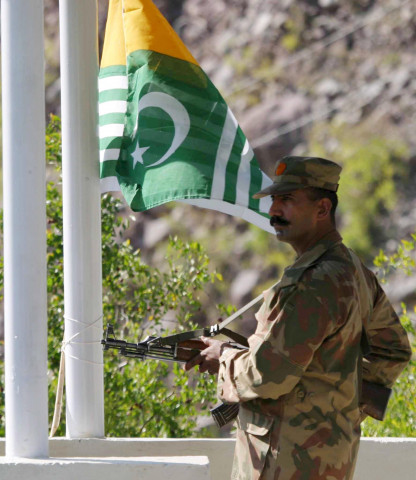
Kashmir has long been a flashpoint between India and Pakistan, both of which claim all of the region but rule only in part.
Ties between the nuclear-armed rivals have been on ice since Indian Prime Minister Narendra Modi withdrew the autonomous status of IIOJK in 2019 to tighten his grip over the territory, provoking outrage in Pakistan and the downgrading of diplomatic ties and suspension of bilateral trade.
The tensions further escalated to new heights last year after a deadly April 22 attack in Pahalgam in IIOJK that left 26 civilians dead. India blamed Pakistan-based elements without providing evidence; Islamabad rejected the claim.
India responded by closing the Wagah border, revoking Pakistani visas, and suspending the Indus Waters Treaty — moves Pakistan labelled as an “act of war.”
Later, India launched attacks inside Pakistan, prompting Islamabad to respond with Operation Bunyan-un-Marsoos, during which it downed five Indian jets, including Rafales, and intercepted 77 Israeli-origin Harop drones.
However, on May 10, both countries agreed to a full and immediate ceasefire led by US President Donald Trump following days of intense military exchanges that raised fears of a full-scale conflict between the nuclear-armed neighbours.
The very next day after the ceasefire, Trump pledged to support efforts toward a resolution of the Kashmir dispute and to increase trade substantially with both nations.
Source link