
ISLAMABAD:
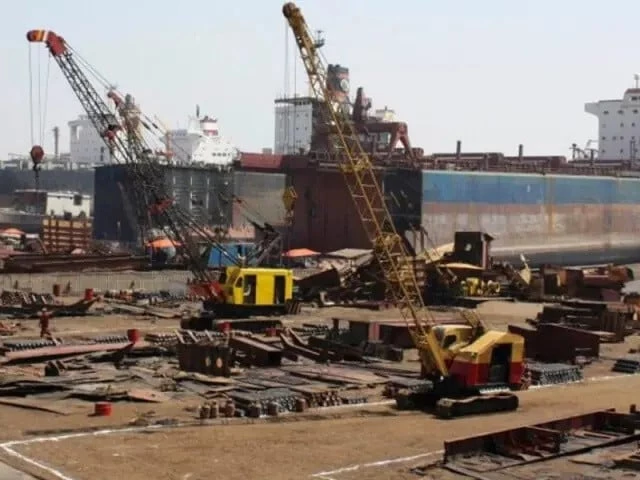
Pakistan has passed a new maritime legislation aimed at enforcing the Hong Kong convention to pave the way for shipbreaking on a large scale in Pakistani shipyards, which will boost the ship recycling industry.
The law will regulate the use of hazardous materials in the ship recycling sector, promote environmentally sustainable shipbreaking practices and advance the implementation of the Hong Kong convention.
Earlier, the government estimated that 400 ships could be moved to Pakistani shipyards following Russia-Ukraine war. The recent US-Israel and Iran war will result in more ships arriving at Pakistani shipyards for dismantling.
Additionally, the maritime affairs minister has floated an idea to introduce a steel corridor by connecting the Karachi shipyard with Pakistan Steel Mills (PSM). It is envisaged that the plan will help run PSM again, which has remained shut for decades due to gas shortage.
“The iron gathered during shipbreaking will be used in Pakistan Steel Mills,” an official said, adding that the Senate had approved a new legislation to give a push to the local ship recycling industry.
Federal Minister for Maritime Affairs Muhammad Junaid Anwar Chaudhry commented that the new law would regulate the handling of hazardous materials in ship recycling, promote environmentally sustainable ship breaking and advance the implementation of the Hong Kong convention.
In a statement after the Senate passed the Environmentally Sound Management of Inventory of Hazardous Material on Ships Bill, 2026, the minister said the legislation would facilitate the implementation of the Hong Kong International Convention for the Safe and Environmentally Sound Recycling of Ships, 2009 by addressing environmental, occupational health and safety risks associated with ship recycling.
He said the bill, moved by himself, had already been approved by the National Assembly and was passed by the Senate on Thursday, clearing the way for its enforcement across the country.
Chaudhry said the bill aimed to ensure that hazardous waste generated through ship recycling was managed in an environmentally sound and sustainable manner. He added that the law would prohibit the use of hazardous materials identified under the convention, mandate the inspection and certification of ships, and impose strict penalties for violations.
Every ship arriving in Pakistani waters for recycling would be subject to mandatory surveys, inspections and certification of its inventory of hazardous materials, he said, noting “ships found violating the law could face seizure, detention, removal from Pakistani waters and other prescribed penalties.”
He said the Ministry of Maritime Affairs would serve as the national focal point for coordination, implementation and reporting to the International Maritime Organisation to ensure compliance with the convention.
The minister noted that Pakistan ranked among the world’s top three ship recycling nations and handled nearly one-third of global ship recycling activity, giving the country a significant responsibility to ensure safe, transparent and environmentally sound recycling practices.
He stressed that the ship recycling industry, established in Gadani in the 1980s, remained an important sector for the national economy and employment, which made it necessary to align local practices with international environmental, labour and safety standards.
Chaudhry said Pakistan had become the 23rd country to accede to the Hong Kong convention, reaffirming its commitment to green and safe ship recycling while enhancing Gadani’s standing in the global ship recycling arena.
He mentioned that two complementary legal frameworks had been developed to implement the convention at both provincial and federal levels. Already, the Balochistan Assembly had enacted the Balochistan Safe and Environmentally Sound Recycling of Ships Act, 2025 in November last year.
The minister stated that the new legislation reflected Pakistan’s broader commitment to climate action, hazardous waste control and sustainable industrial development. The law will also support Pakistan’s transition towards a circular economy and contribute to the United Nations 2030 Agenda for Sustainable Development.
He maintained that the legislation would enhance Pakistan’s international credibility, protect livelihoods linked to the ship recycling sector, improve competitiveness and ensure fair and predictable enforcement of environmental and safety standards.

