
Notification says all offices, educational institutions, and businesses will remain closed on notified dates
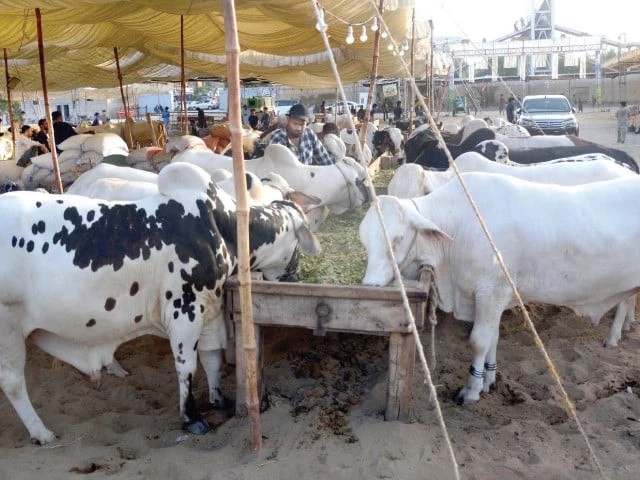
Amid the hum of a city gearing up for Eidul Azha, cattle quietly feast on fresh fodder. PHOTO: JALAL QURESHI/EXPRESS
Prime Minister Shehbaz Sharif on Wednesday approved a three-day public holiday on the occasion of Eidul Azha from May 26-28 (Tuesday to Thursday).
According to a notification issued by the Cabinet Division, the Prime Minister approved the three-day public holiday in continuation of the division’s earlier circular No.10-01/2025-Min-II dated January 19, regarding public and optional holidays for the year 2026.
“All offices, educational institutions, and businesses observing public holidays will remain closed on the notified dates,” the notification said.
On May 17, the Central Ruet-e-Hilal Committee announced that the moon of Zilhajj 1447 AH had been sighted in the country, and Eidul Azha would be observed on May 27.
He said testimonies of moon sighting were received from Karachi and other parts of Sindh, as well as Mardan, Rawalpindi, Peshawar and several other regions. “Therefore, it has been decided that the first Zilhajj 1447 AH will be on May 18, while Eidul Azha will fall on May 27,” he said.
According to the Ministry of Religious Affairs, the meeting of the Central Ruet-e-Hilal Committee for 29 Zilhajj, held on May 17 (today), took place at the Meteorological Department in Karachi.
Read: Zilhaj moon sighted, Pakistan to celebrate Eidul Azha on May 27
On May 12, the Space and Upper Atmosphere Research Commission (SUPARCO issued its forecast for the sighting of the Zilhajj 1447 AH moon, stating that Eidul Azha was expected to be observed on May 27.
Inflation bites ahead of Eid
The Punjab, closely followed by the Sindh and federal government, announced last week that they were temporarily lifting early closing timings ahead of Eidul Azha, sparking hopes among traders for a much-needed business revival after weeks of uncertainty caused by rising fuel prices, regional tensions, and restricted market timings.
Petrol prices and expensive transportation have affected not only traders but also ordinary consumers planning for Eidul Azha. From clothing to groceries and sacrificial animals, prices this year have risen sharply compared to last year.
In cattle markets across Punjab and Sindh, buyers are facing sticker shock. A healthy goat that was available for Rs100,000 to Rs125,000 last year is now being sold for nearly Rs180,000 to Rs220,000 in many urban markets.
Read More: Eid rush returns, inflation bites
“This year, even middle-income families are struggling to arrange money for sacrificial animals,” said Shayan Baig, who was looking for an animal for Eid. “No matter whether it’s a goat, lamb, or a cow, at least Rs100,000 has been added, if we compare prices with the previous year’s rates, which were also higher. I now have to adopt a wait-and-see policy, and will try again close to the Eid in the hope of getting an animal at a lower price.”
Livestock traders argue that their own costs have also surged significantly. Transportation charges, fodder prices and inter-city movement expenses have all increased over recent months. Many sellers say bringing animals from rural areas to major cities has become far more expensive than in previous years.
The livestock sector remains a major part of Pakistan’s rural economy during Eidul Azha. Thousands of seasonal workers, transporters, fodder suppliers and temporary market operators depend on Eid-related activity for income. Economists believe the festival generates billions of rupees in temporary economic activity every year.
At the same time, inflation continues to shape consumer behaviour. According to the Pakistan Bureau of Statistics, inflationary pressures remained significant during the first quarter of 2026 despite some easing in headline figures. Food items, transport costs and energy-related expenses continue to weigh heavily on household budgets.
In shopping centres, many retailers say consumers are visiting markets but spending carefully. Instead of bulk purchases, families are focusing on essential Eid buying only.

