









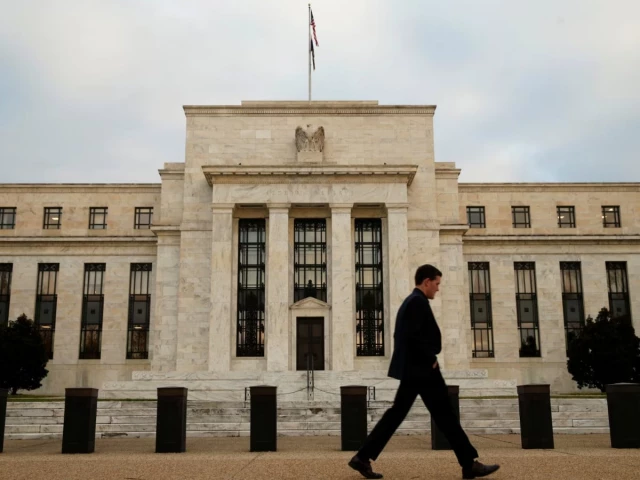
The Federal Reserve building in Washington, December 16, 2015. Photo: Reuters
The US Federal Reserve has raised interest rates for the first time in more than three years, lifting its benchmark policy rate by 25 basis points to 3.75%-4% as persistent inflation keeps pressure on the central bank, while gold has continued to trade near record levels despite the higher borrowing costs.
The unanimous decision by the Federal Open Market Committee marked the first rate increase since July 2023 and came despite repeated demands from President Donald Trump for sharply lower interest rates.
Fed Chair Kevin Warsh defended the unanimous move, saying inflation remained too high and had persisted for too long. He described the decision as “sober” and “responsible” and indicated that rates could be raised further if price pressures failed to ease.
While acknowledging an “attitude of optimism” within the Fed leadership, he stressed that inflation remained a concern. The Fed has a long-standing inflation target of 2%. Warsh said US inflation had remained above that level for more than five years.
Higher interest rates make borrowing more expensive for households and businesses, raising the cost of mortgages, loans and credit cards. They can also increase returns for savers. At the same time, tighter monetary policy can discourage spending and investment and weigh on economic growth.
Trump sharply criticised the Fed decision in a post on Truth Social, arguing that US interest rates should be “1%, or less” and demanding that borrowing costs be reduced “and fast”.
He later said he had spoken to Warsh and suggested the Fed chief might as well vote with the board because it was “very hostile” and “very political”. Trump nevertheless said he retained confidence in Warsh, whom he selected earlier this year to succeed Jerome Powell.
The rate decision, however, has implications beyond borrowing costs. It has also highlighted a striking divergence in financial markets: gold has remained above $4,000 despite real interest rates being at their highest levels in years.
Under conventional economic theory, higher real interest rates should weigh on gold because bullion generates no interest or dividend and therefore becomes relatively less attractive when interest-bearing assets offer higher returns.
Yet gold has remained near record highs, while central-bank purchases have stayed elevated. The divergence has prompted renewed discussion among market observers about whether the traditional relationship between interest rates and gold has weakened and whether other factors, including sovereign and custody risks, are playing a larger role.
One emerging area of discussion concerns where central banks hold their physical gold and other reserve assets.
The issue can be viewed through three channels.
The first is the fiscal and credit channel. Higher interest rates increase the cost of servicing government debt and can influence market assessments of sovereign credit risk. US federal debt has reached around $40 trillion, while debt-servicing costs have risen sharply. The 30-year US Treasury yield has also reached levels not seen in nearly two decades.
Such figures point to rising fiscal costs rather than an imminent US credit crisis. Credit ratings, sovereign spreads and credit-default swaps remain more direct measures of changes in perceived sovereign credit risk.
The second is the reserve portfolio channel. Higher rates push yields up but reduce the market value of existing fixed-income securities such as US Treasuries. Reserve managers must consequently balance return, liquidity and risk when deciding how to allocate their holdings.
Foreign holdings of US Treasuries declined in June, with Japan recording the largest fall, while private foreign demand also weakened, according to data cited by Reuters. At the same time, central-bank demand for gold has remained strong, according to the World Gold Council.
The third channel is legal and jurisdictional risk. The location where reserve assets are held determines the legal framework and jurisdiction governing their custody.
The freezing of roughly $300 billion in Russian central-bank reserves after Moscow’s 2022 invasion of Ukraine demonstrated that sovereign assets held abroad can become subject to extraordinary legal and geopolitical measures. Similar disputes have involved Iranian and Afghan assets.
These precedents have contributed to wider discussions among economists and international institutions about reserve security and diversification. They do not, however, indicate that central banks are abandoning established custody arrangements.
New York and London continue to offer major advantages as reserve-asset centres, including deep financial markets, legal infrastructure, trading and clearing efficiency and longstanding institutional trust. Most central banks continue to rely on these established systems.
The issue, therefore, is less about an immediate migration of gold and more about whether reserve managers are gradually reassessing the risks attached to overseas custody. Historical market behaviour adds to the debate.
During the 1980-81 tightening cycle under Fed Chair Paul Volcker, when US interest rates approached 20%, gold fell sharply after reaching record levels. During the 2013 “taper tantrum”, rapidly rising real yields were likewise accompanied by a significant decline in gold prices.
The current cycle has produced a different outcome. From 2022 to 2026, real rates have risen to exceptionally high levels, yet gold has continued to climb.
Some analysts have described the relationship between gold and interest rates as weakening, while others continue to regard real rates as a major driver of bullion prices. Inflation expectations, the US dollar, geopolitical uncertainty and central-bank purchases are also important factors.
Europe offers another example of how reserve custody has entered public debate. Germany repatriated 674 tonnes of gold from overseas between 2013 and 2017. More recently, questions have resurfaced over the custody arrangements of European gold reserves, including holdings stored in the United States.
For central banks, diversification of assets and custody locations is not a new practice. The appropriate balance varies according to a country’s liquidity needs, legal framework, market access and assessment of risk.
The present combination of higher US interest rates and elevated gold prices therefore does not by itself prove that custody risk is driving bullion prices. Nor does it establish that central banks are preparing for a broad relocation of their gold.
It does, however, highlight a broader shift in the way reserve assets may be assessed: alongside returns and liquidity, questions of sovereign credit, legal jurisdiction and custody can enter the risk calculation.
For now, New York and London retain their traditional advantages, while any changes in custody arrangements remain gradual and country-specific.
The Fed’s latest decision thus presents a wider financial paradox: rates are being raised to contain inflation and preserve price stability, yet an asset traditionally disadvantaged by higher real rates continues to command exceptional demand.
As reserve managers reassess their portfolios in a changing financial and geopolitical environment, the question may increasingly be not only what assets they hold, but also where those assets are held.