



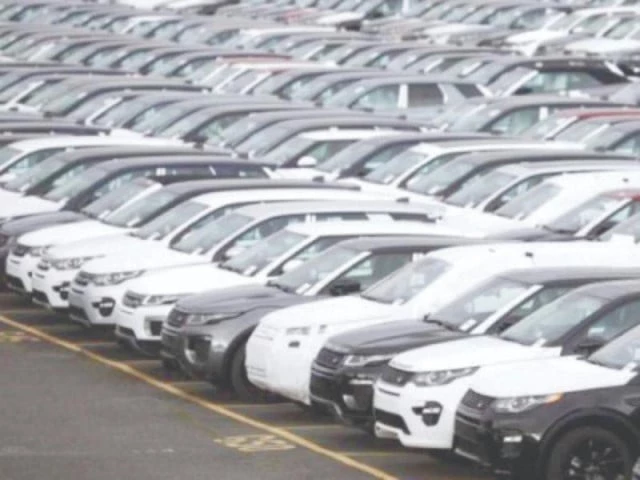
nalysts are anticipating the automobile sector to keep its pace in the near future owing to improving macroeconomic situation and new production lines introduced by the players. photo: file
LAHORE:
Stakeholders in Pakistan’s automotive sector have renewed calls for a ten-year policy roadmap, warning that investors will continue to hesitate unless the government commits to long-term policy continuity in a capital-intensive industry that requires years to recoup investment.
The demand comes as the sector closes fiscal year 2025-26 on a strong note. According to data released by the Pakistan Automotive Manufacturers Association (PAMA), passenger car sales for FY2025-26 reached roughly 156,002 units, a 39% increase over the previous year.
Industry analysts attribute the rebound to improving macroeconomic conditions, including a fall in the central bank’s policy rate from 22% in mid-2024 to 11-12% in 2025-26, which brought down the cost of auto financing and revived consumer demand.
Yet stakeholders caution that the recovery masks a deeper structural problem: chronically low vehicle ownership. Car ownership in Pakistan has fallen further, from 18 to just 11 owners per 1,000 residents. Stakeholders linked the decline to affordability constraints, weak income growth, volatile policies and a distorted tax structure that continue to keep Pakistan among the lowest car-ownership markets in the region. They added that Pakistan’s per capita income of around $1,700 remains well below the roughly $3,000 threshold typically associated with a meaningful jump in car demand, contrasting this with India, where rising incomes now support annual sales exceeding four million vehicles.
Pakistan Association of Automotive Parts & Accessories Manufacturers (PAAPAM) Chairman Usman Aslam Malik, on Wednesday, also expressed deep concern over the prolonged delay in finalising Pakistan’s new Auto Industry Development Policy, warning that continued uncertainty is adversely affecting the country’s automotive manufacturing ecosystem.
Malik said the delay has created significant uncertainty among member industries, many of which are already facing considerable financial and operational challenges. “The new Auto Industry Development Policy must prioritise the development and strengthening of Pakistan’s auto parts and components manufacturing base, which is the backbone of the country’s automotive value chain,” said Malik.
He noted that the last two auto policies focused primarily on attracting new vehicle assemblers. While this approach expanded the number of automotive brands in the market, it did not sufficiently promote localisation, indigenous engineering capabilities or domestic technology development, resulting in a weakened local auto parts manufacturing ecosystem.
Malik urged the government to adopt a policy direction centred on localisation, technology upgradation, engineering capability enhancement and employment generation. He emphasised that without this strategic shift, Pakistan risks eroding its industrial base and becoming increasingly dependent on imported vehicles and components.
Speaking to The Express Tribune, Indus Motors Company CEO Ali Asghar Jamali called for a stable, long-term 10-year Auto Industry Development Policy that provides policy continuity, enhances investor confidence and enables predictable industrial planning.
Despite the low ownership base, industry executives remain cautiously optimistic that if things started moving in the right direction, the 500,000 installed capacity of four-wheelers could easily be utilised annually in coming years.
On the electric vehicle transition, stakeholders reiterated that incentives under the New Energy Vehicle policy should be reserved strictly for fully electric models to avoid distorting the market for hybrid and ICE vehicles that still dominate sales. Current EV volumes remain negligible. Pakistan’s New Energy Vehicles Policy 2025-30 targets new energy vehicles making up 30% of new sales by 2030 across two-wheelers, three-wheelers and cars, but sales data show the segment is starting from a very small base.
Stakeholders warned that unchecked imports, whether of used vehicles or fully-built units, would undermine the thousands of jobs tied to local assembly and the wider parts-vendor ecosystem, already under strain from policy unpredictability. They repeated their appeal to the government to finalise a long-term auto policy only after meaningful consultation with manufacturers, parts makers and investors, arguing that a consistent taxation structure and technology-neutral rules would draw fresh investment, deepen localisation and boost exports.
They warned that repeated policy shifts risk making it more profitable for manufacturers to import rather than produce locally, a scenario that would hollow out the vendor base built over decades. They expect the government to consult stakeholders and finalise a stable, long-term auto policy that secures investment, protects jobs and allows Pakistan to make fuller use of its existing manufacturing capacity in the years ahead.