
FinMin seeks easier digital onboarding, stronger data-sharing and greater integration between banks, capital markets
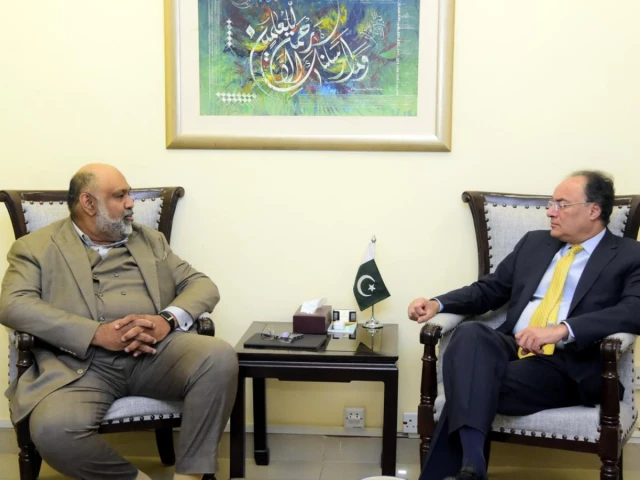
Finance Minister Muhammad Auranzgeb meets with Pakistan Digital Authority (PDA) Chairperson Dr Sohail Munir in Islamabad. PHOTO: X
Finance Minister Muhammad Aurangzeb on Thursday pushed for an enabling regulatory framework to expand electronic transactions and simplify digital access to finance, including easier customer onboarding and stronger data-sharing between banks and capital markets, according to the Ministry of Finance.
During a meeting with Pakistan Digital Authority (PDA) Chairperson Dr Sohail Munir, the two discussed digital transformation, digital finance and the wider use of technology to support economic activity, the ministry posted on X.
it said the finance minister emphasised the importance of ensuring that “existing frameworks evolve alongside advancements in digital technology and emerging business models”.
The participants discussed the need for an “enabling framework that recognises electronic transactions” and supports the wider adoption of digital processes across trade and financial activities, it added.
Finance Minister Meets Chairperson Pakistan Digital Authority to Advance Digital Transformation and Support a Technology-Enabled Economy
Federal Minister for Finance and Revenue, Senator Muhammad Aurangzeb, held a meeting with Chairperson Pakistan Digital Authority (PDA), Dr.… pic.twitter.com/8udgZYO1bL
— Ministry of Finance, Government of Pakistan (@Financegovpk) August 13, 2026
According to the ministry, the meeting also examined opportunities to improve access to finance through “greater use of digital platforms and more efficient processes”.
It further said Aurangzeb highlighted the importance of “simplifying customer onboarding, strengthening data-sharing mechanisms and improving interoperability of financial data”, including “greater integration between banks and capital markets”.
Measures to facilitate wider participation in the capital market through digital platforms and “streamlined account-opening processes” were also discussed, the ministry said.
The minister said stronger integration between banking and capital-market systems could support “greater investor participation and access to investment opportunities,” it added. The participants also exchanged views on improving the “use and interoperability of data across government systems”.
According to the ministry, Aurangzeb highlighted the potential of “better-connected data” to support “policy formulation, planning and decision-making”, including through greater use of technology and artificial intelligence.
Also Read: Electronic payments reach 3.7b transactions
The meeting also covered ways to strengthen digital infrastructure to support “more efficient delivery of public and financial services”. He further stressed the importance of ensuring that such initiatives were “practical, scalable and aligned with the broader digital transformation objectives”.
Digital assets and tokenisation were also discussed, including their potential applications in “real estate and other investment assets,” the ministry said. The participants highlighted the importance of an “appropriate framework and supporting mechanisms” to facilitate the “responsible adoption of emerging technologies,” it added.
According to the statement, Aurangzeb appreciated the work being undertaken by the Pakistan Digital Authority and stressed the importance of focusing on “practical, high-impact initiatives” that could “improve efficiency, facilitate access to finance and contribute to stronger digital capabilities across the economy”.
The finance minister also underscored the importance of “sustained coordination with relevant stakeholders” to advance digital initiatives, strengthen efficiency and support the “continued development of Pakistan’s digital economy,” the statement added.
Read More: Pakistan’s cashless dream has a cash problem
Pakistan’s digital payments ecosystem had expanded rapidly, with retail payments through the banking system reaching 3.7 billion transactions in January-March 2026, up 9% from the previous quarter, according to the State Bank of Pakistan.
Digital channels accounted for 92% of retail payment volumes, processing 3.4 billion transactions worth Rs68.3 trillion.
The number of mobile banking and digital wallet registrations had also exceeded 132 million by March 2026, up 37% from a year earlier, while nearly half of the country’s 268 million bank accounts were linked to a mobile banking app or digital wallet.
Meanwhile, Raast had processed 742 million transactions worth Rs23.27 trillion during the quarter, underscoring the rapid shift towards digital payments.
Raast’s peer-to-peer transfer system has seen genuine adoption in urban areas. Mobile wallets like Easypaisa and JazzCash have brought basic financial services to segments of the population that traditional banks never reached.
QR-enabled merchants more than doubled in FY25 — from 516,000 in FY24 to over 1.9 million by end of 2025 — which is a real sign of merchant-side momentum, even if still concentrated in urban centres.

