








Growth in Asia-Pacific developing economies slows to 4.6% in 2025, projected at 4% in 2026
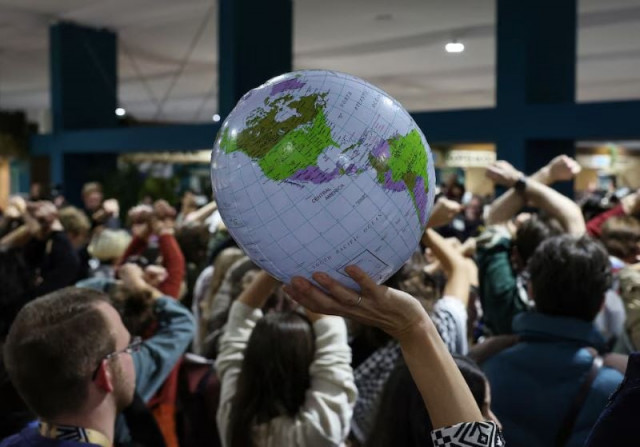
Activists hold a silent protest against the draft agreement, during the COP29 United Nations Climate Change Conference, in Baku, Azerbaijan November 22, 2024. PHOTO: REUTERS
Despite mounting global headwinds, Asia-Pacific developing economies’ growth is projected to slow to 4.0% in 2026 from 4.6% in 2025, while inflation is expected to rise to 4.6% from 3.5%, though the region remains the fastest-growing among developing economies globally.
The 2026 edition of the Economic and Social Survey of Asia and the Pacific, published by the United Nations Economic and Social Commission for Asia and the Pacific, noted that surging energy and food prices alongside weakening global demand are dampening growth prospects and pushing up the cost of living across the region.
Rising geopolitical tensions in the Middle East are casting a shadow over the economic outlook of the Asia-Pacific region, disrupting energy and commodity markets as well as trade routes at a time of heightened global uncertainty, the United Nations warned in a new report.
Also Read: Tear down this war
It suggested that the low-skilled workers and low-income households remain particularly exposed, as they face rising expenses with limited access to social protection mechanisms. At the same time, high public debt levels and the likelihood of rising interest rates due to inflationary pressures may constrain governments’ ability to respond to fresh economic shocks.
The report emphasised the need for a gradual shift away from export-led growth towards stronger domestic and regional demand. Priorities include boosting productivity, expanding social protection, improving access to finance and strengthening digital and physical connectivity, alongside deeper regional cooperation to counter global economic fragmentation.
The UN also highlighted the urgency of strengthening energy resilience through increased reliance on renewable sources, noting that the ongoing global energy crisis underscores the risks of dependence on fossil fuels.
Read More: Floods vs Economy: WB warns Pakistan’s FY26 growth at risk
“This is especially critical today, as we witness in real time the effects of a dependence on fossil fuels, where every conflict risks sending shock waves through the global economy,” said United Nations Secretary-General Antonio Guterres.
However, ESCAP cautioned that poorly designed energy transition policies could trigger unintended socioeconomic consequences, including higher inflation, fiscal strain, rising poverty and widening inequality. It stressed that policy choices must be tailored to country-specific conditions and implemented in a calibrated manner.
Measures such as gradual fossil fuel subsidy reforms, mobilising private capital for green investment and strengthening international support for least developed and small island economies were identified as critical to ensuring a smooth transition.
The report also underscored the role of political and behavioural insights in sustaining reform momentum, including timing policy changes strategically and improving public acceptance of measures such as carbon pricing through transparent and equitable use of revenues.