Home Blog Page 938

My mother Pino!

0
My mother Pino!


Imagine waking up one day to discover that the couple you always thought to be your parents, are your adoptive parents

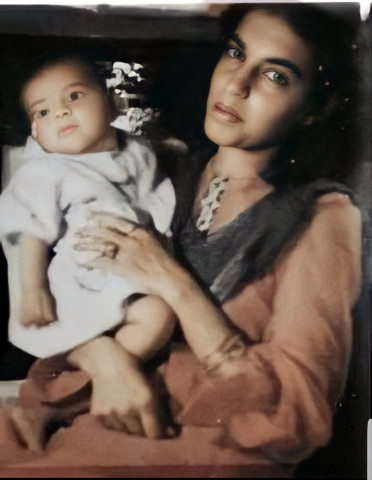
The writer and his mother. SOURCE: AUTHOR

Imagine waking up one fine morning to discover that the couple you always thought to be your birth parents, are in-fact, your adoptive parents. This is how I came to know about my origins it was indeed a shocking discovery. Yes, it did hurt at the time and it hit me hard, just as a ten-ton truck would have done but little did I know that this new information would change the course of my life and trigger a bitter-sweet domino effect that would lead me to such love and affection. The discovery was indeed worth taking a hit.

I started my journey to self-discovery with just one name: Pino. Yes, that was my mother’s nickname, and that is all I knew. I had known her as Aunty Pino through family photo albums though. Her real name was Raheela and I had always known her as my mamu’s (paternal uncle) second wife. Mamu Ishaq was actually my birth father but I didn’t know this until he passed away in a car accident in Syria in the early 80s. At the time, I was six years old. Before he went off to Syria on a military deputation through Pakistan Army’s medical corp, he gifted me a teddy bear that I still have and adore.

My work was cut out for me. Pino’s family was totally disconnected from my adoptive family. All I knew was that one of my adoptive father’s friends was somehow related to Pino. But, my adoptive father passed away in 2014, before I could broach the subject with him. He was everything to me since Ammi passed away in 1999. I had always known him as a kind-hearted human being and also a very honest and upright administrator when on duty. He was a military officer and served as Lahore Development Authority’s director general and also served as Water and Sewer Authority’s managing director from mid to late 80s. Abu retired as a brigadier and was a recipient of Sitara-e-Imtiaz from the Government of Pakistan. It was through his stories that I remembered that one of his friends was related to Pino’s family.

I knew his friend’s cell number was in one of his telephone diaries. I was curious and wanted to know more about my birth mother. I was also worried since I had no idea who I would bump into on the other side of the wall and what would the level of acceptability be, if any. Finally, after a lot of convincing by my wife, Maryam, I made the call which opened up new doors in ways that I could not have imagined. I will always be thankful to my wife for her support when I needed it the most.

We started by meeting a couple of Pino’s first cousins in Lahore and from there I never really looked back. One after the other, I kept meeting my blood relatives from around the world. Although, I still have not been able to meet all of my first cousins and an uncle (my actual Mamu Khalid), it is so joyful to know that my family, despite the gap of more than four decades, always kept me in their thoughts and accepted me with open arms once I showed up.

This journey has been exquisite. I met my first cousins in Lahore for the first time and could see both, sorrow and joy, in their eyes. When I telephonically talked to my Khala Zarina (who resides in England) for the first time, she could not control her emotions. She is the one who wanted to adopt me when Pino passed away. However, Ishaq eventually decided to let his sister have me so that I would live in Pakistan and stay close to him. Hence, it was a magical moment when I landed in England to meet my khala and found myself in her loving embrace while tears dropped from her eyes.

Although some of my uncles and aunties have passed away, the love that others have showered upon me has given me a very good idea of how they would have been if they were still in this world.

It gave me chills as I started to see more pictures of Pino. I came to know that she was a brilliant student, a good writer, a melodious singer and had a very cheerful and loving personality. I was able to discover and visit her grave in Miani Sahib graveyard and it felt as if I was meeting her for the first time. On her tombstone, I found excerpts from a poem written by Allama Muhammad Iqbal in memory of his mother when she passed away. Since then, I have never missed visiting her grave on her death anniversary, where I pause and reflect on these two lines from the poem on her epitaph:

Asman teri lehad par shabnam afshani kare

Sabza-e-Noorasta is ghar ki nigehbani kare

(May the sky shed its dew on your grave

May the freshly grown verdure watch over your home)

I was fascinated to know that my lineage is Kashmiri from my maternal side. The elders, in the nineteenth century, moved from India to the British Protectorate in Kenya. With time they established themselves while some of the family moved to Uganda. My great grandfather, Khwaja Shamsud Deen became a member of the Kenyan Legislative Council in 1922. Other family members served in the Bombay Police and Uganda Police from time to time. Some of the family members also became very successful businessmen in East Africa. The famous Indian/Pakistani writer Saadat Hassan Manto was also part of the family.

Pino met Ishaq while she was visiting Lahore from East Africa. It was during this time that they fell in love. There was strong opposition from the two families against their union but nothing could separate them. Even when Ishaq became a prisoner of war, the distance could only make their love stronger. They eventually got married in 1974. I was born on March 16, 1975. Like all good things must come to an end, Ishaq and Pino’s love story also ended but it came to a close too early.

Due to tension at home owing to Ishaq’s first marriage, Pino took her own life on September 10, 1975. I was only six months old at the time and obviously had no idea what calamity had befallen me.

I call my adoptive parents my guardian angels since they brought me up just like they would have their own progeny. Through the years, never did I realise that they were not my birth parents and all credit goes to them for loving me all through the decades while keeping me oblivious to the bitter facts.

And how can I thank God enough for bringing me in this world as Pino’s son? Although, I don’t remember seeing her but the thought that my tiny eyes, when I was an infant, must have gazed upon her gives me solace. She talked about me in the last letter that she left before ending her life and was concerned about my up-bringing. Her words showed affection and love that only a loving mother can feel for her child. When I go through the letters that Ishaq wrote to my maternal side after Pino’s death, I can feel anguish, sorrow and helplessness in his writings for he was, obviously, a broken man. Both, Pino and Ishaq will always have a special place in my heart. They are, after all, my parents.

When I came to know about the facts, I never thought I would share these details in public. However, on my 46th birthday I decided to open up. I chose to share my story with the world as I thought this is a story of love that must be told: love between Pino and Ishaq; love for me by my foster parents; and love with which Pino and Ishaq showered me with until they lived.

I consider myself a person who has been very lucky; lucky to be protected by God when I was just too small to secure myself; lucky to be born as Pino and Ishaq’s son; and lucky to be brought up immaculately by my foster parents. I am glad to say now that I didn’t just have two parents – but four. After all these years of silence, mystery and estrangement, I am deeply relieved to have rediscovered and forged this connection, and to let the whole world know how proud I am of my mother: Pino.


Source link

K-P announces Rs2,000 fuel subsidy for bikers, rickshaw owners

0
K-P announces Rs2,000 fuel subsidy for bikers, rickshaw owners


Through Dastak App eligible individuals can register and avail financial assistance

Khyber-Pakhtunkhwa Chief Minister Sohail Afrid. SCREENGRAB

The Khyber Pakhtunkhwa (K-P) government on Sunday, in response to surging petrol prices and an ongoing energy crisis, launched the Ehsaas Fuel Support Programme, under which motorcycle, scooter, and rickshaw owners will be given Rs2,000.

Special Assistant to the Chief Minister on Information and Public Relations, Shafi Jan, said in a statement on X that the initiative had been introduced on the instructions of CM Sohail Afridi to provide financial relief to transport users.

“A sum of Rs2,000 will be provided to motorcycle, scooter, and rickshaw owners under the Ehsaas Fuel Scheme,” he said, adding that the scheme aims to ease the burden on low-income groups.

The statement added that a “simple and transparent system” had been introduced through the Dastak App, allowing eligible individuals to register and access financial assistance.

Jan said the programme would support the common man and described it as a model public welfare initiative, adding that providing relief to low-income and deserving groups remained the provincial government’s top priority.

He said the government would continue public-focused measures in line with the vision of Imran Khan, while criticising federal policies as placing additional strain on poorer segments of society.

The statement further added that the provincial government was taking practical steps to reduce the financial burden on citizens and remained actively engaged at all levels to provide relief.

On Thursday, the government further increased petrol prices by Rs137 per litre to a record-high of Rs458.4. It was the second major increase in fuel prices in less than a month. However, on Friday night, PM Shehbaz announced a Rs80 per litre reduction in the petroleum levy on petrol.

It was the second major increase in the fuel prices in less than a month after PM Shehbaz increased the diesel and petrol prices by Rs55 per litre last month. The cumulative increase in the petrol price within a month stands at 63%, and that of the high-speed diesel at 75%.

Read: Centre, provinces close ranks on targeted relief

To provide relief to the masses, other provinces had already taken such initiatives. On Friday, the Sindh government had announced a monthly subsidy of Rs2,000 for registered motorcyclists across the province and public transport and goods transport operators would also receive monthly subsidies ranging from Rs70,000 to Rs100,000. Punjab Chief Minister Maryam Nawaz had also announced that public transport across all cities in the province will be made free of charge.


Source link

Asim Khan qualifies for PSA World Championships 2026

0
Asim Khan qualifies for PSA World Championships 2026


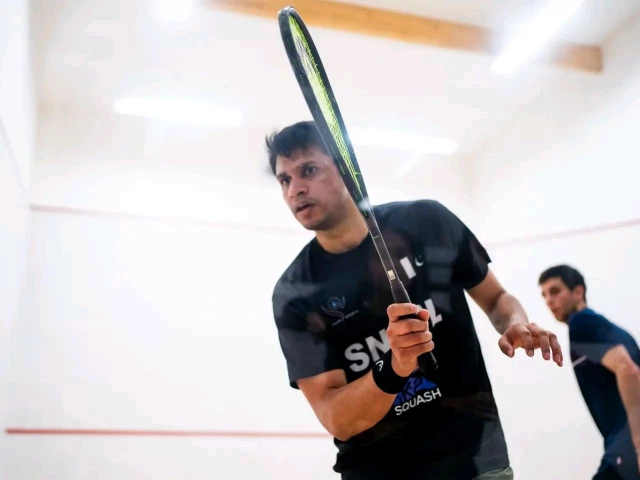
Pakistan’s rising squash star Muhammad Asim Khan delivered a stellar performance to clinch the title at the World Championship Qualifying Event–Asia, securing his place in the prestigious PSA World Championships 2026.
According to information made available by Pakistan Squash Federation here Saturday, Asim fought valiantly in a gripping five-game final against Malaysia’s Joachim Chuah, winning 3-2 after an intense 82-minute battle.
The match scores were 11-3, 13-11, 9-11, 3-11, 12-10, reflecting the high level of competition and resilience displayed by both players.
Asim started strongly, dominating the first two games with aggressive shot-making and precise control. However, Chuah staged a remarkable comeback, taking the next two games to level the contest. In the fifth game, Asim held his nerve to edge past his opponent in a nail-biting finish.
With this victory, Asim Khan has officially qualified for the PSA World Championships 2026, scheduled to be held in Giza, Egypt from May 8 to 16. The mega event will feature the world’s top squash players competing for a lucrative prize purse of $700,000.
Meanwhile, Pakistan’s Noor Zaman and Muhammad Ashab Irfan have already secured their berths in the global event owing to their impressive world rankings.


Source link

Illicit cigarette trade costs Rs300b annually

0
Illicit cigarette trade costs Rs300b annually


Weak enforcement measures against illegal manufacturing, smuggling fuel revenue gap


LAHORE:

Effective control over tax evasion in the tobacco sector can significantly reduce the revenue deficit and enable the government to better withstand internal and external economic pressures.

The evolving situation in the Middle East, coupled with the failure to meet tax targets, is putting a serious strain on Pakistan’s fiscal balance. On the one hand, the government is cutting development funds to provide fuel relief to the public and on the other, a shortfall of Rs185 billion in the March tax target is widening the budget deficit. To bridge this gap, the IMF is pushing for the withdrawal of tax exemptions, a move expected to increase the cost of doing business.

The Federal Board of Revenue (FBR) had been assigned a target of Rs1,367 billion for March; however, collections fell short by Rs185 billion, reaching Rs1,182 billion. Last year, the FBR collected Rs1,116 billion in March, requiring a 21% growth this year to meet the target, but only a 6% rise was recorded.

Meanwhile, significant cuts have been made to the development budget, including Rs22.3 billion for the National Highway Authority, Rs12.9 billion for water-sector projects, Rs10.2 billion for provincial schemes, Rs9.1 billion for the Power Division and Rs7 billion for Sustainable Development Goals (SDGs)-related projects, along with smaller reductions across other sectors.

“Amid rising fiscal pressure, the illegal cigarette trade is a major source of tax evasion, with more than Rs300 billion in annual revenue losses from non-duty-paid cigarettes,” said Osama Siddiqui, a macroeconomic analyst.

He added that curbing tax evasion in the tobacco sector could substantially reduce the revenue shortfall and help the government better manage both domestic and external economic challenges.

He emphasised that instead of repeatedly increasing direct or indirect taxes on consumers, the salaried class or already taxed sectors, the government should focus on targeted enforcement against illegal manufacturing and the smuggling of cigarettes, effective implementation of the track-and-trace system and strict monitoring at the retail level. Moreover, he said that eliminating tax evasion in the cigarette trade could not only provide fiscal space for public relief but also generate additional resources for development projects, playing a critical role in addressing current economic challenges.


Source link

Hamdard Pakistan celebrates 3rd Shaheed

0


The event reaffirmed Hamdard Pakistan’s pledge to drive national social growth, holistic health, and future prosperity

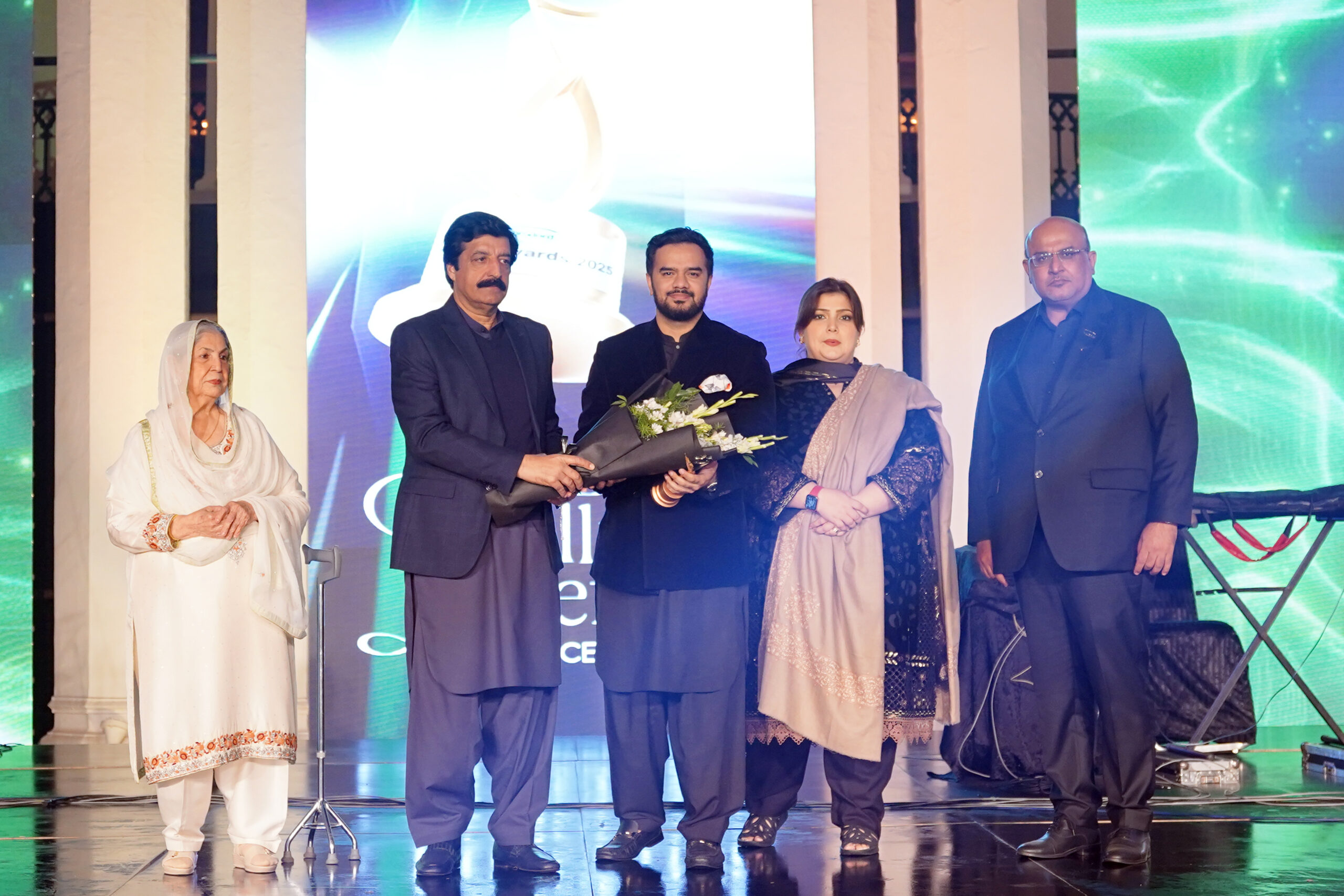
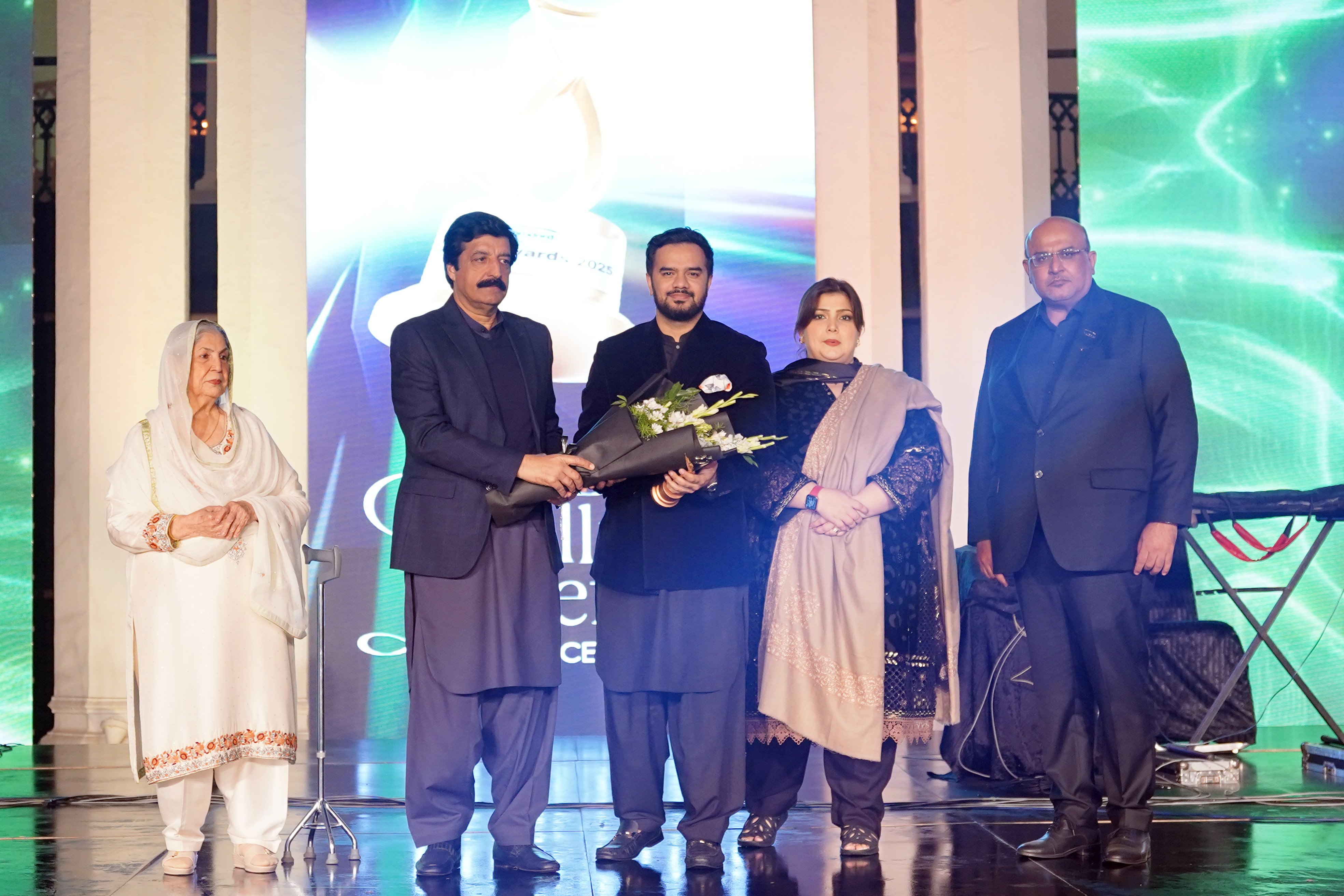
With more than 800 guests in attendance, Hamdard Pakistan recently hosted the 3rd Shaheed Hakim Mohammed Said Awards at the Governor’s House, Lahore.

Centred on the theme “Wellness Redefined,” the event celebrated visionary leaders who are actively shaping a brighter future for Pakistan through their contributions to health, education, and community development.

For the very first time, the awards were held in Lahore, reflecting Hamdard Pakistan’s expanding national footprint and its commitment to spotlighting excellence nationwide.

The evening was graced by His Excellency, the Governor of Punjab, Sardar Saleem Haider Khan as Chief Guest. In his address, the Governor highlighted the importance of celebrating those dedicated to knowledge, health, and community uplift, noting that Pakistan can only progress when the nation actively encourages and supports exceptional contributions.

Mrs Sadia Rashid, Chairperson, Hamdard Pakistan Group, in her remarks, connected the ceremony to the founding vision of Shaheed Hakim Mohammed Said. She explained how Hamdard was founded to be self-sustaining, funneling its earnings back into social welfare, education, and healthcare. By celebrating exceptional Pakistanis, she noted that the organisation is upholding its 70-year legacy of integrity and selfless service.

Ms Fatema Munir Ahmed, Managing Director & CEO, Hamdard Pakistan, shared key elements of Hamdard Pakistan’s ongoing transformation.

Her remarks focused on the organisation’s upgraded manufacturing infrastructure, its diversification from health, medicaments, and Rooh Afza drink syrup to beverages, foods and spices, including syrups, herbal drinks, cereals, dessert mixes, condiments and recipe mixes, as well as an enhanced retail presence and export readiness.

Ms Ahmed highlighted that Hamdard Pakistan continues to evolve under the theme “Wellness Redefined,” focusing on expanding the reach of premium wellbeing solutions to a broader audience on both a local and global scale.

Closing the formal addresses, Mr Faisal Nadeem Mangroria, COO, Hamdard Pakistan, thanked guests, dignitaries, media partners, and honourees, reiterating that Hamdard Pakistan’s mission will continue to expand through innovation and social impact.

Applauding excellence across all sectors

The awards began by spotlighting Education Excellence. Prof. Dr Muhammad Iqbal Choudhary was recognised for his pioneering contributions to biochemical research that have earned Pakistan international recognition. Dr Mariam Chughtai was also honoured for her leadership in modern education and academic reform.

In Sports Excellence, international sports champion Mr Arslan Ash received recognition for placing Pakistan on the global competitive gaming map. Squash Champions Ms Mahnoor, Ms Mehwish, and Ms Sehrish Ali were all honoured for their sporting achievements and for championing women’s participation in competitive sport.

Acknowledging the evolving landscape of modern influence, the Digital Influencer Awards were granted to Irfan Junejo and Muhammad Shiraz. Both creators were celebrated for their genuine storytelling and creative impact, which have helped foster more meaningful and positive engagement within the digital space.

Honouring exceptional valor, the Bravery Award was given to Mr Muhammad Ali Swati and Ms Syeda Shehrbano Naqvi—two individuals who redefined courage under fire for all Pakistanis.

In Health Excellence, Hakim Abdul Hannan was honoured for preserving Tibb-e-Unani and strengthening its relevance in contemporary healthcare. Dr Faisal Sultan received recognition for his leadership in modern medicine and national healthcare, particularly during periods of heightened medical need.

In the Leaders & Social Change Makers category, the 2025 Awards celebrated two pioneers of societal progress:

  • Ms Roshaneh Zafar was recognised for her transformative work in economic empowerment and expanding financial inclusion for women.
  • Mr Aslam Khaliq was honoured for his visionary leadership in embedding social responsibility within corporate structures; his daughter, Ms Shaista Khaliq, accepted the distinction in his stead.

In the realm of Journalism Excellence, the 3rd Shaheed Hakim Mohammed Said Awards celebrated Mr Mazhar Abbas for his steadfast adherence to ethical reporting. A posthumous honour was also granted to the visionary Mr Arshad Zuberi for his transformative role in nation-building, with the award being accepted by Mr Shahab Zuberi of the Business Recorder.

The Literature Award paid tribute to two giants of the craft: Ms Ghazi Salahuddin, who shared a moving message with the guests, and Ms Zehra Nigah, celebrated as a cornerstone of modern Urdu poetry.

Likewise, the Arts &Culture Excellence Award was given to Mr Tauqeer Nasir for his performance career and to Ms Samina Peerzada for her contributions both as a mentor and as an artist legend.

As the evening reached its emotional zenith, the Lifetime Achievement Awards were presented to Ms Seema Aziz for her work in education and social development, and to the late Mr Talat Hussain for his contributions to culture. The award was accepted on his behalf by his daughter, Ms Tazeen Hussain.


Official media partners Hum TV, Tamasha, MyCo, and Mera FM 107 helped extend the event’s reach. The ceremony concluded with a musical performance by Mr Shafqat Amanat Ali Khan, followed by dinner for award recipients and guests.

The Shaheed Hakim Mohammed Said Awards 2025 reaffirmed Hamdard Pakistan’s role as an organisation that channels commercial success into public wellbeing. With the theme “Wellness Redefined,” the evening hailed individuals redefining excellence and emphasised Hamdard’s continued commitment to Pakistan’s wellbeing, growth and future.


Source link

The year of conflicts and crises ends without resolution

0
The year of conflicts and crises ends without resolution


PUBLISHED
January 04, 2026


KARACHI:

It is the first weekend of 2026. The world wakes to a social-media post from Donald Trump, one year into his second term as president, claiming US forces have captured Venezuela’s Nicolás Maduro. A bold statement, delivered with the casual certainty of a post on Truth Social, it lands against a world already fraying at the edges.

Since Trump returned to the White House, the rules that once governed international power have been tested and bent. Laws meant to restrain leaders are applied selectively. Multilateral institutions struggle to assert influence. Meanwhile, wars that should have ended continue to cause death and destruction. In Gaza, a ceasefire the president called peace has collapsed repeatedly. In Ukraine, negotiations between Trump, Vladimir Putin and European capitals have yet to produce an end to the suffering that began in 2022. In Sudan, a brutal conflict continues, attracting far less international attention than its scale demands.

Accusations of war crimes hang over multiple leaders. Putin and Sudan’s Omar al-Bashir face international warrants and are treated as outlaws by the west. While Benjamin Netanyahu faces similar charges, he recently traveled freely over Italy and Greece to meet the US president at Mar-a-Lago, apparently without consequence.

The epitaph of 2025 is written not only in conflict and broken law. The world emerged from another UN climate summit in November that failed to commit to ending fossil fuels or even outline a credible plan to phase them out. Scientists report that 2025 was the hottest year on record, marked by unprecedented heatwaves and climate disasters. While leaders continue to dither and delay, nature is taking its own course, and none of us will escape its consequences.

The year ended with no relief in sight, and 2026 opens under the same shadow of unresolved crises—conflicts that refuse to end, leaders whose actions flout law, and a climate that grows ever more volatile. Experts say optimism is scarce, and nothing suggests relief is coming anytime soon.

Alongside wars and climate disasters, human rights face mounting pressure in 2026. Governments across the world, particularly in the global south, are leaning toward authoritarianism, tightening control over dissent and undermining democratic norms.

Amid a world of such encroachments and failing norms, Kenneth Roth argues that the demand for human rights remains strong. “People around the world continue to want their rights. No one wants to be executed or tortured, imprisoned for their political views, discriminated against, or deprived of housing, education, or healthcare. These are universal needs and desires.”

Roth cautions, however, that the system is under pressure. Authoritarian governments—China, Russia, Saudi Arabia, Egypt—and manipulated democracies such as Turkey, Hungary, and Pakistan are testing its limits. At the same time, Trump’s alignment with autocratic leaders reflects a broader pattern in which powerful states are emboldened to disregard democratic norms. “Yet, as mass protests in Iran and elsewhere show, people continue to demand democracy as the most reliable safeguard for their rights.”

Through it all, President Trump’s administration remains the single major unknown factor for 2026. Ashok Swain, a Sweden-based expert on international politics, conflict, and climate, argues that Trump’s election has further weakened the rules-based order by treating international norms as optional and transactional.

He adds that over the next three years, this approach is likely to reinforce a system in which power and loyalty matter more than law and consistency. Alliances, he notes, are pressured rather than strengthened — institutions are used instrumentally, and multilateral cooperation is viewed with suspicion.

According to Swain, a professor of peace and conflict at Uppsala University, this dynamic encourages other states to follow suit, accelerating a global shift away from shared rules toward ad hoc deals, unilateral actions, and coercive diplomacy. Even when framed as strength or realism, he warns, the long-term effect is greater instability and less predictability.

Conflicts and illusion of peace

The conflict in Gaza dominated the headlines over the past twelve months. More than 71,000 Palestinians were killed during Israel’s military assault on the Strip, which began in 2023 following a Hamas-led attack. A momentary ceasefire was announced by Trump, accompanied by a number of Middle Eastern and Western leaders. Praise from figures including Pakistan’s Prime Minister was lavish, seemingly intended to flatter the president, but on the ground the reality remained grim: more than 400 were killed in Gaza since the ceasefire was announced in late October, and over 1,000 were injured. Independent estimates suggest Israel has violated the ceasefire more than 500 times over the past two months.

Swain warns that the war-torn Palestinian enclave is likely to enter 2026 trapped in a familiar cycle of death and destruction. He notes that ceasefires, while announced with political fanfare, often fail to alter the underlying dynamics of the conflict. “What was presented in 2025 as a functioning ceasefire increasingly resembled a temporary pause without protection, allowing violence to continue under a different name,” he notes. Without accountability, Swain adds, such arrangements only freeze the conflict while suffering deepens. He emphasizes that a genuine and lasting peace would require an enforced ceasefire with independent monitoring, unrestricted humanitarian access, an end to large-scale territorial control and forced displacement, and a political settlement that restores Palestinian self-determination rather than treating Palestinians as a permanent security problem. Without these measures, he cautions, reconstruction will remain a cycle of destruction and repair, with no horizon of dignity or safety.
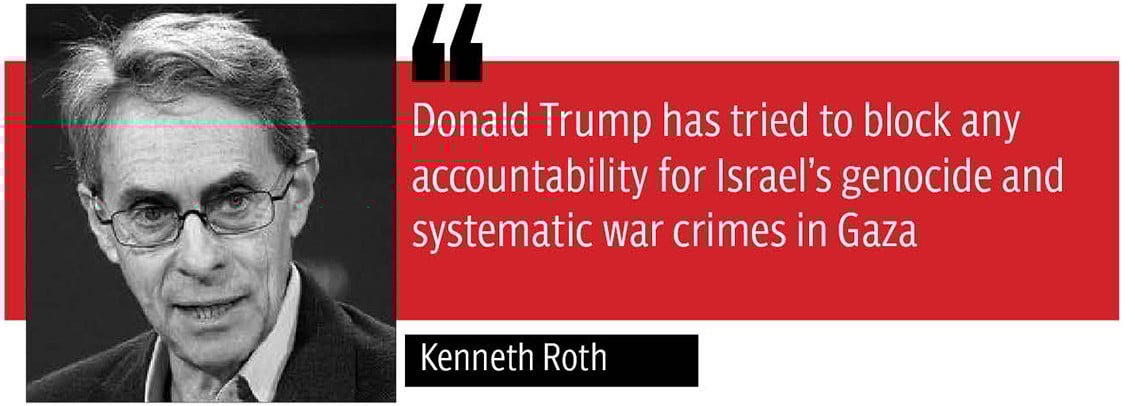
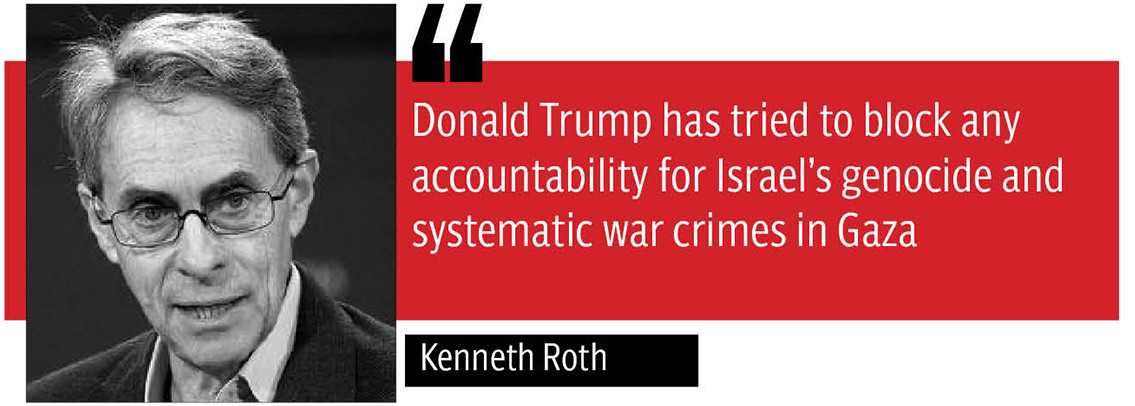
Roth observes that Trump has provided Israel with room to carry out atrocities without accountability. “The US president has attempted to block justice for alleged war crimes in Gaza, including by imposing sanctions on International Criminal Court prosecutors and judges.” Yet, he emphasizes, few governments have joined Trump in opposing accountability. Most ICC members, he explains, continue to back the court, and several governments supported South Africa’s genocide case against Israel before the International Court of Justice. “Strong condemnations have also come from the UN General Assembly and the UN Human Rights Council, though the UN Security Council has been blocked by the US veto.”

According to Roth, the broader global system remains resilient, as the vast majority of states continue to uphold norms, pursue accountability, and resist unilateral obstruction. That resilience appeared to be on display after Trump’s recent claim of attacking Caracas and taking Venezuela’s president into custody. Even a close ally such as the UK felt compelled to publicly distance itself, with Prime Minister Keir Starmer clarifying that Britain had no involvement in the operation.

When asked whether global responses, or inaction, have exposed the fragility of international law, Roth acknowledges that longstanding exceptions remain. He points to Israeli repression—its military actions in Gaza, apartheid policies across the occupied territories, and systematic repression of Palestinians—as a striking example where Western claims of promoting human rights have always been selective. At the same time, he notes, double standards persist elsewhere. “The European Union, for instance, largely overlooks severe repression in Egypt under President Sisi, motivated by his cooperation on migration control.”

In Gaza specifically, the former HRW executive director points out that the problem is not the ceasefire itself. Temporary pauses in fighting can be a necessary step toward a lasting peace, he notes. The real question is what comes after the ceasefire. “Trump’s abandoned vision for a “Gaza Riviera”—a Gaza without Palestinians—has been replaced with promises of reconstruction. Yet, other governments remain hesitant to contribute troops for stabilization or fund rebuilding efforts while the occupation continues. They insist on a pathway toward Palestinian statehood, a demand Israel refuses to meet.” Roth points out that this creates a tension: “although Trump’s peace plan references Palestinian self-determination, it is unclear whether he will apply sufficient pressure on Israel to turn those words into action.”

Elsewhere, the picture is no less complicated. In Ukraine, now approaching its fourth year of conflict, Trump’s approach has whiplashed traditional alliances, favoring a more conciliatory stance toward Vladimir Putin, who had been treated as a pariah by previous US administrations. The former HRW executive director notes that Trump initially sought to push Ukraine into accepting Putin’s maximalist demands—a move that would have left its democracy highly vulnerable to further Russian aggression. The former HRW executive director notes that the US president has not yet enforced the “severe consequences” he had promised for Russian intransigence.

In Sudan and eastern Congo, according to Roth, Trump was initially reluctant to publicly name the main perpetrators. “Only recently has his administration acknowledged Rwanda as the invading force in eastern Congo, and it continues to allude to—without explicitly naming—the United Arab Emirates’ role in arming Sudan’s genocidal Rapid Support Forces.” The former HRW executive director points out that these conflicts will not end without sustained international pressure on both Rwanda and the UAE.

The erosion and selective application of international law adds another layer to the crisis, Swain explains. The Sweden-based expert points out that inconsistent enforcement will make resolving ongoing conflicts even harder. When violations of international law continue unchecked and Western governments shield allies like Israel from consequences, he notes, the legal order does not collapse suddenly—it erodes quietly through hypocrisy. Law increasingly appears as a tool applied to adversaries while close partners enjoy exceptions. Swain warns that this encourages other states to ignore rulings they dislike, weakens international institutions, and reduces human rights to rhetoric rather than obligation. He emphasizes that reversing this trajectory will require consistent enforcement of the law, including against allies, with real consequences tied to arms transfers, sanctions, and diplomatic relations.
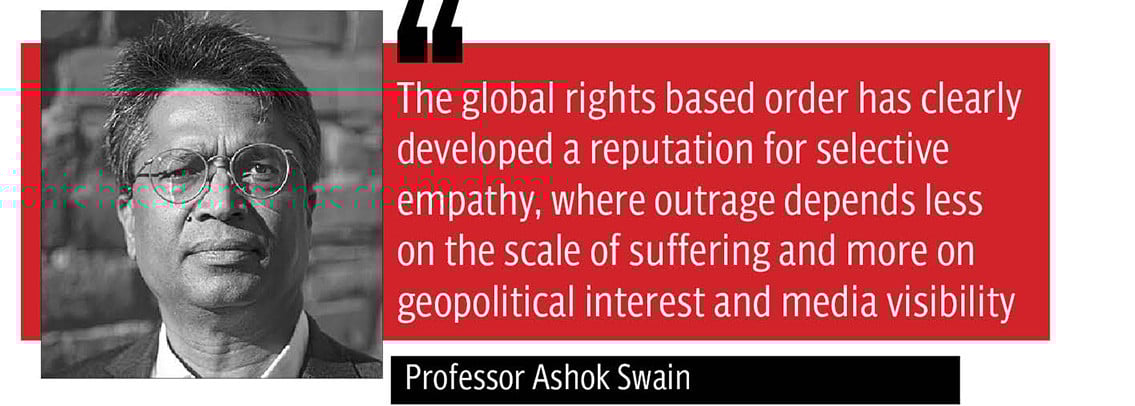
Sudan, the academic adds, illustrates the consequences of selective international attention. As the conflict dragged through 2025 with minimal sustained focus, mass displacement, famine, and systematic violence became normalized. By 2026, Swain warns, this neglect risks locking Sudan into prolonged state collapse with serious regional repercussions. He points out that the global rights-based order has developed a reputation for selective empathy, where outrage depends less on the scale of suffering and more on geopolitical interest and media visibility. Such selectivity, he argues, sends a dangerous signal: some lives appear to matter less than others, and extreme violence can continue with impunity when it occurs outside the spotlight.

The climate conundrum

The global environmental crisis accelerated sharply in 2025, with no shortage of climate-related tragedies and human suffering. Extreme weather events struck with alarming intensity, from deadly typhoons in the Philippines and Indonesia to devastating floods and heatwaves across India, Pakistan, Bangladesh, and Mexico. Record-breaking rainfall triggered landslides and mass displacements, while prolonged droughts worsened water scarcity and agricultural losses. Scientists confirmed that 2025 was the hottest year on record, breaking previous temperature highs and intensifying disasters tied to climate and ecological disruption. The relentless impact of human-driven emissions and environmental degradation has made it clear that nature’s wrath is impartial—no region, rich or poor, is immune.

Despite mounting evidence, global climate and environmental diplomacy once again fell short. The UN climate conference in Brazil toward the end of the year offered little more than lip service. Negotiations on emissions reductions, fossil fuel phase-outs, and broader environmental safeguards remained stuck in rhetoric, with delegates struggling to achieve meaningful commitments. Current trajectories suggest the world could exceed 2°C of warming between 2030 and 2050, with cascading consequences: severe food insecurity, intensified natural disasters, displacement, and threats to human survival and social stability.

Swain, who has recently authored a book on climate and conflict, points out that the summit failed to match the scale of the crisis. He notes that it “offered incremental progress while avoiding hard decisions on fossil fuels.” The Sweden-based expert cautions that the world is heading toward more extreme heat, floods, food insecurity, and climate-driven displacement, yet environmental crises continue to be treated politically as future problems rather than urgent realities. He adds that one of the greatest dangers lies not only in rising temperatures but in the political response: securitized borders, abandonment of vulnerable populations, and authoritarian measures justified in the name of stability.

For Swain, what will determine whether 2026 marks a turning point is decisive action rather than new promises. “Rapid fossil fuel reduction, massive investment in clean energy and adaptation, real climate finance delivered now, and a just transition that protects livelihoods—these are the measures that can align policy with reality. Without them, climate and environmental responses will continue to lag behind the urgency of the crisis, with profound consequences for humanity,” he concludes.

Neglect, trends, and looking ahead

While headlines often focused on conflicts and crises, several of last year’s most consequential human rights violations, Roth points out, went largely unnoticed.

“In Africa, the UAE-backed Rapid Support Forces continue to carry out out a genocide in Sudan, while the Rwandan-supported M23 inflicted slaughter and sexual violence in eastern Democratic Republic of Congo. Beyond the continent, China’s systematic persecution of Uyghur Muslims in Xinjiang continued unabated.” These atrocities, Roth notes, expose the depth of human suffering that too often escapes sustained international attention.

The former HRW executive director stresses that last year was less a rupture in the global order than an acceleration of existing trends. While violations were widespread, they were widely condemned, and some steps toward accountability were taken. “When there is crime on the street, we don’t call it the end of criminal law unless the crime is officially authorized,” he observes. “The same principle applies to human rights: abuses were never legitimized, but the year reinforced the urgent need to strengthen global pressure on those responsible.”

For the months to come, Roth warns that media coverage alone is insufficient. Crises in Gaza, Ukraine, and increasingly Sudan are known to the world, but the crucial task is sustained pressure on the perpetrators—Israel, Russia, and the United Arab Emirates—to halt their atrocities. Some progress has begun, he notes, but the year ahead demands an intensification of international commitments, ensuring that the most abusive governments are compelled to curb their actions. “Without decisive enforcement, human rights risks remaining a principle rather than a practice, perpetually vulnerable to impunity and selective attention,” he concludes.


Source link

Digital wallet relief payments begin: PM

0
Digital wallet relief payments begin: PM


Prime Minister Shehbaz Sharif has said that money saved through government austerity and simplicity measures will be spent on the public.

The premier chaired a meeting on Saturday to review petroleum reserves in the country and public relief measures amid recent regional tensions.

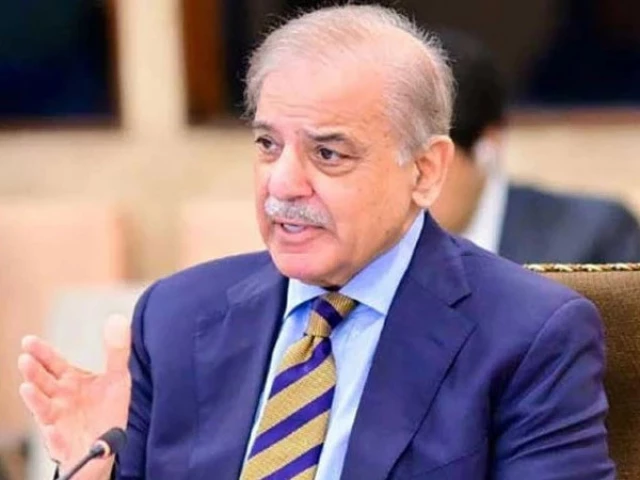
He said, "Provision of relief funds to public transport and freight vehicle operators through digital wallets has been initiated."

He added that, under an effective and transparent system, the digital transfer of subsidies to public transport buses and wagons, as well as goods transport trucks and freight vehicles, has begun.

He said, "We are striving to ensure that relief reaches economically weaker segments as soon as possible."

Sharif said, "We will not leave our people alone in difficult times."

He maintained that providing relief to the common man in challenging circumstances was the government's top priority.

The meeting apprised the Prime Minister of the progress in implementing public relief measures in view of the increase in petroleum product prices.

The briefing stated that there are adequate reserves of petroleum products available to meet the country's needs.

The meeting was also informed about progress in the implementation of public relief initiatives.

Federal ministers Dr Musadik Masood Malik, Attaullah Tarar, Ali Pervaiz Malik, Special Assistant Talha Burki and other senior officials attended the meeting.


Source link

The plight of the noble Aseel

0
The plight of the noble Aseel


The birds are facing extinction and have started disappearing from some provinces in India

Aseel rooster and chicken. SOURCE: AUTHOR

Pakistan is a diverse country; our languages, cultures, histories are all different, and nothing unites us except religion and, maybe to some extent living in the same country. However, one thing is shared: a string that will make people from Turbat come to Sindh or Punjab and share their collective love. It is a hobby that is common in urban and rural Pakistan, in all ethnicities and all linguistically distinct areas with the same passion: the keeping of gamecocks called Aseels, an Arabic word given to our local chicken breed, developed 2000 years ago. It is said that Emperor Akbar fell in love with Aseel chickens, and perhaps that influenced the breed’s standardisation and the name Aseel, which means pure and noble.


Game animals have always inspired awe and respect from their human keepers. Qualities they display are considered noble, be it war horses, extreme hunting dogs or gamecocks. They are incredibly docile and trusting towards their human companions, and they do not shy away from being handled. They are happy in any environment. They never back down from the fights, which is the main trait. The only trait that separates them from the rest of the chicken breeds and even many game chicken breeds developed elsewhere. In the old days, it inspired Mughal emperors and filled them with so much awe that they made it mandatory for their soldiers to watch cock fights, to show them how bravery is defined. These birds have a high pain threshold due to selective breeding over the span of thousands of years; stepping back, running away, or crying out in pain are disqualifying traits. Such cocks are then not bred further.


This ancient breed has its origins from the subcontinent, but the province of Punjab is considered their actual birthplace. Some local experts suggest that Aseel birds did not exist in Pakistan at the time of partition, and Pir Shah Alam Shah, who migrated from India to Mianwali, brought his birds and introduced this hobby in Pakistan. Attributing the entire hobby to a single person is distinctly and naively a Pakistani thing and probably untrue as it is shrouded in more myths than facts. These birds must have been here, but animal husbandry was restricted to financially stable households and families in the pre-partition era. Now the same hobby is considered as an activity for the lower class and associated with illiteracy. These stereotypes may not be entirely unfounded and untrue, but it does not mean that hobby itself is lowly. It is the illegal gambling and fight till death matches that are giving it a bad name. 


Aseel chickens have a rather gamey look with tall, muscular bodies and unmistakable aggression. Both roosters and hens display gameness and never back down. Even the newborn chicks instinctively start fighting and can kill each other. There are two main categories for which Aseels are bred: open spur and closed heel games. As the name suggests, open spur games, birds fight with their spurs intact, and in closed heel games, a spur glove is used. Aseels used in open spur games are lighter in weight and smaller in size, due to which they can be faster. In closed heel games, since birds cannot use their spurs, they have to rely on powerful punches and strong shanks thus they are bred for more weight and height. Mianwali is the hub of open spur birds in Pakistan, while in North Punjab and Sahiwal region, Aseels fight with closed heels or covered spurs.


Aseels’ sizes and colours vary greatly, depending on what lines they have been bred out of and what part of the country they belong to. They come in almost all colours; dark reds, light reds, black, speckled red, duckwings, pure whites, spangles, golden, blue, and grey. Usually, people think colours are also a marker for their breed but that is not true at all as breeds are not determined by colour, unless a line is specifically bred.


Though these birds are found in abundance in Pakistan, they are still facing extinction and have in fact started disappearing from some provinces in India. The Aseel’s eventual extinction will be a result of breeding the bird with imported gamecocks from Thailand, Japan, and Turkey. In my opinion, this is a form of interbreeding, as most these imported birds can probably be genetically traced back to the Aseels from Pakistan and India.


This is not the only threat to the Aseel, as most breeders now only want to win fights and do not really care for the purity of the bird’s breeding line. They thus breed birds that will fight in illegal pits. Heavy gambling and bragging rights further enhance the criminal element associated with cock fighting. There are certain breeders that are actually trying to preserve this noble breed of cocks and chickens but I can count them on one hand. Compared to thousands of breeders who are interbreeding, this number is abysmal. In the coming decades, we will not be able to find pure Pakistani Aseel if this trend continues.


Stigma and bad image associated with this hobby can only be countered if more people from diverse backgrounds and good education embrace it. The majesty and beauty of Aseel birds are matchless. Qualities they possess are rare, even in humans. Fighting them in pits is abhorrent and must be condemned. We should encourage people to keep them for ornamental purposes especially to save this breed from extinction.


Source link

On Easter, Pope Leo urges world leaders to end wars, renounce conquest

0
On Easter, Pope Leo urges world leaders to end wars, renounce conquest


Pope Leo XIV blesses the faithful at the end of the Easter Mass in St Peter’s Square at the Vatican on April 5, 2026. PHOTO: REUTERS

Pope Leo urged global leaders in his Easter message on Sunday to end the conflicts raging across the world and abandon any schemes for power, conquest, or domination.

The pope, who has emerged as an outspoken critic of the Iran war, lamented in a special message to the thousands gathered in St Peter’s Square that people “are growing accustomed to violence, resigning ourselves to it, and becoming indifferent”.

“Let those who have weapons lay them down!” the first United States pope exhorted. “Let those who have the power to unleash wars choose peace!”

Read: Pope Leo says God rejects prayers of leaders who wage wars

Leo did not mention any specific conflicts in the message, known as the “Urbi et Orbi” (to the city and the world) blessing. It was unusually brief and direct. The pope said that the story of Easter, when the Bible says Jesus rose from the dead three days after not resisting his execution by crucifixion, shows that Christ was “entirely nonviolent”.

“On this day of celebration, let us abandon every desire for conflict, domination, and power, and implore the Lord to grant his peace to a world ravaged by wars,” Leo urged.

Leo, who is known for choosing his words carefully, has been forcefully decrying the world’s violent conflicts in recent weeks and ramping up his criticism of the Iran war.

In an address on March 29, the pontiff had also said that God rejects the prayers of leaders who start wars and have “hands full of blood”. The pontiff called the Gulf conflict “atrocious” and said Jesus cannot be used to justify any wars.

Read More: Pope Leo condemns Gaza conditions in unusually direct Christmas sermon

In a sermon for the Easter vigil on Saturday night, he urged people not to feel numbed by the scope of the conflicts raging across the world but to work for peace. The pope made a rare direct appeal to US President Donald Trump ​on ⁠Tuesday, urging him to find an “off-ramp” to end the Iran war.

In his address from the balcony of St Peter’s Basilica on Sunday to the Square below, decorated with thousands of brightly coloured flowers for the holiday, Leo offered brief Easter greetings in ten languages, including Latin, Arabic and Chinese. The pope also announced he would return to the Basilica on April 11 to host a prayer vigil for peace.


Source link

Ronaldo scores twice on return

0
Ronaldo scores twice on return


RIYADH:

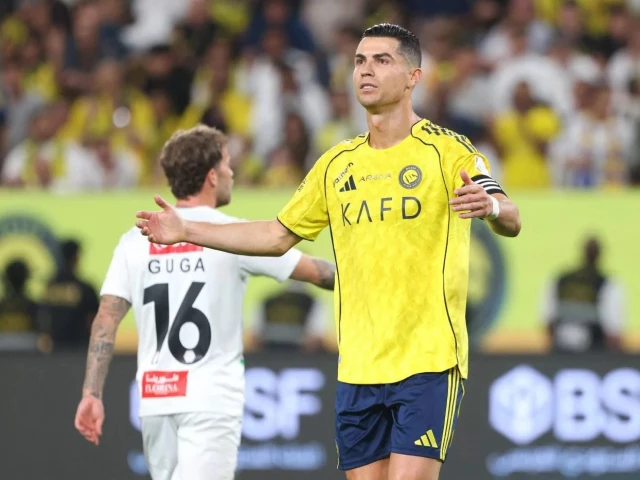
Cristiano Ronaldo marked his return from a month-long injury layoff by scoring twice in the second half as Al ‌Nassr maintained their winning run with a 5-2 victory over bottom side Al Najma in the Saudi Pro League on Friday.

The Portuguese forward, sidelined since February, had missed Al Nassr’s previous two ⁠league matches and was also ruled out of Portugal’s friendlies against Mexico and the United States last month.

Al Najma, who have won only once in 27 league games, took a surprise lead a minute before halftime through Rakan Al Tulayhi.

Al Nassr responded swiftly, with Abdullah Al Hamdan and Sadio Mane scoring ‌in ⁠first-half stoppage time to turn the match around.

The visitors drew level two minutes after the restart when Felippe Cardoso struck, but Al Nassr regained control when Ronaldo ⁠converted a penalty in the 56th minute.

The 41-year-old added his second in the 73rd minute before Mane sealed the ⁠win with a stoppage-time strike.

Earlier on Friday, Al-Ittihad claimed a 1-0 win at home against Al-Hazem despite having Moussa Diaby sent off after 34 minutes. Having been denied a penalty by VAR in the 66th minute, the reigning SPL champions took the lead six minutes later through Abdulrahman Al-Obud. Al-Ittihad now sit sixth in the table with 45 points from 27 matches. Al-Hazem are in 10th place with 31 points from the same number of matches.

In the day’s other match, Al-Kholood drew 2-2 with Khaleej Club with two first-half goals from Guga (9 minutes) and Abdulaziz Al-Elewai (37), the visitors’ first equalizer coming from a Konstantinos Fortounis penalty spot on 18 minutes. Khaleej grabbed a point thanks to a second leveller from Giorgos Masouras in the 85th minute.

The result leaves Al-Kholood in 14th place and Khaleej in 10th.

Al Nassr’s 13th consecutive league victory kept them top of the standings ⁠on 70 points, six clear of second-placed Al Hilal, who play Al Taawoun on Saturday. 


Source link