Home Blog Page 936

Pakistan questions UN experts over TTP presence in Afghanistan, cites multiple UN, int’l reports

0
Pakistan questions UN experts over TTP presence in Afghanistan, cites multiple UN, int’l reports


Islamabad refers to the 35th, 36th, 16th and 37th UN Security Council monitoring team reports

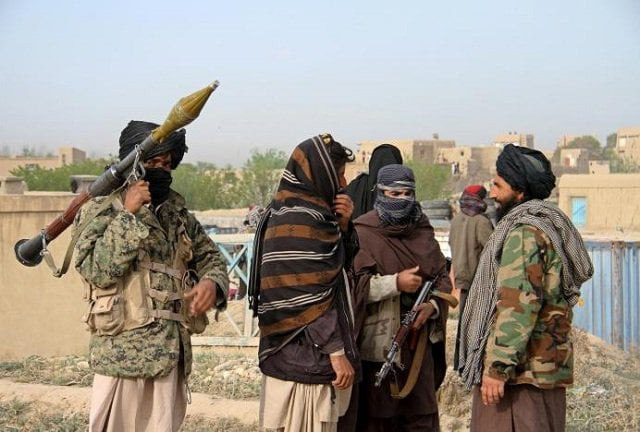
File photo of Tehreek-e-Taliban Pakistan militants. PHOTO: REUTERS

Pakistan on Sunday questioned the position of United Nations human rights experts regarding the lack of “credible evidence” linking the banned Tehreek-i-Taliban Pakistan (TTP) attacks to Afghan soil, pointing to multiple UN and international reports that documented the presence and activities of terrorist groups operating from Afghanistan.

Last month, the UN experts had urged Pakistan and Afghanistan to commit to a permanent ceasefire and had also claimed that Pakistan had not published credible evidence that TTP attacks within its territory were directed or controlled by the de facto Afghan authorities.

The experts had called on the parties to respect international human rights law and international humanitarian law, including the protection of civilians and civilian objects. They called for prompt, independent and transparent investigations of all alleged violations, accountability for perpetrators, and remedies for victims, in line with international standards.

Contrary to their position, Pakistan highlighted a contrast between the UN experts’ statement and established findings from various UN Security Council Monitoring Team reports and assessments consistently documenting TTP presence, safe havens and operational activity from Afghan soil.

Read More: 796 Afghan Taliban killed, 286 checkposts destroyed in Operation Ghazab Lil Haq so far: Tarar

Pakistan referred to the 35th, 36th, 16th and 37th UN Security Council monitoring team reports. It also cited the SIGAR 66th and 68th reports of January 2025. Additional references include the Russian MFA Military-Political Assessment of February 2026, the CSTO Security Assessment of 2026, the SCO Deliberations of September 2025, and the Quadrilateral Assessment by Russia, China and Iran in September 2025.

Pakistan further mentioned statements by the Danish ambassador at the UN Security Council in November 2025, Russia’s Security Council Secretary Sergei Shoigu in 2025, Russia’s UN Ambassador Vassily Nebenzia in 2025, and Russian Foreign Minister Sergei Lavrov in August 2025.

The said reports and assessments collectively highlighted Afghanistan as a hub for over 20 international terrorist organisations (ITOs), with 13,000–23,000 foreign terrorists, including more than 6,000 TTP fighters enjoying safe havens and operational freedom.

They also note continued Al-Qaeda presence and leadership regrouping, as well as active ISIL-K expansion.

The assessments document over 600 TTP attacks in Pakistan launched from Afghan soil, with the Afghan Taliban providing sanctuary, facilitation, and logistical support that enabled cross-border attacks and regional instability.

Pakistan questioned what additional evidence the UN human rights experts required, noting that multiple UN and international assessments already confirmed the presence of over 20 terrorist groups, thousands of foreign terrorists, and continued Taliban support to proxies operating from Afghan soil.

“Whether these findings are being ignored? Do they expect Pakistan’s leadership to go to Afghanistan and have photographs with TTP leaders like Hafiz Gul Bahadar and Mufti Noor Wali Mehsud?” a security analyst questioned.

Read More: Death toll reaches 50 in K-P as rain-related incidents devastate province

He also raised concern over the UN experts questioning the credibility of the very UN institutions tasked with monitoring, reporting and upholding international norms, maintaining that these established reports provided clear documentation of the threats originating from Afghan territory.

The 37th report by the Analytical Support and Sanctions Monitoring Team, dated February 4, said that attacks on Pakistan by the TTP from Afghanistan had increased, endorsing Islamabad’s long-running complaints about militant sanctuaries across the border.

The report not only endorsed Islamabad’s stance that Afghanistan had become a sanctuary for militants who used its territory to launch attacks on Pakistan, but also came at a time when the country is facing a renewed spate of violence.


Source link

PSX ends in red amid oil shock

0
PSX ends in red amid oil shock


Overall market participation was strong, as 1,066 million shares were traded with a total value of Rs. 49 billion. KEL led the volume chart, with 195.8 million shares..Photo: Express


KARACHI:

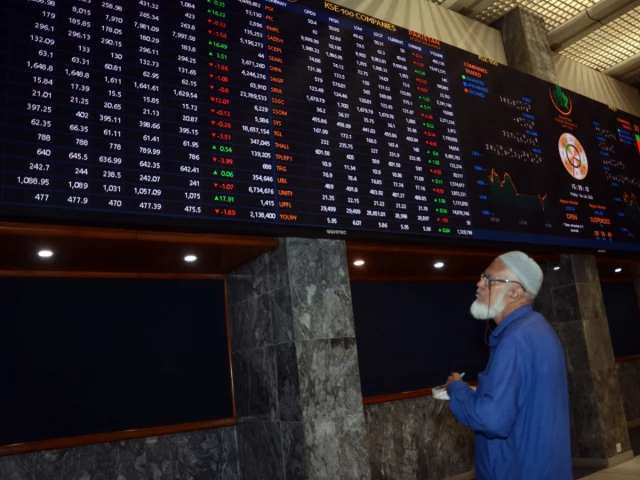
Pakistan’s stock market remained under pressure during the outgoing week as persistent geopolitical tensions and surging global oil prices kept investor sentiment fragile, leading to continued volatility at the bourse. The benchmark KSE-100 index closed at 150,399, posting a decline of 1,309 points, or 0.9% week-on-week.

On a day-on-day basis, the Pakistan Stock Exchange (PSX) commenced the week with a negative session as the KSE-100 declined by 4,865 points (-3.21%), settling at 146,843. However, the PSX witnessed a positive session on Tuesday, gaining 1,900 points (+1.29%) at 148,743.

On Wednesday, the index surged 6,768 points (+4.55%) to 155,512, decisively reclaiming the key psychological threshold of 150k. Nevertheless, on Thursday, the market surrendered part of its previous session’s gains, with the index falling 3,500 points (-2.25%) to close at 152,011. PSX continued its negative streak on Friday and lost a further 1,613 points (-1.06%) to settle at 150,399.

Arif Habib Limited (AHL), in its weekly commentary, stated that the KSE-100 index continued to experience volatility during the week amid geopolitical developments, resulting in persistent selling pressure. The index closed at 150,399, marking a modest decline of 0.9% WoW (1,309 points).

Among economic news, the Consumer Price Index (CPI) for Mar’26 rose 7.3% year-on-year (the highest since Aug’24), up from 7% in Feb’26. High-speed diesel (HSD) prices rose Rs184.9/litre to Rs520.35, while motor spirit went up Rs137.24/litre to Rs458.41. The price differential claim (PDC) on HSD (Rs203.88/litre) was removed and the petroleum levy was increased by Rs55.24. For 2QFY26, a GDP growth of 3.89% was reported, driven by industry (7.40%), agriculture (1.76%) and services (3.69%), AHL mentioned.

Trade deficit stood at $2.7 billion in Mar’26 as exports fell 14% YoY to $2.3 billion while imports declined 5.4% YoY to $5 billion. The T-bills’ auction raised Rs776.9 billion vs the target of Rs750 billion, with demand concentrated in one-month and three-month papers. Yields were mixed, where one-month (-29 basis points) and six-month (-3 basis points) bills declined while three-month (+29 basis points) and 12-month (+25 basis points) bills increased.

Pakistan’s public debt rose 1.1% to Rs81.4 trillion ($290.6 billion) in 1HFY26, with Rs55.4 trillion domestic (68%) and Rs26 trillion external (32%) debt. The Federal Board of Revenue (FBR) collected Rs1,185 billion (+8% YoY) in Mar’26, missing the target by Rs182 billion whereas 9MFY26 collection stood at Rs9,307 billion, short by Rs610 billion.

The State Bank-held reserves rose $6.2 million to $16.4 billion while commercial bank reserves increased by $47.8 million to $5.4 billion. Refinery offtake rose 13% YoY, led by HSD (+26.8%) and motor spirit (+25.1%) while production increased 13.9% YoY with utilisation at 58%.

Petroleum sales rose 19% YoY to 1.44 million tons in Mar’26 (ex-furnace oil +16.7%), with HSD +21%, motor spirit +16%, furnace oil +62% while 9MFY26 volumes grew 5% to 12.4 million tons. Cement dispatches increased 0.9% YoY to 3.74 million tons in Mar’26, driven by export growth despite weak local demand, while 9MFY26 dispatches grew 9.8% YoY, AHL added.

Syed Danyal Hussain of JS Global noted that the KSE-100 index remained volatile during the week, declining 1,309 points (0.9% WoW) amid escalating geopolitical tensions and persistently high Brent crude prices, which stayed above $100 per barrel throughout the week. On a positive note, Pakistan reached a staff-level agreement with the IMF on the third review under the Extended Fund Facility and the Resilience and Sustainability Facility, paving the way for a $1.2 billion tranche, subject to the IMF board approval.

Separately, the National Accounts Committee reported that Pakistan’s economy grew 3.9% YoY in 2QFY26, driven by a recovery in industrial output (+7.4%). Meanwhile, inflation clocked in at 7.3% YoY in Mar’26, the highest reading since August 2024, taking the average 9MFY26 inflation to 5.7%.

The FBR collected Rs1.2 trillion in taxes during March, falling short of its target by Rs182 billion, while cumulative collection in 9MFY26 reached Rs9.9 trillion, missing the target by Rs610 billion. The government finally passed through higher international oil prices by raising petrol and diesel rates by Rs137/litre and Rs184/litre, respectively, effectively ending the subsidy regime, Hussain said.


Source link

PTF junior tennis begins

0
PTF junior tennis begins


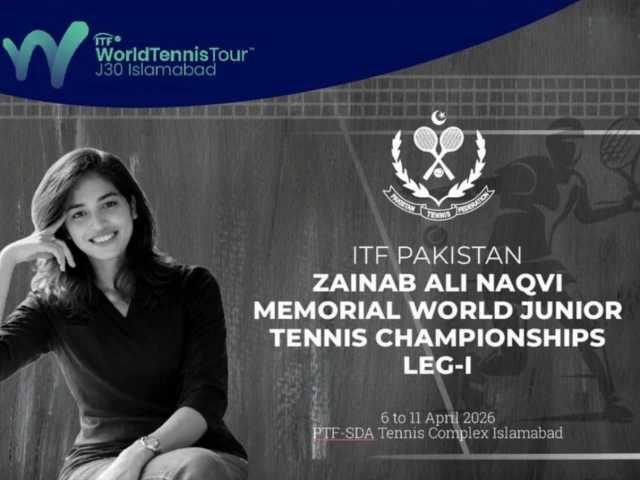
The Pakistan Tennis Federation (PTF) is set to host the ITF Pakistan 3rd Zainab Ali Naqvi Memorial World Juniors Tennis Championship 2026, which will begin on Monday at the PTF Tennis Complex in Islamabad.
A total of 39 young players – 24 boys and 15 girls – from 14 countries including Pakistan, Kazakhstan, Singapore, Japan, China, Australia, Russia, Poland, South Korea, Sri Lanka, Bangladesh, Malaysia, Hong Kong, and Thailand will compete in the week-long tournament.
The championship is dedicated to the memory of Zainab Ali Naqvi, a talented young tennis player from Karachi who died in February 2024 after suffering a heart attack during an ITF junior tournament in Islamabad. Officials said the event aims to honor her legacy and inspire emerging tennis talent in Pakistan and abroad.
PTF President Aisam-ul-Haq Qureshi, along with Secretary General Col. Zia-ud-Din Tufail, paid tribute to Zainab. “This championship is a meaningful way to keep her memory alive while providing international exposure for young players,” Qureshi said.
Matches for both boys’ and girls’ categories will commence at 10:00 a.m. on Monday. Organizers expect a high standard of play and said the tournament offers a platform for young athletes to showcase their skills against international competitors.
The PTF extended a warm welcome to all participants and expressed hope that the event would strengthen Pakistan’s role in junior international tennis. Fans and tennis enthusiasts are encouraged to attend the matches, which will run through the week and conclude with the final rounds.
The championship represents Pakistan’s continued commitment to fostering youth talent and hosting international-standard tennis events, while keeping alive the memory of a promising player whose life ended too soon.


Source link

Prophecy, politics & the poetic imagination

0
Prophecy, politics & the poetic imagination


PUBLISHED
August 17, 2025


KARACHI:

To wait for a saviour is to inhabit a paradox — where passivity masks longing, and hope suspends time. This condition resists easy categorisation: it is neither purely mystical nor wholly political, neither naïve faith nor mere deferral. At its core lies a fundamental tension between the unbearable present and an imagined horizon — one that promises not just change, but transformation. This horizon may be divine or secular, collective or intimate, abstract or vividly embodied. The figure awaited may never arrive; yet the act of waiting continues to shape our dreams, define our silences, and haunt the thresholds of our becoming.

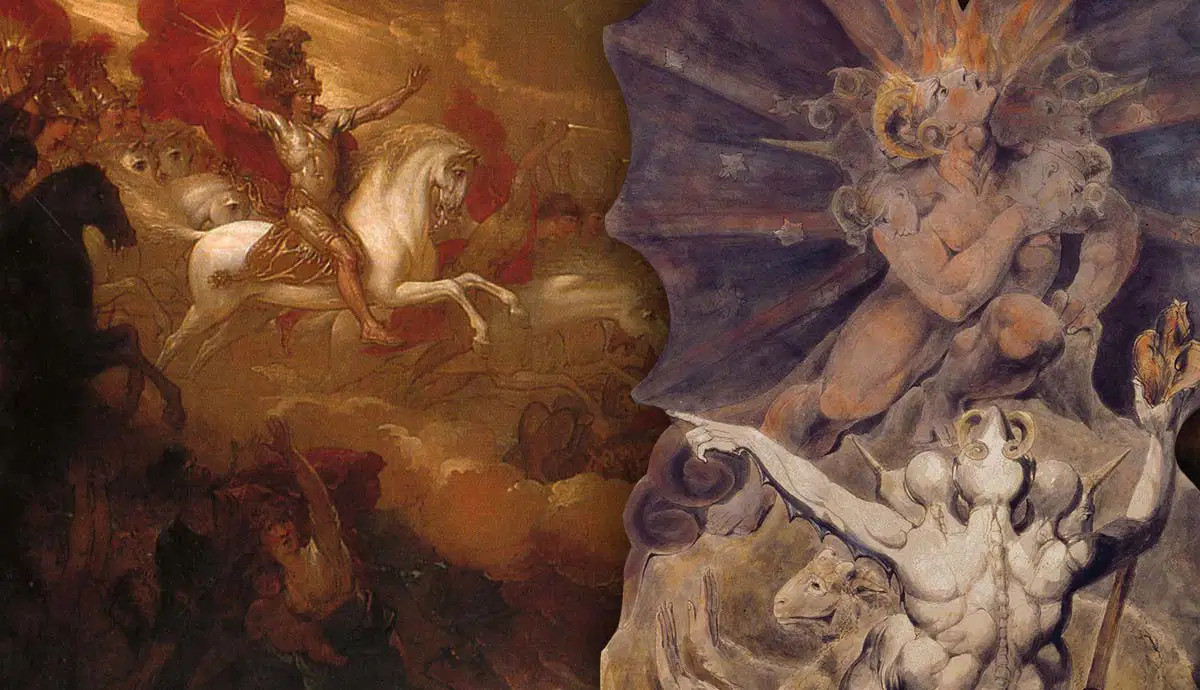
Walter Benjamin reminds us that “the Messiah comes not only as the redeemer, he comes as the subduer of Antichrist.” This duality — redeemer and destroyer — reveals the messianic figure as not just a bearer of peace, but a force of historical rupture. Benjamin further warns that even “the dead will not be safe from the enemy if he wins,” insisting that the task of hope is as much about redeeming the past as anticipating the future. Franz Kafka, with his paradoxical clarity, wrote: “The Messiah will come only when he is no longer necessary… on the very last day.” This deferral of arrival mirrors the way hope often remains just beyond reach. Yet Ernst Bloch distinguished between false hope that enervates and “concretely genuine hope” that fortifies the soul. And perhaps Che Guevara captured the ethical charge of such hope in its most radical form when he exhorted: “Be realistic, demand the impossible!”

Such waiting, then, is not a singular or static experience — it emerges from a web of human needs, histories, and narratives. Beneath its various forms lies a layered architecture of emotion, ideology, and belief. These dimensions may differ in their source or articulation, but they are all animated by the same inner ache: the yearning for another presence to enter the scene of absence, to alter the course of what seems unchangeable.

Psychological and existential need

Humans crave order, redemption, and meaning, especially in the face of suffering or chaos. Waiting for a saviour externalises hope — placing the burden of resolution onto another imagined presence. This impulse reflects a profound existential tension: the yearning to be rescued versus the terror of being ultimately alone and responsible for one’s salvation. The longing for an external saviour becomes a proxy for confronting internal fragmentation. It is not merely romanticism but an ontological hunger — a need deeply embedded in the very condition of being human.

Political and social function

Waiting for a redeemer often becomes a tool of ideology or control. It urges inaction in the face of injustice, whispering that change is always on the horizon but never in the moment. Political regimes and institutions have long exploited this impulse, urging citizens to wait for the revolution, the leader, the next election. The narrative of an impending saviour becomes a method of deferral — pushing justice, reform, or transformation into a nebulous future.

However, this same waiting can also mobilise resistance. The image of a coming change sustains hope, fortifies solidarity, and keeps oppressed communities enduring through pain. In some cases, the figure of the awaited one functions like a placeholder for collective will, anchoring revolutionary imagination. Thus, the messianic becomes double-edged: it can be opium that dulls or oxygen that sustains, depending on how it is interpreted and held.

Religious and mythic archetype

The awaited one emerges as a mythic constant across cultures and epochs. From Christ to the Mahdi, Maitreya to Kalki, traditions everywhere are haunted by the promise of a final redeemer. According to thinkers like Carl Jung and Mircea Eliade, such figures are not merely religious inventions but archetypes — expressions of the psyche’s deep longing for order, justice, and transcendence.

These messianic narratives are not passive fantasies. They are containers for moral and metaphysical longing — stories of balance restored, injustice defeated, harmony regained. In this sense, waiting becomes not inaction but ritualised hope. It is an embodied narrative structure, enacted in prayer, poetry, and political imagination alike.

Romanticism, yes — but in the Classical Sense

In the classical Romantic tradition, the act of waiting gains its own value. Romanticism privileged longing over fulfilment, the sublime over the rational, the journey over the destination. In this sense, waiting itself becomes meaningful — not merely as a means to an end, but as a state of heightened consciousness.

To wait is to be fully present in one’s yearning, to recognise the sacred in incompletion. The awaited one becomes less a solution and more a mirror, reflecting our deepest desires. Thus, the romanticism of the awaited figure is not naïve, but tragic-hopeful — a mode of enduring and meaning-making.

Modern critique

Modern philosophers and activists have mounted serious critiques of the saviour complex. Figures like Frantz Fanon, Jean-Paul Sartre, and Angela Davis have warned against waiting as a form of disempowerment. The mantra “we are the ones we’ve been waiting for” rejects the deferral of agency, insisting that change must emerge from the collective self, not an external redeemer.

Derrida’s concept of “the messianic without a messiah” captures this shift. It speaks to a radical openness toward the future — an ethical readiness to be transformed — without clinging to the image of a specific saviour. Here, the figure of the awaited one dissolves, but the impulse toward justice and change remains.

The Awaited One in literature

Literature has long been the hearth where mythic and philosophical flames burn together, where private longing and public history meet in the form of image, rhythm, and paradox. The figure of the awaited one — at once eschatological and existential — finds one of its most poignant and challenging expressions in the work of two poets: Forugh Farrokhzad and Jaun Elia. While earlier thinkers and poets such as Iqbal imagined the awaited one as a moral and spiritual imperative, Farrokhzad and Elia place the figure under the sharp lens of modern disillusionment, forging from their distinct poetics two radically divergent critiques of messianic hope.

In Farrokhzad’s poem “Someone Who Is Not Like Anyone” (kasi keh mesl-e hichkas nist), the awaited one is neither divine nor doctrinal. She frames her entire vision through the innocent but knowing eyes of a child. This child does not wait for a Mahdi or a Christ but for a figure of intimacy, dignity, and quiet transformation. The poem lists what this awaited one is not: he is not like the father, not like Yahya, not like the mother. In this series of negations, Farrokhzad destabilises traditional relational archetypes, refusing inherited roles.

Yet what emerges is not absence but potential — the awaited one, the poem insists, can do things no one else does. He can read hard words. He can subtract a thousand from twenty million. He can buy things on credit. He can distribute Pepsi and hospital numbers. These banal gestures shimmer with the poet’s genius: Farrokhzad displaces the messianic from the heavens to the street corner. The awaited one is neither supernatural nor victorious — he is the one who understands systems, who has access, who can navigate bureaucracies and basic needs.

The tone here is revolutionary in its restraint. There is no thunderclap of prophecy, no eschaton; instead, there is gentle insistence. Farrokhzad’s saviour is made from the materials of this world. The child’s imagination is not naïve — it is fiercely precise. Farrokhzad’s awaited one is, in essence, a dream of dignity reconstituted in the aftermath of social trauma. He is an ethical figure who has no miracle to perform other than restoring fractured dailiness. The poem, therefore, becomes a quiet theological coup: Farrokhzad trades metaphysics for material justice, but retains the sacred tone of longing.

Thus, Farrokhzad transforms absence into ethical imagination. Her awaited one may never arrive in a grand sense, but she dreams nonetheless — and through that dreaming, constructs a world worth saving. The tone is tender yet defiant, childlike yet visionary. She rejects messianic spectacle, but not the right to hope.

If Farrokhzad’s voice is the quiet reimagining of presence, Jaun Elia’s is the sardonic dirge for presence itself. In one of his most philosophically charged couplets, Elia writes:

Woh jo na āne wālā hai nā, us se mujh ko mat̤lab thā / Āne wāloṅ se kyā mat̤lab — āte haiṅ, āte hoṅge (That one who is not going to come — it was he that I cared about. / What do I have to do with those who come? They come; they will come.)

This line encapsulates Elia’s radical anti-messianism. The saviour is meaningful precisely because he is absent. The act of waiting becomes, in Elia’s hands, a psychological theatre of deferral — not because we believe in arrival, but because we need the illusion. The poet exposes a deep truth of the human condition: we attach value to what remains just out of reach. Arrival is banal; it closes the loop. Non-arrival sustains the myth, nourishes desire, and preserves the sublime distance between hope and its object.

Unlike Farrokhzad, whose tone holds pain and possibility in a kind of luminous suspension, Elia’s tone is irreverent, ironic, and often cruel. His awaited one is a spectre — conjured not from belief, but from absence. There is no tenderness, only razor-sharp scepticism. Where Farrokhzad seeks to repair the world through re-imagined hope, Elia seeks to unmask it — to show that our longing for salvation is often a refusal to face the emptiness of the present.

This is not to say that Elia lacks emotion — on the contrary, his poetry is saturated with loss, disillusionment, and intellectual despair. But he never gives this despair the crutch of transcendence. His awaited one never comes — and this non-arrival is not a disappointment, but a metaphysical condition. Elia’s messianic is an infinite postponement, a paradoxical affirmation of futility that becomes, strangely, a form of honesty.

Comparative reflection: two poetics of longing

Farrokhzad and Elia dramatise two radically different responses to the collapse of traditional messianic belief. Farrokhzad channels this collapse into a new ethics of presence — where waiting is infused with care, imagination, and earthly justice. She holds onto longing not as a weakness but as a radical act of reconstruction. Her awaited one is reconfigured through secular compassion.

Elia, by contrast, does not reconstruct; he demolishes. He does not offer an alternative saviour — he questions the very grammar of salvation. His tone is that of someone who has seen too much, who refuses to lie to himself. For Elia, the saviour matters only because he never arrives. His poetry is not about deferred redemption, but about the exposure of our dependence on deferral itself.

Together, these two voices — one Persian, one Urdu; one marked by hope, the other by irony — articulate the dialectic of modern waiting. Farrokhzad lifts the ruins of theology and builds small altars of kindness. Elia sets the ruins ablaze, revealing the absurd architecture of longing. Both, in their way, preserve the sacred tension between expectation and abandonment.

The Awaited as mirror

The awaited one, as seen through these poets, is not always a divine emissary. Sometimes he is a projection of our needs, a critique of those needs. Sometimes, he is a question we refuse to answer. In Farrokhzad’s poem, he is the soft silhouette of dignity glimpsed through the eyes of a war-scarred child. In Elia’s, he is the absent cypher of a longing that mocks itself even as it persists.

To wait, then, is not always to believe. It can be to imagine otherwise, to bear witness, to laugh, to resist. The awaited one becomes, in the end, not a saviour from without, but a mirror held up to our most persistent human condition: the hope that someone, somewhere, will make sense of it all.

And so, we wait — not for the end, but for the meaning forged in the act of waiting itself.


Aftab Husain is a Pakistan-born and Austria-based poet in Urdu and English. He teaches South Asian literature and culture at Vienna University

All facts and information are the sole responsibility of the author


Source link

Why 40,000 Karachi families refused the polio vaccine

0
Why 40,000 Karachi families refused the polio vaccine


Pakistan built a world-class Polio system. Then 40,000 Karachi families said no

Forty thousand Karachi families refused polio vaccines this year. In a city where the virus circulates through every district, those refusals represent the gap between Pakistan’s impressive polio infrastructure and its inability to close the final mile of eradication.

Pakistan has cut polio cases by more than 99.6% since 1994—from 20,000 annual cases to just 30 this year. It has built one of the world’s most extensive surveillance systems: 127 environmental sampling sites, 12,500 reporting locations, and campaigns that reach 45 million children. Two of three global poliovirus strains have been eliminated.

But Pakistan and Afghanistan remain the only countries where polio still circulates. And in 2024, the WPV1 strain resurged across 90 districts, forcing authorities to overhaul their approach with a “2-4-6 roadmap” under the National Emergency Action Plan.

“The last mile is actually very difficult to achieve,” said Dr Azra Pechuho, Sindh’s Minister of Health and Population Welfare, speaking at Aga Khan University on Friday. “It’s the small pockets we’re missing as the number of infected children is reducing.” A two-hour event brought together the top names in Polio from the WHO, Sindh government, federal government and AKU.

Environmental samples confirm what health officials already know: the virus persists in underserved communities that vaccination campaigns struggle to reach. Every district in Sindh shows ongoing transmission.

The 42,000 vaccine refusals across Sindh—40,000 of them in Karachi—reflect what Dr Azra calls “vaccination fatigue.” But Dr Sebastian Taylor from the Technical Advisory Group for Polio Eradication cautioned against assuming families refuse because of too many vaccines. Many refusals stem from lack of knowledge rather than vaccine overload, he said.

The WHO reports that authorities have narrowed the gap, reducing missed children from 1.48 million to 1.13 million. But low routine immunization coverage, vaccine hesitancy, and population movement continue leaving spaces where the virus survives.

South Khyber Pakhtunkhwa presents the most urgent challenge. “That’s where we need to do something really fast and really hard,” said Prof. Shahnaz Ibrahim, chair of the National Certification Committee, which annually determines whether Pakistan qualifies as polio-free.

The certification process requires three consecutive years with no cases and no environmental detection of the virus—and Pakistan cannot achieve it alone. “It has to be both Pakistan and Afghanistan as a unit,” Prof. Ibrahim explained.

The Prime Minister’s Focal Person for Polio Eradication, Ayesha Farooq, noted that WPV1’s genetic diversity is “increasingly squeezed,” meaning fewer chances of new strains emerging. Dr Azra said eradication remains achievable if Pakistan maintains focus during the upcoming low-transmission season.

“To the students today, you don’t have to study smallpox. It’s history,” said Aziz Memon, National Chair of Pakistan’s PolioPlus Committee. “Let us put polio in the books of history.”


Source link

Is Pakistan’s N-CPEC+ vision finally beginning to take shape?

0
Is Pakistan’s N-CPEC+ vision finally beginning to take shape?


Russian, Chinese, and Pakistani interests are all directly served through N-CPEC+

Prime Minister Imran Khan. PHOTO: AFP/FILE

Pakistan’s unique geostrategic location at the crossroads of East, South, West, and Central Asia enables it to function as the “Zipper of Eurasia”, as I wrote over half a decade ago in September 2015 for the Russian Institute of Strategic Studies. I built upon this observation in March 2019 to declare that the creative leveraging of the unprecedented trans-regional connectivity potential offered by CPEC enables Pakistan to become the Global Pivot State. This ambitious vision is finally beginning to take shape after Prime Minister Imran Khan and the Uzbekistani Minister of Transport agreed to pursue a trans-Afghan railway line on Wednesday.

I previously proposed such a corridor in my April 2019 debut analysis for CGTN about how “CPEC+ Is The Key To Achieving Regional Integration Goals”, which described the northern branch of CPEC through Afghanistan into Central Asia as N-CPEC+ (“N” referring to North). Eventually, this corridor could expand as far northwards as Russia to create a new North-South integration axis across Eurasia which aligns with President Putin’s vision for the Greater Eurasian Partnership (GEP) like I explained in an academic article that I co-authored over the summer that was republished by the prestigious Russian International Affairs Council (RIAC).

As Pakistan begins to take on a more prominent role in trans-Eurasian integration processes, its strategic importance to both China and Russia will continue to rise. Both Great Powers have a shared interest in the South Asian state fulfilling its destiny to unite the supercontinent through CPEC+. It’s only through this connectivity paradigm that a true Convergence of Civilisations can occur, like I explained in an analysis for CGTN in May 2019. The outcome of Eurasia’s diverse civilisations cooperating on trade and other forms of integration could powerfully discredit Huntington’s infamous prediction about a coming “Clash of Civilisations”.

Russian, Chinese, and Pakistani interests are all directly served through N-CPEC+. Moscow’s regional allies can become more internally stable as their economies grow upon securing access to the global markets that this corridor provides through the Indian Ocean, as could Russia’s resource-rich Siberian region. Beijing, meanwhile, will see its Pakistani-based CPEC investments put to use as a springboard for trans-continental integration processes and could also secure contracts to construct parts of its northern branch expansion as well. As for Islamabad, it would financially benefit by having its ports facilitate Central Asian trade with the wider world.

N-CPEC+ is therefore more than just a connectivity corridor, it’s a grand strategic concept for the future of intra-Eurasian relations in the emerging Multipolar World Order. Russia, China, and Pakistan are coming closer together as each country realises that they need the others in order to fulfill their shared vision of stability in the supercontinent. In fact, continued movement in this direction might even lead to the creation of a new multipolar trilateral between them to replace the stalled one between Russia-India-China (RIC). The end result could be that a Golden Ring rises between them, Iran, Turkey, and Azerbaijan in the Heartland of Eurasia.

To be clear, this won’t happen overnight, but the progress that was just made on agreeing to the Peshawar-Kabul-Mazar-e-Sharif trans-Afghan railway shows that the political will is certainly present to take this vision to its ultimate conclusion with time. Some formidable obstacles still remain, however, such as the unresolved conflict in Afghanistan and the efforts of external powers like India to sabotage this vision. There are also obvious questions of financing and other issues related to project implementation, as well as identifying which companies in the region and beyond are most eager to immediately tap into this project upon its completion.

Nevertheless, there are plenty of reasons to remain optimistic, especially since it’s becoming undeniable that Russia and China both appreciate the strategic significance of Pakistan’s N-CPEC+ initiative to their GEP and Belt & Road Initiative (BRI) respectively. In fact, as GEP and BRI continue to synergise their connectivity capabilities, their patron states are realising that N-CPEC+ is indispensable to the success of their joint vision for the supercontinent. This understanding is accelerating trilateral integration between them and therefore leading to one of the most exciting geopolitical developments of the 21st century thus far.


Source link

McIlroy seeks rare Masters repeat

0
McIlroy seeks rare Masters repeat


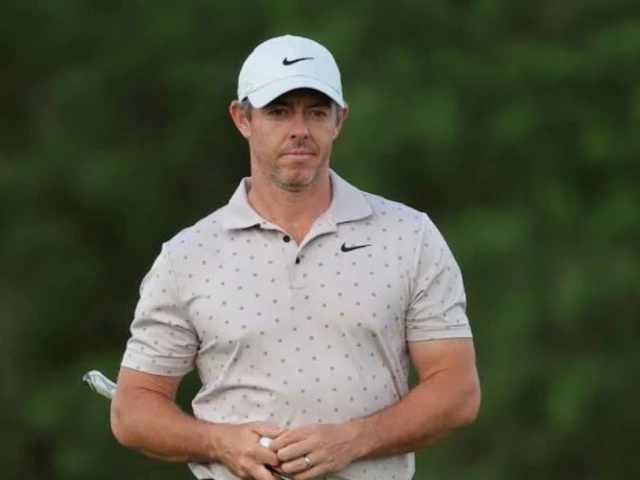
Rory McIlroy eyes rare back-to-back Masters title at Augusta after historic 2025 win. Photo: AFP/FILE


AUGUSTA:

Rory McIlroy, whose emotional 2025 Masters victory completed an incredible career grand slam, chases an even rarer feat this year — repeating as champion at Augusta National.

The 36-year-old from Northern Ireland hopes to join Tiger Woods, Jack Nicklaus and Nick Faldo as the only golfers to capture back-to-back green jackets when the 90th Masters tees off Thursday.
“I know defending the Masters tournament is a pretty rare feat, and it’s something I’d love to do.” McIlroy said.
“I’ve won it once and I feel like that will make it a bit easier for me to win again.”
McIlroy delivered an image for the ages when he fell to his knees last April after ending a 10-year major win drought by defeating Justin Rose in a playoff to win the Masters.

McIlroy joined a career grand slam group that also includes Nicklaus, Woods, Gary Player, Ben Hogan and Gene Sarazen.
Oddsmakers have made top-ranked Scottie Scheffler a slight favorite over world number two McIlroy, even though the defending champion said he has recovered from a back injury that forced him to withdraw last month at Bay Hill.
American Scheffler, a two-time Masters winner, took the American Express title in January and last year’s British Open and PGA Championship.
Scheffler, who withdrew from last month’s Houston Open as he and his wife are expecting their second child, is working on mental aspects of his game.
“My expectations all are based around what I want mentally,” Scheffler said. “So far throughout this season I’ve been really good in some spots and some other spots I feel like I can improve in terms of my commitment to the shot.”
Tiger Woods, a 15-time major winner, will not attend after pleading not guilty to DUI charges stemming from a March 27 car crash.
“I know and understand the seriousness of the situation I find myself in,” Woods said. “I am stepping away for a period of time to seek treatment and focus on my health.”
Masters chairman Fred Ridley and the PGA Tour supported the 15-time major winner’s decision.
Five Americans with multiple major titles seek their first green jacket — Justin Thomas, Bryson DeChambeau, Brooks Koepka, Xander Schauffele and Collin Morikawa, who withdrew from the PGA’s Texas Open with a sore back.
DeChambeau and Jon Rahm from LIV Golf also are fancied by oddsmakers. DeChambeau won titles last month in South Africa and Singapore while Rahm won in Hong Kong.
“I know I have to dial in my wedges. That’s going to be a big thing for me,” DeChambeau said when asked about the Masters.
“If I’m five more percent consistent, I have a better chance than what I did last year at the Masters.”
‘Probably going to win’
PGA Valspar Championship winner Matt Fitzpatrick was asked about Masters confidence after his first PGA title in almost three years.
“I’m probably going to win,” Fitzpatrick said with a laugh. “No, I mean, I’m obviously very confident in my game right now.
“But what it takes to win a major is very different to what it takes to win on the PGA Tour, particularly the Masters. There’s extra pressure on the Masters, no matter who you are. It just has that standing above all the other events, as well as the majors.”
England’s Fitzpatrick, the 2022 US Open winner, seeks a hot start at Augusta.
“There’s stuff I want to improve,” he said. “I want to make sure I’m ready for when I get to Augusta and to be ready that Thursday morning.”
Players Championship winner Cameron Young said winning at TPC Sawgrass was “the best prep you could ask for.”

“My goal is to be prepared to be playing late on Sunday at Augusta… it’s to be ready and comfortable when that moment comes.”


Source link

796 Afghan Taliban killed, 286 checkposts destroyed: Tarar

0
796 Afghan Taliban killed, 286 checkposts destroyed: Tarar


Information minister says 81 locations across Afghanistan targeted by air strikes

A Pakistani army soldier stands guard on a border terminal in Ghulam Khan, a town in North Waziristan, on the border between Pakistan and Afghanistan. Photo: AFP

Information Minister Attaullah Tarar said on Sunday that 796 Afghan Taliban operatives have been killed and more than 1,043 injured during the ongoing “Operation Ghazab Lil Haq“, launched in response to “unprovoked action” from across the Afghan border.

The operation resumed following a temporary pause in deference to Eidul Fitr celebrations and requests from Islamic countries. The pause concluded at midnight between March 23 and 24. The operation was launched over a month ago in retaliation for the Afghan Taliban forces’ firing on multiple locations. Islamabad said its February air strikes that sparked the escalation were targeting terrorists. Islamabad accused Afghanistan of failing to act against terrorist groups that carry out attacks in Pakistan, which the Taliban government rejected.

Providing a summary of the Afghan Taliban regime’s losses on his X account, the information minister said that 286 check posts had been destroyed and 44 others captured by Pakistani security forces.

“Two hundred and forty-nine tanks, armoured vehicles and artillery guns have also been destroyed during the operation,” he said.

Read More: K-P announces Rs2,000 fuel subsidy for bikers, rickshaw owners

The minister added that air strikes effectively targeted 81 locations across Afghanistan.

“As part of these operations on night 2/3 April, an attempt to physically attack a border post in Ghulam Khan Sector by Afghan Taliban/FAK (Fitna al-Khawarij) was comprehensively foiled in which they suffered heavy casualties, including up to 37 sent to hell and 80+ injured,” Tarar said.

China, which shares a western border with ​both nations, has been trying to mediate between ​the allies turned foes, holding telephone calls with ⁠their foreign ministers and sending a special envoy ​on visits in March.

It said on Friday that negotiations between the two were advancing steadily, following reports that ​the neighbours were meeting in China to ‌try to end their worst conflict since the Taliban returned to power in 2021.

“Both Pakistan and Afghanistan attach importance ​to, and welcome, China’s mediation, and are willing to sit down for talks again, which is a positive development,” foreign ministry ​spokesperson Mao Ning told a daily press conference.

The fighting ​between Pakistan and Afghanistan that started in October ​has ⁠killed scores of people on both sides, with Afghans taking the brunt.

Islamabad accuses the Afghan Taliban of harbouring ⁠militants ​who launch attacks in Pakistan, ​although Kabul denies this, calling the militancy its neighbour’s domestic problem.


Source link

‘No war surcharges on shipments’

0
‘No war surcharges on shipments’


Customs process 10 complaints as terminal operators agree to demurrage relief for export containers

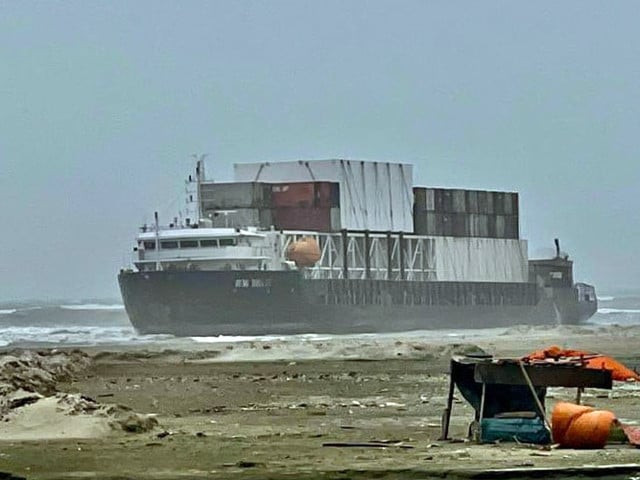
Hang Tong got stuck due to high sea waves and faulty engine while it was returning after offloading shipments at the Karachi port. PHOTO COURTESY: MMNEWS.TV


ISLAMABAD:

Federal Minister for Maritime Affairs Muhammad Junaid Anwar Chaudhry has said shipping agents assured that no war-related surcharges are being imposed on in-transit shipments or shipments on other routes.

Speaking at a high-level meeting addressing challenges faced by Pakistan’s importers and exporters, the minister highlighted proactive measures already in place, according to an official statement issued on Saturday.

Customs authorities have issued circulars urging traders to report any unjustified surcharges, with about 10 complaints processed to date. “This ensures accountability and protects our trading community,” Chaudhry said.

Key industry bodies, including the Pakistan Ship’s Agents Association and the All Pakistan Shipping Association, will release advisories directing members to refrain from charging retention fees on export containers stranded at ports. Additionally, terminal operators have agreed to offer relief on demurrage charges for export containers that arrived before March 3, 2026.

These steps form part of a broader government strategy to alleviate pressure on Pakistan’s ports amid persistent logistical hurdles. “We are coordinating closely with port authorities, customs officials and shipping stakeholders to streamline cargo movement and cut financial burdens on exporters,” Chaudhry stated.

Earlier this week, the minister directed port authorities to finalise and implement a comprehensive 30-day plan for shifting, auctioning and disposing of stuck-up containers and surplus materials to ease congestion at port terminals.

Chairing a sub-committee review meeting, the minister instructed authorities to transfer these items from on-dock areas to designated off-dock facilities within the timeframe. He stressed that port operations must remain seamless, ensuring domestic trade faces no disruption from transshipment cargo or stuck-up containers.

Noting the rising volume of transshipment cargo due to improved port performance and regional dynamics, Chaudhry called for a clear mechanism to shift it to off-dock terminals on defined commercial terms. “Pakistan must seize emerging regional opportunities by adopting a forward-looking framework to sustain and expand our ports’ potential,” he said.

Officials reported that stuck-up containers and surplus materials can be relocated to sites such as Sky Media Terminal, Al-Hamd Terminal, Northern Bypass and other off-dock facilities. The Federal Board of Revenue will permit shipping companies to remove and destroy abandoned containers per regulations.

Chaudhry asked the Karachi Port Trust to obtain detailed shifting plans from terminal operators and share them with the sub-committee and customs by the week’s end.

The meeting also discussed that customs will facilitate the auction of stuck-up containers within one month, while terminal operators dispose of surplus items such as wooden pallets and unused equipment in the same period. Rationalised reserve prices for mixed lots will speed up auctions.

The minister expressed confidence that these coordinated steps will sharply reduce congestion, support trade and boost maritime logistics efficiency.


Source link

Pegula reaches Charleston final

0
Pegula reaches Charleston final


MIAMI:

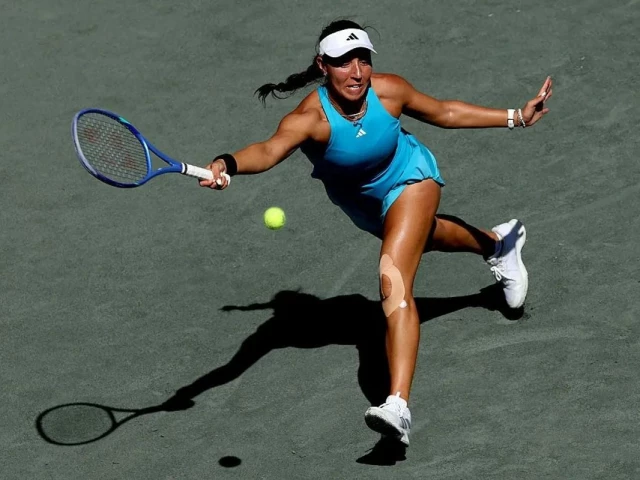
Defending champion Jessica Pegula advanced to the final of the WTA Charleston Open clay-court tournament on Saturday, defeating fourth seed Iva Jovic 6-4, 5-7, 6-3. 
American top seed Pegula, who has been taken to three sets in each of her four matches in Charleston this week, finally wrapped up victory in 2hr 35min when Jovic pulled a forehand return wide.
The 32-year-old from New York will face Yuliia Starodubtseva in Sunday’s final after the unseeded Ukrainian upset fifth seed Madison Keys in the other semi-final.
World number 89 Starodubtseva, who was initially scheduled to go through qualifying in Charleston before being granted a place in the main draw after a withdrawal, defeated Keys 6-1, 6-4.
World number five Pegula will be chasing her second title of the season on Sunday after her victory in Dubai in February.
The American admitted after Saturday’s latest three-setter that she has become used to taking the scenic route as she has advanced through the rounds in Charleston.
“When I won the first set today I thought ‘Oh man, I have such a great chance to not go to three’. I was like ‘Maybe I’ll get it done in two today’,” Pegula told the Tennis Channel.
“I’d love some straight sets victories — that would be nice. But a win’s a win. If I’m gonna win every match for the rest of my life, but it’s three sets, I’ll take the three sets.”
While Pegula will be targeting her second title of the year on Sunday, Starodubtseva will be aiming for the first of her career.
The 26-year-old Ukrainian punished Keys’s fragile service game to race through the first set in just 31 minutes, breaking the American four times to win 6-1, before clinching victory with another service break in the 10th game of the second set.
“I did not expect to break her that many times today,” Starodubtseva said. “I feel like I did quite well at neutralizing her power and just hitting a heavy ball back.
“I can’t really described my feelings right now. I may not have expected this outcome in this tournament but hard work pays off.” 


Source link