







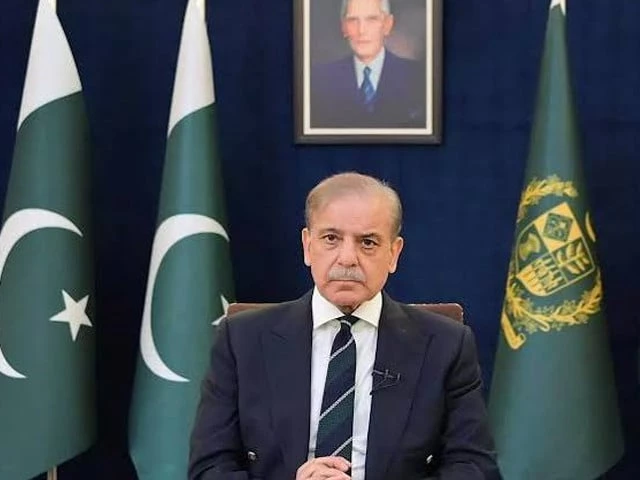
Prime Minister Shehbaz Sharif. PHOTO: FILE
Prime Minister Shehbaz Sharif on Thursday announced the electronic signing of the “Islamabad Memorandum of Understanding” between US President Donald Trump and Iranian President Masoud Pezeshkian.
In a post on X, he stated that “the Memorandum has been signed by honourable Presidents of both the countries and also endorsed by me as the mediator.”
I am honoured to announce that the historic ‘Islamabad Memorandum of Understanding’ has been electronically signed today between the United States of America and the Islamic Republic of Iran. The Memorandum has been signed by honourable Presidents of both the countries and also…
— Shehbaz Sharif (@CMShehbaz) June 18, 2026
He added that the memorandum would enter into force immediately and as a “first step, Islamic Republic of Iran will instantly reopen the Strait of Hormuz and the United States of America will immediately lift the naval blockade.”
He extended his congratulations to Trump and the US negotiating team comprised of Vice President JD Vance, Steve Witkoff and Jared Kushner, and extended his “profound respect and appreciation” to Iranian Supreme Leader Mojtaba Khamenei and Pezeshkian for “their wisdom, foresight and statesmanship in embracing the cause of peace.”
“I also wish to recognise the efforts of the Iranian negotiating team, including Mohammad Bagher Ghalibaf, Abbas Araghchi and Eskandar Momeni, whose patience, perseverance and commitment to constructive engagement were instrumental in bringing this agreement to fruition,” he added.
Shehbaz also acknowledged the efforts of Qatar, Saudi Arabia, Turkiye and Egypt for their contributions.
US and Iran presidents sign ceasefire agreement at Versailles
The US and Iran released the text of the Islamabad MoU that their presidents have signed to end their war on Wednesday.
Le Président Trump a signé ce soir à Versailles l’accord entre l’Iran et les États-Unis.
Cet accord ouvre la voie à une paix durable et permet la réouverture du détroit d’Ormuz.
C’est un pas important dans la bonne direction pour nos compatriotes… pic.twitter.com/b1XgZrBv0m
— Emmanuel Macron (@EmmanuelMacron) June 18, 2026
However, US President Donald Trump threatened to resume attacks and kill Iranian officials if they failed to honour their commitments.
Trump, attending the G7 with other leaders in France, also withdrew at least one of his stated rationales for attacking Iran in the first place, saying it would be “unfair” for Tehran not to have ballistic missiles, having previously vowed to obliterate them.
“We’re going to bomb the hell out of them if they violate the agreement,” Trump said of Iran at a press conference. “I don’t want them to. I want them to honour the agreement.” He also called Iranians “smart people” as US and Iranian negotiators work on a permanent truce over the coming 60 days, which Trump said he hoped would usher in peace in the Middle East and lower oil prices.
Read: Trump says Iran accord to be signed ‘shortly’, ‘maybe’ Thursday or Friday
Earlier, he had said: “If I don’t like it, if they don’t behave, we’ll go right back to dropping bombs right smack in the middle of their head, OK?”
Iran’s leaders did not address the new threats while celebrating the moment, releasing photographs of what is believed to be the first agreement signed by both a US and Iranian president since the Islamic Republic’s founding in 1979.
“Everything we sought to achieve through military action, we obtained several times over through negotiation; it was not even comparable,” Iran’s lead negotiator Mohammad Baqer Qalibaf told state television about the agreement, which includes the unfreezing of billions of dollars in Iranian assets.
The US and Israel launched the war on Iran on February 28, assassinating the 86-year-old Supreme Leader Ayatollah Ali Khamenei and military leaders on the first day. It quickly spiralled into a regional conflict that has killed more than 7,000 people, mostly in Iran and Lebanon; driven up energy prices; renewed inflationary pressures and sparked concerns about a major food supply crisis in developing countries.
The 14-point agreement extends a ceasefire announced in April by another 60 days, including in Lebanon, to allow the two sides to negotiate a final truce. Both Trump and Iranian President Masoud Pezeshkian have digitally signed the memorandum in English and Farsi, US and Iran officials said, with Iran’s foreign ministry saying the agreement was already in effect as of Wednesday.
Trump signed just before a grand dinner with French President Emmanuel Macron at the Palace of Versailles, the site of the signing of the eponymous treaty that formally ended World War One.
Iran’s President Dr. Pezeshkian and U.S. President Trump have BOTH Signed the MoU
At 00:00 Eastern time, U.S. sanctions on Iranian oil, gas, and petrochemical products will be lifted
HUGE: Sources are reporting that as part of the clause on non-interference in Iranian domestic… https://t.co/mHCQmNaLtI pic.twitter.com/6kn7If9h88
— Ryan Rozbiani (@RyanRozbiani) June 18, 2026
Trump also recanted his February promise to destroy all of Iran’s missiles and “raze their missile industry to the ground.”
“I’m saying that if other countries have them, it’s a little bit unfair for them not to have some,” Trump told reporters in Paris after leaving the summit.
“It’s signed.”
President Trump told reporters he signed the Iran memorandum of understanding in Versailles as he departed the palace following a dinner with French President Emmanuel Macron.
A White House official says a photo of the signed agreement was sent to Iran and the… pic.twitter.com/HVELS6RYVB
— Fox News (@FoxNews) June 17, 2026
Switzerland says talks planned for Friday between Iran and US
Initial talks between the United States and Iran are planned at the Buergenstock mountaintop resort in Switzerland on Friday, following the signing of a ceasefire agreement between Tehran and Washington, the Swiss government said on Thursday.
“As things stand, the plan is still for the US and Iran, along with mediators Pakistan and Qatar and other involved countries, to meet tomorrow at Buergenstock for initial negotiations about implementing the agreement.
“No further information is currently available regarding the schedule and details of this meeting,” the Swiss foreign ministry said in a statement.
G7 leaders welcome Iran deal
G7 leaders hailed the agreement at their summit, held in the French town of Evian-les-Bains, an hour’s drive along the shore of Lake Geneva from where the US has said a formal signing ceremony for the US-Iran agreement was due to be held across the Swiss border on Friday.
But Iranian foreign ministry spokesperson Esmaeil Baghaei cast doubt on this, telling IRIB’s News Network that, because the two presidents had already signed, “No signing ceremony will be held in Switzerland.”
European leaders share US concerns about Iran’s nuclear program, but never endorsed his decision to go to war without United Nations authorisation, and worry Iran has gained leverage by withstanding the superpower onslaught and asserting control over the strait.
The leaders of France, Germany, Britain, Japan, Italy, Canada and the US demanded in a joint statement an immediate ceasefire in Lebanon, where the memorandum calls for a halt to hostilities between Israel and the Iran-backed Hezbollah group that have killed thousands of people and displaced more than a million more.
Fighting there has abated but not ceased since the agreement was reached on Sunday, and Israel, which was not part of the negotiations and whose military is occupying southern Lebanon, says it retains the right to use force.
Iran says memorandum of understanding with US formally finalised after presidents sign text
Iranian Foreign Ministry spokesperson Esmail Baghaei said the “Islamabad memorandum” had become fully official after being signed by both Tehran and Washington, according to remarks carried by Iran’s semi-official Mehr News Agency.
Baghaei said the agreement would be signed digitally and confirmed that negotiations under the memorandum would focus exclusively on nuclear issues and sanctions relief.
He said the two sides would hold talks for up to 60 days, with the possibility of extending negotiations if necessary due to the complexity of the issues involved, but added that Tehran’s missile programme was off the table. “Iran’s missiles are only for firing, not for negotiation. Iran’s defence capabilities will not be discussed in any process with any party,” he said.
The spokesperson also said US commitments regarding the lifting of its naval blockade had effectively begun following urgent talks after Israeli attacks on Beirut’s southern suburbs and Iranian threats of retaliation.
He added that Iranian vessels had already entered and exited ports “without problems,” describing it as a sign that US commitments were beginning to take effect.
Baghaei said Iran’s commitments regarding the Strait of Hormuz would begin following the signing and implementation of the memorandum.
On Lebanon, Baghaei said Iran has shown it “does not abandon its friends” and that it was the US’s responsibility to compel Israel to respect commitments to Iran, as per Al Jazeera.
Baghaei added that Iran would not ship its stockpile of highly enriched uranium abroad and that dilution of the material was “introduced as an option to close the door on other possibilities”.
On the Strait of Hormuz, Baghaei said Iran will finalise a new regime to manage the waterway along with Oman and will “charge fees for services” there.
Iran releases 14-point draft agreement outlining US deal
IRNA on Wednesday published the text of an Islamabad memorandum of understanding between Iran and the US that outlines a roadmap to end their military conflict and negotiate a final agreement.
Below is the 14-point document released by Tehran:
- The Islamic Republic of Iran, the United States of America, and their respective allies in the current war, by signing this memorandum of understanding, declare the immediate and permanent cessation of military operations on all fronts, including in Lebanon. They commit not to initiate any war or military operation against one another in the future, to refrain from the threat or use of force against each other, and to guarantee Lebanon’s territorial integrity and sovereignty. The final agreement will confirm the permanent end of the war on all fronts, including in Lebanon, and the remaining provisions of this clause.
- Iran and the United States commit to respecting each other’s sovereignty and territorial integrity and to refraining from interference in each other’s internal affairs.
- Iran and the United States commit to conducting negotiations and reaching a final agreement within a maximum of 60 days, extendable by mutual consent.
- Immediately upon signing this memorandum, the United States will begin lifting its naval blockade and any harassment or obstruction directed against Iran and will completely terminate the blockade within 30 days. During this period, maritime traffic will be maintained at levels corresponding to pre-war traffic as restored by Iran. The United States also commits to withdrawing its military forces from the area surrounding Iran within 30 days of a final agreement.
- Upon signing this memorandum, Iran will make its utmost efforts to ensure the safe passage of commercial vessels, free of charge for 60 days, between the Persian Gulf and the Gulf of Oman. Commercial shipping will resume immediately and, subject to the removal of technical and military obstacles and mine-clearing operations by Iran, will be fully restored within 30 days. Iran will hold discussions with the Sultanate of Oman regarding the future administration and maritime services of the Strait of Hormuz in accordance with applicable international law and the sovereign rights of the littoral states, and will also consult with other Gulf littoral states.
- The United States commits, together with its regional partners, to establish an agreed program providing at least $300 billion for Iran’s reconstruction and economic development. The implementation mechanism for this program will be finalised within 60 days as part of the final agreement. The United States will provide all necessary approvals, waivers, and licenses for related financial transactions.
- The United States commits to ending all sanctions against Iran, including those stemming from UN Security Council resolutions, resolutions of the International Atomic Energy Agency Board of Governors, and all US unilateral sanctions, both primary and secondary, according to a mutually agreed timetable as part of the final agreement. Both sides acknowledge the fundamental importance of sanctions relief and express their intention to address the issue promptly during negotiations.
- Iran reaffirms that it will neither produce nor acquire nuclear weapons. Iran and the United States agree to resolve the status of stored enriched materials through a mutually agreed mechanism and in accordance with the timetable set out in Clause 7, at a minimum through on-site dilution under IAEA supervision. The parties also agree to discuss enrichment and other mutually agreed nuclear issues related to Iran’s nuclear needs within a satisfactory framework to be established in the final agreement. The final agreement will confirm the provisions of this clause. Both sides recognise the fundamental importance of these nuclear issues and intend to address them promptly in negotiations.
- Iran and the United States agree to maintain the status quo until a final agreement is reached. Iran will maintain the current status of its nuclear program, while the United States will impose no new sanctions on Iran and will not deploy additional military forces to the region.
- The United States commits, immediately upon signing this memorandum and until sanctions are terminated, to issue Treasury Department waivers for the export of Iranian crude oil, petrochemical products and derivatives, and all related services, including banking transactions, insurance, transportation, and other associated activities.
- The United States commits to making all restricted or frozen Iranian funds and assets fully available for use upon implementation of this memorandum. The two sides will agree bilaterally on the procedures for releasing these funds during negotiations. Whether the funds remain in their original accounts or are transferred, they must be fully usable for payments to any final beneficiary designated by the Central Bank of Iran. The United States commits to issuing all necessary approvals and licenses in this regard.
- Iran and the United States agree to establish an implementation mechanism to monitor the successful execution of this memorandum and future compliance with the final agreement.
- Following the signing of this memorandum, and subject to the commencement and continuation of implementation of Clauses 1, 4, 5, 10, and 11, Iran and the United States will begin negotiations on a final agreement exclusively concerning the remaining clauses.
- The final agreement will be endorsed by a binding resolution of the United Nations Security Council
Netanyahu rejects ceasefire deal
Israeli Prime Minister Benjamin Netanyahu has distanced Israel from the US-Iran agreement over his tactics in Lebanon against Hezbollah. The two men have repeatedly clashed over Israel’s refusal to constrain its pursuit of Hezbollah in Lebanon, where a cessation of hostilities is a key Iranian demand.
Trump told reporters regarding Netanyahu that, “You don’t have to knock down a building every time somebody walks into it that’s from Hezbollah.”
Lebanese state media reported fresh Israeli air strikes and artillery fire in several southern towns throughout Wednesday. Lebanese security sources said Hezbollah had also launched two drone attacks on Israeli forces in the south. The group did not publicly claim the attacks.
Israel later said five of its soldiers had been injured in two Hezbollah drone attacks in southern Lebanon.
Israeli soldier killed by ‘Hezbollah explosive device’
The Times of Israel, citing an “Israeli military investigation”, is saying that a soldier killed in southern Lebanon died in a blast from a Hezbollah explosive device, according to Al Jazeera.
It said the attack took place at 5pm (19:00 PKT) on Wednesday as a group of soldiers from the Israeli military’s 36th Division were walking along the Litani River. The attack killed 29-year-old combat soldier Alexander Filin and injured seven other soldiers, according to the military.