





G-B caretaker information minister urges citizens to vote, hopes polls boost development and prosperity
ISLAMABAD:
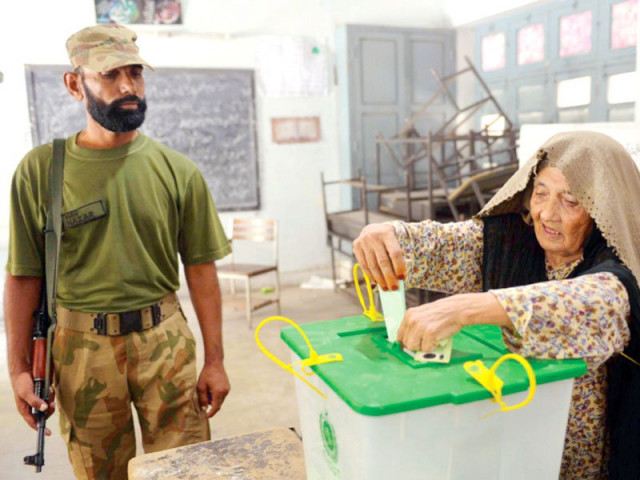
Voting is underway on Sunday in the 2026 Gilgit-Baltistan (G-B) Legislative Assembly elections, with more than 958,000 registered voters expected to cast their ballots across 24 constituencies.
Polling will be held from 8am to 5pm, with 13 seats required to form the next government in the strategically important region. It has begun at 1,691 polling stations, with more than 7,500 polling staff deployed. A total of 130 candidates from 24 political parties and 266 independent candidates are contesting the elections.
The G-B Assembly comprises 33 seats, including 24 elected through direct elections, 6 reserved for women, and 3 reserved for technocrats and professionals. Reserved seats are allocated to political parties based on proportional representation.
G-B’s caretaker Information Minister Ghulam Abbas said polling had begun peacefully across the region, with a large number of voters exercising their right to vote.
He said the caretaker government and the Election Commission had made comprehensive security arrangements, with personnel from the police, Rangers, Gilgit-Baltistan Scouts, and the Pakistan Army deployed at sensitive locations.
Ghulam Abbas urged citizens to come out and vote, expressing hope that the electoral process would contribute to the continued development and prosperity of G-B.
Chief Election Commissioner
Meanwhile, Chief Election Commissioner Raja Shahbaz Khan visited several polling stations in Gilgit, accompanied by Provincial Election Commissioner Abid Raza, to review polling arrangements, security measures, and the overall electoral environment.
During visits to polling stations at Jutial Elementary College and Khomar City Park, the chief election commissioner expressed satisfaction with the arrangements and directed polling staff and security personnel to ensure neutrality, transparency, and the smooth conduct of the voting process.
Election officials said voter turnout was steady, although long queues of male and female voters formed outside several polling stations. Some voters complained of delays and a slow polling process. Raja Shahbaz Khan took notice of the complaints and sought reports from relevant officials.
The chief election commissioner also inspected facilities available to voters and met polling agents representing candidates. According to election officials, polling agents expressed satisfaction with the peaceful atmosphere and arrangements at polling stations.
Read: 24 seats up for grabs as G-B goes to polls today
As part of his review of security preparations, Khan visited the Gilgit Safe City Control Centre, where he was briefed on security measures and monitoring arrangements. Officials informed him that election-related activities were being continuously monitored through a modern surveillance system.
The inspector general of police and other officials briefed the chief election commissioner on the security plan and special measures put in place for election day.
Speaking during the visit, Raja Shehbaz Khan said all available resources were being utilised to ensure free, fair, peaceful and transparent elections. He also praised the performance of the district administration and law-enforcement agencies and urged voters to participate fully in the democratic process while helping maintain a peaceful environment.
Section 144
In Diamer district, authorities imposed Section 144 of the Criminal Procedure Code for 60 days to maintain law and order. A notification issued by Deputy Commissioner Lt (retd) Muhammad Owais banned the public display of weapons, aerial firing, the use of firecrackers, and the unauthorised operation of drones and unmanned aerial vehicles (UAVs).
The order, effective from June 5, requires prior approval from the district magistrate for drone operations. Law enforcement agencies have been exempted from the restrictions. Officials warned that strict legal action would be taken against violators.
With polling preparations complete, a total of 551 polling stations, of 1,391, were declared highly sensitive, 349 were categorised as sensitive, and 488 fell under the normal category.
Security arrangements were made at the polling stations according to their category.
Of Gilgit’s 253 polling stations, 154 were declared highly sensitive, 48 were categorised as sensitive, and 51 as normal. In Ghizer, of 207 stations, 69 were declared highly sensitive, 52 sensitive, and 83 normal.
Of Nagar’s 85 polling stations, 18 were declared highly sensitive, 39 sensitive, and 28 normal, while 24 of Hunza’s 88 polling stations were categorised as highly sensitive, 31 as sensitive, and 33 as normal.
In Skardu, out of 208 polling stations, 69 were declared highly sensitive, 51 sensitive, and 88 normal. Of Shigar’s 71 stations, 17 were said to be highly sensitive, 23 sensitive, and 31 normal, while in Kharmang, out of 43 polling stations, 21 were declared highly sensitive, 10 sensitive, and 12 normal.
Similarly, of Ghanche’s 154 polling stations, 26 were categorised as highly sensitive, 39 as sensitive, and 89 as normal, while of 108 polling stations in Astore, 34 were declared highly sensitive, 34 sensitive, and 40 normal.
Finally, of Diamer’s 174 polling stations, 119 were declared highly sensitive, 22 sensitive, and 33 normal.
Security
Security arrangements have been significantly enhanced across the region. Punjab Police personnel have arrived in Gilgit-Baltistan to assist local authorities, including a deployment of 5,000 officers for election security duties.
Read More: Security tightened in G-B as Section 144 imposed in Diamer ahead of polls
In the Shigar district, 350 Punjab Police personnel will work alongside local police and other law enforcement agencies.
An additional 150 Islamabad Capital Territory Police officers — drawn from sensitive postings including the President’s House, PM House, and Foreign Office security detail — have also been assigned election duty and are set to depart for G-B on Thursday, returning on June 9.
Campaign
The election campaign has unfolded in a politically uneven environment. While the PPP maintained a sustained and highly visible presence across Gilgit-Baltistan, the PTI’s central leadership was largely absent from the campaign trail. PTI leaders alleged that the party faced restrictions on holding rallies and public meetings, hampering its ability to campaign freely. The conditions tilted the electoral contest in favour of the traditional mainstream parties, particularly the PPP and PML-N, which emerged as the dominant players in the campaign.
Pakistan Peoples Party Chairman Bilawal Bhutto-Zardari was among the most active leaders on the campaign trail, covering ground extensively across the region. He had called for G-B to be granted the same constitutional rights and powers available to the provinces under the 18th Amendment, arguing this is the only path to the region’s people having genuine ownership of their resources.
The Istehkam-e-Pakistan Party (IPP) was the newest entrant to the political landscape, launching its campaign in the region about 10 weeks before the elections. Taking advantage of the reduced political space for the PTI, the party managed to recruit several prominent political heavyweights and quickly establish a presence in the contest.
Led by Federal Minister for Communications Abdul Aleem Khan, the IPP sought to attract voters with pledges of infrastructure development, expressing confidence that its development-focused agenda would translate into seats in the assembly.
The PPP was further aided by dissatisfaction among sections of the electorate with the PML-N-led government over its response to protests that turned deadly in the wake of the killing of Iran’s supreme leader.
Political observers believe the situation enabled the PPP to shape much of the campaign narrative ahead of polling day.
PML-N had deployed senior leadership on the ground, with Rafique, Khurram Dastgir Khan, and Abid Sher Ali leading rallies across multiple districts. Federal ministers Attaullah Tarar and Amir Muqam have also been active on the trail. Party president Nawaz Sharif addressed a rally earlier this week, pledging infrastructure, aviation, and energy projects for the region and promising to raise G-B’s concerns with Prime Minister Shehbaz Sharif.
Pakistan Tehreek-e-Insaf, on the other hand, had alleged it is operating under significant restrictions, with its election symbol removed and leaders like Asad Qaiser reportedly stopped from travelling to the region. Chairman Barrister Gohar Ali Khan maintained that the party would continue its campaign despite these constraints.