
Security official says 400kg stockpile is off table as Trump demands it be destroyed or transferred to US
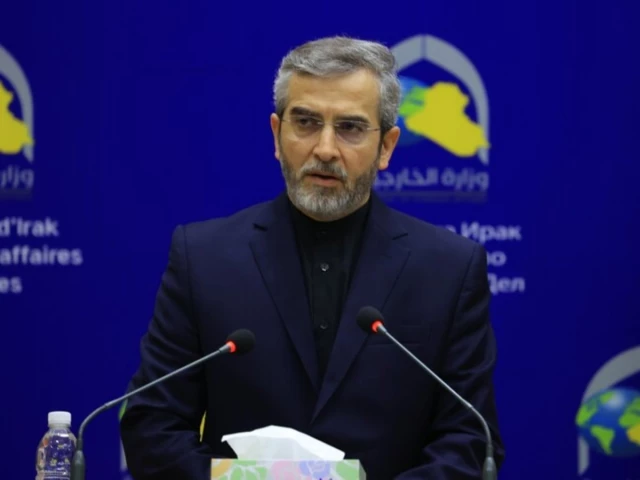
Deputy for Foreign Policy and International Security at Iran’s Supreme National Security Council Ali Bagheri Kani. Photo: Anadolu Agency
Deputy for Foreign Policy and International Security at Iran’s Supreme National Security Council Ali Bagheri Kani once again restated Tehran’s position that the fate of its highly enriched uranium was off limits in the current talks with the United States, Al Jazeera reported on Wednesday.
“This issue is not on the agenda of the negotiations,” Kani told Iran’s semi-official Fars news agency on the sidelines of an international security conference in Moscow, according to Al Jazeera.
As per Fars, Kani had travelled on Wednesday to participate in the 14th International Meeting of High Representatives on Security, where he made the remarks in response to a question regarding the fate of Iran’s enriched uranium reserves.
Read: Iran demands release of $12b in frozen assets in potential deal with US
Kani’s comments, Fars wrote, came after Foreign Ministry Spokesman Esmaeil Baghaei previously stated regarding the fate of 400 kilogrammes of 60% enriched uranium that “the nuclear issue is very clear — we are a member of the NPT and as a member, we have the right to use nuclear energy for peaceful purposes.”
The spokesman added, according to Fars, that Iran’s position on its high-enriched uranium stockpile was very clear, and that discussing details at this stage would not lead to results, as the two sides had previously tried that path and disagreements had been too significant to reach an outcome.
On Monday, US President Donald Trump said Iran’s stockpile of enriched uranium would be either transferred to the US “immediately” to be destroyed or “destroyed in place, or at another acceptable location”.
The statements come as Washington and Tehran continue the Pakistan-mediated diplomatic process to end the war that started with US and Israeli attacks on Iran on February 28 and was followed by Iranian retaliation.
Adversaries turning to hybrid warfare, says Iran’s Intelligence Ministry
Iran’s Intelligence Ministry said the enemy had been “defeated” on the battlefield and was now resorting to other means of warfare. The tactics, Al Jazeera wrote, included economic pressure, cyberattacks, weapons smuggling, assassinations and hostile media campaigns, the ministry alleged.
“The defeated enemy on the military front has now shifted its focus to soft war, cognitive warfare, and social provocations,” it said.
Read More: Iran’s top envoys discussing potential peace deal with Qatar prime minister, official says
In comments carried by Fars, the ministry warned Iranian authorities would “strictly prosecute” any espionage or “separatist activity”.
Iran says renewed war with US unlikely
Meanwhile, an Islamic Revolutionary Guard Corps (IRGC) official said a renewed war with the US was unlikely but warned that Iran stood ready to repel any attack, Iran’s semi-official Tasnim News Agency reported.
“The possibility of war is low because of the enemy’s weakness, but the armed forces are lying in wait,” said Mohammad Akbarzadeh, deputy political chief of the IRGC’s navy.
“Do not doubt we will turn the area from Chabahar to Mahshahr into a graveyard for aggressors,” he said, naming locations at each end of Iran’s lengthy southern coast, according to Al Jazeera, citing Tasnim.
South Korea says attack on ship in Strait of Hormuz likely involved Iranian missile
Separately, South Korea’s Foreign Ministry said that an attack on a cargo ship operated by a local shipper in the Strait of Hormuz earlier this month likely involved an Iranian anti-ship missile.
The Iranian embassy in Seoul did not immediately respond to a request for comment.
The ministry made the assessment at a briefing to announce the outcome of a government investigation into the May 4 attack on the bulk carrier, which caused a fire and damaged the lower stern hull.
“Various pieces of evidence point toward Iran,” said First Vice Foreign Minister Park Yoon-joo, adding that Seoul had not conclusively determined who was responsible or whether the attack was intentional.
The probe looked at debris from unidentified objects that were found inside the ship after the attack on the vessel.
The analysis showed that the ship, named Namu, was attacked twice and while the first warhead did not explode, a second did. Components in the debris indicated the objects were likely made in Iran, the ministry said.
“Their engines were similar to turbojet engines made in Iran,” Park said, noting that one component had markings that appeared to be used by an Iranian manufacturer.
The warheads resembled those used in Iranian anti-ship missiles, the Noor or Qader, Park said.
Also Read: Pakistan plans oil reserves, storage push as Hormuz constraints expose vulnerabilities
South Korea will summon the Iranian ambassador to share the results of the investigation and deliver a protest message, he said. Seoul will also demand Iran take responsible measures to prevent a similar incident from recurring, Park added.
He declined to speculate on why a South Korean ship would have been targeted, saying Seoul could not determine intent without access to the attacker’s decision-making process.
A South Korean defence official said, however, that from a naval perspective, the firing of two missiles suggested an intention to cause damage.
Trump said soon after the incident that Iran had fired at the South Korean vessel, and urged Seoul to join US-led efforts to secure shipping through the strait.
Tehran has previously denied any responsibility for the attack.

