
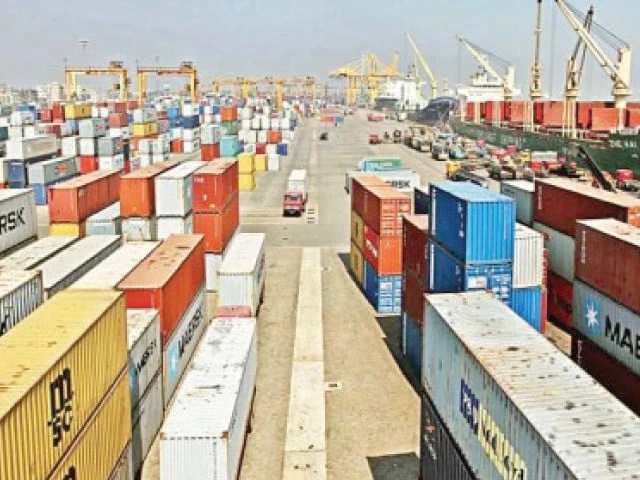
Analysts said Pakistan’s external sector remained stable for now due to strong remittances and IMF‑backed financing support, but cautioned that a sustained increase in imports without corresponding export growth could revive balance‑of‑payments risks. photo:file
KARACHI:
Pakistan’s external account slipped back into deficit in April 2026 as a sharp rise in imports outpaced export growth, highlighting renewed pressure on the country’s balance of payments despite strong remittance inflows and improving services exports.
According to data released by the State Bank of Pakistan (SBP), the country posted a current account deficit of $324 million in April 2026, compared with a marginal deficit of $12 million in the same month last year. On a month-on-month basis, the deterioration was also significant after the country recorded a surplus in March. The latest reading brought the cumulative current account position in the first ten months of FY26 to a deficit of $252 million, against a surplus of $1.66 billion in the corresponding period of the last fiscal year.
Analysts said the deterioration mainly stemmed from a strong rebound in imports amid improving domestic demand, easing restrictions on inflows and higher global commodity prices.
Brokerage house Arif Habib Limited (AHL) noted that the widening deficit was driven by an 11.4% year-on-year increase in total imports, which significantly exceeded the 3.4% growth in exports during April. Total imports stood at $6.9 billion in April, compared with about $6.2 billion a year earlier, while exports increased to $3.47 billion from $3.36 billion in April 2025.
SBP data showed that goods imports rose sharply by 14% year-on-year during April, indicating stronger purchases of petroleum products, machinery, industrial raw materials and consumer goods. In contrast, goods exports fell 2% on an annual basis, underscoring continued weakness in merchandise trade.
However, services exports remained a bright spot for the economy, registering a robust 22% year-on-year growth in April. Technology-related exports continued to support the external account, particularly telecommunications, computer and information services exports, which reached $423 million during the month. Despite the growth in services exports, the overall trade deficit widened considerably. According to the central bank, the trade deficit expanded to $3.4 billion in April, marking a 21% increase on a yearly basis and a sharp 47% rise compared with March.
For the July-April period, total imports increased to $63.1 billion from $58.1 billion in the same period last year, while exports edged down 0.7% to $34.1 billion from $34.3 billion.
Economists warned that the rising import bill could increase pressure on foreign exchange reserves and the rupee if export growth fails to accelerate in the coming months.
The Real Effective Exchange Rate (REER), a measure of currency competitiveness, rose to 105.80 in April from 105.17 in March, indicating that the rupee remained relatively overvalued against trading partners’ currencies. Analysts believe the stronger REER may further constrain export competitiveness.
Meanwhile, the primary income deficit, which includes profit repatriation and interest payments, widened to $657 million in April from $614 million a year earlier, reflecting higher external debt servicing obligations and corporate outflows. However, for the first ten months of FY26, the primary income deficit narrowed 4% to $7 billion, compared with $7.3 billion in the same period last year.
Pakistan continued to receive strong support from overseas workers, whose remittances remained the key buffer against external account pressures. Secondary income reached $3.7 billion in April, up 9% year-on-year, with workers’ remittances contributing about $3.5 billion. Remittance inflows rose 11% compared with the same month last year, although they declined 7.6% from March’s level of $3.8 billion.
Cumulatively, remittances increased to $33.9 billion during the first ten months of FY26, compared with $31.2 billion in the same period last year, providing crucial support to the external sector amid widening trade imbalances.
The financial account posted a surplus of $206 million in April. However, cumulative financial account inflows for the first ten months of FY26 slowed sharply to just $12 million, compared with a surplus of $1.49 billion in the corresponding period of last year, reflecting weaker foreign investment and financing inflows.
Analysts said Pakistan’s external sector remained stable for now due to strong remittances and IMF?backed financing support, but cautioned that a sustained increase in imports without corresponding export growth could revive balance?of?payments risks in the coming quarters.
Furthermore, the rupee posted a marginal gain against the US dollar in the interbank market on Monday, closing at 278.60 compared with Friday’s 278.61, up by Rs0.01.
Gold prices in Pakistan moved higher on Monday, tracking gains in the global bullion market. In the domestic market, the price of gold rose by Rs900 per tola to settle at Rs477,162. According to the All?Pakistan Gems and Jewellers Sarafa Association (APGJSA), the rate for 10 grams of gold also climbed by Rs772 to Rs409,089. In the previous session on Saturday, the price of gold had declined by Rs600 per tola to close at Rs476,262.
Globally, gold prices increased by $9 per ounce, taking the international rate to $4,548 per ounce, including a premium of $20. Silver prices also recorded an uptick in the local market, rising by Rs26 to Rs8,099 per tola.

