






Says Pakistan achieved success on narrative, military, diplomatic fronts during Marka-e-Haq
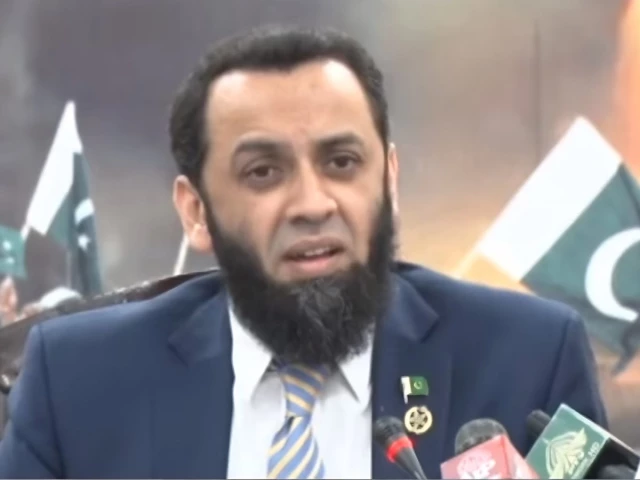
Information Minister Attaullah Tarar speaks at the Institute of Strategic Studies in Islamabad on May 13, 2026. SCREENGRAB
ISLAMABAD:
Information Minister Attaullah Tarar said on Wednesday that the Pakistan Air Force (PAF) demonstrated its dominance during aerial engagements, stating that the Rafale aircraft brought down during the conflict shattered Indian arrogance and highlighted Pakistan’s indigenous technological capabilities.
Speaking at the Institute of Strategic Studies in Islamabad on the occasion of Marka-e-Haq, Tarar said India had imposed aggression on Pakistan, targeting civilian populations, while Pakistan had restricted its response to military objectives.
“Pakistan believes in peace,” he said, adding that the country was a responsible state and a frontline nation in the fight against terrorism.
He said that Pakistan had achieved success on the narrative, military, and diplomatic fronts during Marka-e-Haq, crediting the unity of the nation, its institutions, and the leadership of Chief of Army Staff and Chief of Defence Forces, Field Marshal Asim Munir, for the country’s response to Indian aggression.
On the Pahalgam incident, Tarar said no investigation was conducted, but Pakistan was blamed. “An FIR was registered within 10 minutes,” he said, adding that Prime Minister Shehbaz Sharif had offered a transparent investigation into the incident during his address to cadets at the Pakistan Military Academy Kakul. “A year has passed and India has given no response,” he said. “India is running away from the investigation of the Pahalgam incident.”
The minister said India had a habit of turning internal issues into external ones and external issues into internal ones, saying that the issue of Indian Illegally Occupied Jammu and Kashmir (IIOJK) was an international issue with United Nations resolutions behind it, while terrorism was India’s internal issue, not an external one.
Tarar pointed to the arrest of Kulbhushan Yadav in Pakistan as evidence of India’s involvement in terrorism, adding that a country accusing Pakistan was itself found involved in the killing of Sikhs in Canada and other countries.
“Pakistan is fighting terrorism while India is promoting terrorism,” he said.
The minister further said that Pakistan had successfully conveyed the truth to the world, with local residents and journalists taken on a visit to the Bela Noor Shah area regarding the Pahalgam incident. He contrasted this with what he described as misinformation from the Indian side, noting that Indian media had made false claims about targeting ports in Lahore and Multan — both landlocked cities.
Tarar praised the role of Pakistani media during the conflict, saying it had acted responsibly, while the nation’s youth had used social media as a weapon on the narrative front. He added that Pakistan’s civilian and military leadership had been on the same page throughout, with coordination and harmony at every level.
The minister also highlighted Pakistan’s sacrifices in the broader war against terrorism, saying the country had suffered billions of dollars in losses. “If a Pakistani sacrifices his life in the fight against terrorism, it is not only for Pakistan but for the entire world,” he said, adding that Pakistan’s sacrifices for the elimination of terrorism were unparalleled.
He paid tribute to the leadership of Field Marshal Munir in navigating the challenges Pakistan faced during Marka-e-Haq.
Last year, on April 22, the escalation between Pakistan and India escalated when an attack in Pahalgam killed 26 people. India immediately blamed Pakistan for the incident. However, Pakistan categorically rejected the blame.
India then undertook a series of hostile actions the next day, including suspending the 65-year-old Indus Waters Treaty (IWT), cancelling visas for Pakistani citizens, closing the Wagah-Attari border crossing, ordering the shutdown of the Pakistan High Commission in New Delhi, and reducing diplomatic staff at each other’s embassies.
Tensions heightened further in the early hours of May 7 when missile strikes hit six cities in Punjab and Azad Jammu and Kashmir (AJK), destroying a mosque and killing dozens of civilians, including women, children, and the elderly.
In a swift military response, Pakistan’s armed forces shot down Indian warplanes, including three Rafale jets. The confrontation intensified again in the early hours of May 10 when India targeted several Pakistani airbases with missile strikes. In retaliation, Pakistan launched Operation Bunyanum Marsoos, damaging Indian military installations, including missile storage sites, airbases, and other strategic targets.
On the same day, United States President Donald Trump announced that a ceasefire had been reached between India and Pakistan following intense overnight diplomatic efforts. Minutes later, the agreement was confirmed separately by Pakistan’s Foreign Minister Ishaq Dar and the Indian foreign secretary.