






Sometime in the near future, an astronaut from Pakistan will float through a hatch into China’s space station and become, in that small weightless moment, the first foreign national to board Tiangong. He will have trained for months in a language that is not his own, in a country with its own complicated reasons for wanting him there. And back home, a country that has been to space only once before will watch on screens, caught between pride, surprise, and joy.
The two men in the race, Muhammad Zeeshan Ali and Khurram Daud, arrived in Beijing earlier this year to begin training as payload specialists. They are, by all accounts, the real thing, not ceremonial passengers but working scientists being prepared to conduct experiments in microgravity, operate complex equipment, and handle emergencies in an environment where emergencies tend to be very final. Whatever happens as they meet the deadlines of this project, one thing is almost certain, Pakistan’s space ambitions have entered a historic new phase.
How is China opening space
Space, for most of its human history, has been a gated community that was reserved for the rich nations. The International Space Station, assembled over a decade at a cost that runs, depending on who you ask and what you count, somewhere north of $150 billion, is the most expensive object ever built. It is also, in its way, a monument to exclusion. The United States, Russia, Europe, Japan, Canada, the founding members wrote the rules, controlled the access, and decided who got a ticket, and who got the real seat.
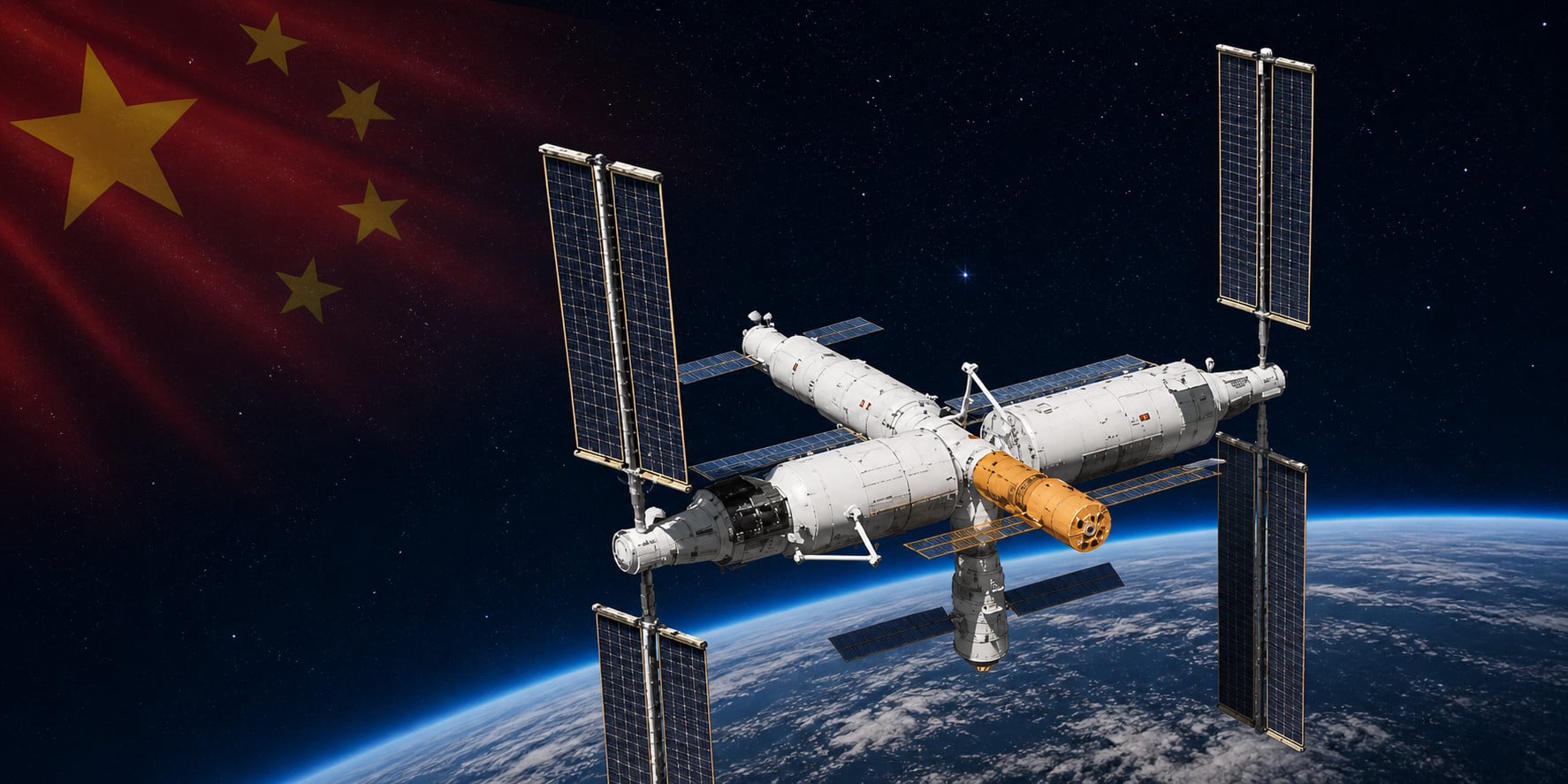
China tried to get in, but like most things, the Americans said no, formally, via the Wolf Amendment of 2011, which barred NASA from bilateral cooperation with Chinese entities without explicit congressional approval. The stated concern was predictable – the usual scare around technology transfer and national security. The practical effect was to push the world’s most populous country and then the world’s second-largest economy to build its own station if it wanted one. And so China did. Tiangong, fully operational since 2022, is the result of roughly two decades of work conducted almost entirely in isolation, which, given the circumstances, is either a remarkable feat of self-reliance or a cautionary tale about what happens when you exclude a large, capable, and aggrieved country from your club, or probably both.
What Beijing has done with that station since is the interesting part. Rather than run an exclusive programme, which would have been the obvious move, and arguably the justified one, China opened it up – though, not to everyone. The Americans, for obvious reasons, remain locked out. But to developing nations across Asia, Africa, and Latin America that the ISS had simply never bothered with, the invitation is genuine. The UN Office for Outer Space Affairs has been facilitating research agreements for those countries aboard Tiangong and Pakistan is first in line.
One reading, and it is not wrong, is that China is doing this for reasons that have little to do with the advancement of science and everything to do with geopolitics. Building relationships with developing nations, positioning itself as an alternative to Western-led institutions, demonstrating soft power through hard technology, yes, all of that. But consider the alternative on offer. The ISS is expected to be decommissioned by 2030. When it goes, Tiangong may be the only permanently crewed station in orbit. Countries that refuse Beijing’s hand on ideological grounds will be refusing the only hand extended. Pakistan, to its credit, and fortunately, is on the right side of things.
Pakistan’s place and the new phase
Pakistan’s Space and Upper Atmosphere Research Commission (SUPARCO) was founded in 1961, before India had a space agency, before most of the world had thought seriously about the question, and for a decade or so it looked like it might actually go somewhere. But history tells us that politics, underfunding, and a brain drain that hollowed out the sciences left SUPARCO as present on paper, absent in practice.
What is different now, those involved will tell you, is that the cooperation is structural rather than transactional. Zeeshan Ali and Khurram Daud are not going to space and coming back with a certificate. They are being trained properly in Chinese, in spacecraft systems, emergency procedures, and orbital science. When one of them returns, he will be the most experienced human spaceflight professional Pakistan has ever produced.
The collaboration also opens a research pipeline that has never existed before. Pakistani universities will be able to propose experiments for future Tiangong missions, competing for payload space alongside scientists from considerably wealthier countries. In the past, our researchers have had no access to that environment. Now, cautiously, carefully, they do. Whether the academic institutions can mobilise quickly enough to take advantage of it is a separate question, and one worth watching.
Eye in the sky
While the astronaut programme has attracted most of the attention, the satellite story running alongside it may be the more consequential one. Over the past sixteen months, SUPARCO has launched five indigenous satellites. Five satellites in sixteen months, from an agency that spent the better part of three decades struggling to put one up, is nothing short of an achievement.
Three of them are electro-optical earth observation satellites. EO-1 went up in January 2025, EO-2 in February 2026. Both are operational. EO-3, the most recent and most sophisticated, launched from the Taiyuan Satellite Launch Centre in China and carries something Pakistan has not had before – an AI-powered onboard computer that processes data in orbit, in real time, rather than beaming raw imagery to a ground station and waiting. It also carries a Multi-Geometry Imaging Module, a piece of technology that improves imaging accuracy, along with an advanced energy storage system, both developed indigenously. EO-3’s low-inclination orbit means it passes over Pakistan’s territory more frequently than a polar orbit would, which is not an incidental design choice.
Technical information aside, Pakistan’s satellites provide the nation an eye in the sky. For a country that floods regularly, absence of real-time satellite data that Pakistan controlled could be felt after every disaster. EO-3’s onboard processing will simply allow us to know where the water is going today, rather than finding out when it is already moved somewhere else.
Partnership with China
All five satellites were launched on Chinese rockets. Pakistan has not made domestic launch capability a budget priority, and Dr. Sarah Qureshi, an aerospace propulsion engineer who has spoken recently with Sputnik about the programme, frames the logic with admirable bluntness: “If a satellite costs a million to build, the rocket to launch it costs billions.” Pakistan is, in effect, running a focused strategy, build the payload, leave the rocket to Beijing, and the results, at least in volume and pace, justify it. The Strategic Plans Division Force now coordinates aerospace, defence, and satellite work under a single institutional roof, which has eliminated the kind of inter-agency friction that used to add years to projects.
Less comfortably, Dr. Qureshi has also noted that Pakistan relies heavily on established Chinese designs rather than conducting foundational research of its own. This is the part of the story that the press releases tend to skip. There is a meaningful difference between a space programme that builds things and a space programme that assembles things, and Pakistan, right now, is somewhere on that spectrum without being entirely clear about where it should be. That said, the pace of launches is genuinely impressive. What would be more impressive and more telling is knowing how much of the engineering lives in Pakistani heads versus Chinese manuals.
Long term impact
Space programmes are not difficult to start, but they are difficult to sustain and Pakistan knows this better than most. The question hanging over the current momentum is not whether the technology works, it demonstrably does, but whether the institutions around it are durable enough to survive a change of government, a budget crisis, or the quiet departure of the engineers who actually know what they are doing.
The security dimension adds its own complications. Communication satellites, surveillance capabilities, navigation support: all of these now flow, in significant part, through Pakistan’s relationship with China. That relationship is currently good but in the long run Pakistan will have to be independent. A space programme built substantially on a single partner’s goodwill and technology is not fully a space programme, it is, in part, a dependency. None of which should take away the spotlight from what has actually happened. We now have three working earth observation satellites, the nation’s first AI-powered satellite computer, and two astronauts in serious training for an important mission. For a programme with SUPARCO’s history and challenges, this is not a minor achievement. It is, in fact, the most remarkable version of a Pakistani space programme that has ever existed.
All that said, sometime soon, one of those two men in Beijing will board a spacecraft. He will leave the atmosphere, dock with a station that was built by a country that was told it could not have one, and look out at a planet that is, from that altitude, entirely indifferent to the politics below. He will be carrying Pakistan’s flag and whatever it is that he hopes for our country. The rest is up to the people on the ground, the engineers, the politicians, the institution, and our collective desire to go further than before.
Source link