









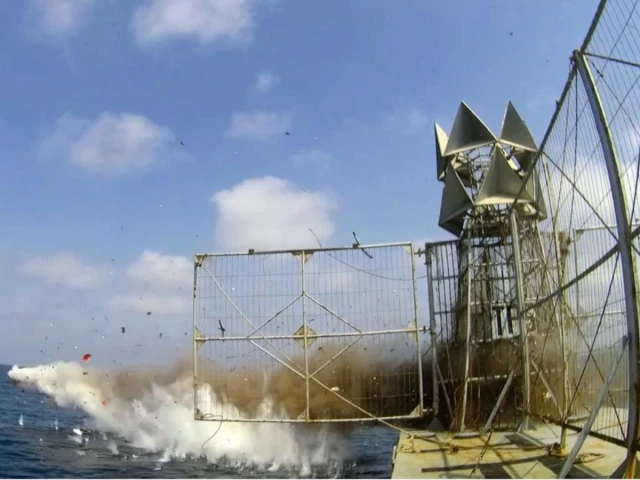
President, PM, CDF and services chiefs congratulate scientists and engineers on achieving this significant milestone
Pakistan Navy on Tuesday conducted a successful test of the Taimoor air-launched cruise missile, an indigenously developed anti-ship weapon system, described as “a powerful demonstration of precision strike capability and operational readiness,” according to a statement from the military’s media wing.
According to the Inter-Services Public Relations (ISPR), the air-launched cruise missile executed its mission with exceptional precision, validating Pakistan Navy’s combat capability to detect, target and decisively neutralise enemy sea-based threats at extended ranges
“This demonstration by the Pakistan Navy marks a pivotal elevation of national defence capability, further strengthening the Pakistan Armed Forces’ multi-dimensional coordinated strike posture and capabilities in the conventional domain,” the statement added.
It further stated that the Pakistan Navy stood resolute in its commitment to safeguard the nation’s maritime interests and sovereign waters.
“The president, prime minister, chief of defence forces and services chiefs have congratulated the scientists and engineers on achieving this significant milestone,” it added.
Read: Pakistan Navy inducts advanced PNS KHAIBAR into its fleet
Interior Minister Mohsin Naqvi congratulated the nation on the successful test of the Pakistan Navy’s Taimoor air-launched cruise missile.
He said the successful test of the indigenously developed anti-ship cruise missile is a remarkable achievement by Pakistan Navy’s scientists and engineers.
Mohsin Naqvi stated that Pakistan has achieved another success in the field of defence. He added that the successful test of the anti-ship cruise missile is an important milestone in the defence sector.
He further said that the Pakistan Navy remains committed to safeguarding the country’s maritime boundaries.
Sindh Chief Minister Syed Murad Ali Shah has congratulated the Pakistan Navy on the successful test of the Taimoor air-launched cruise missile, calling it a milestone in national defence.
In a statement, he said the successful trial of the indigenously developed missile reflected the Pakistan Navy’s professional expertise and strong defence capabilities. He paid tribute to the country’s scientists and engineers for what he described as a remarkable achievement.
The chief minister said the success would further strengthen the defence of Pakistan’s maritime boundaries. He added that the country’s armed forces were fully prepared to defend the nation on all fronts.
He also said the entire nation takes pride in the Pakistan Navy’s professional capabilities and reaffirmed that defence preparedness was complete to counter any hostile intentions.
On April 16, the Pakistan Navy successfully conducted a live weapon firing of an indigenously developed ship-launched anti-ship missile, the military’s media wing said in a statement.
“In a resolute display of preparedness and precision-strike capability, Pakistan Navy successfully conducted a live weapon firing of an indigenously developed ship-launched anti-ship missile, accurately engaging its target at high speed and extended range,” according to ISPR.
It said that Chief of Naval Staff Admiral Naveed Ashraf, along with leading scientists and engineers, witnessed the missile firing. “The missile integrates a cutting-edge guidance system and advanced manoeuvrability, enabling it to evade threats, adapt to dynamic conditions, and strike with precision and lethality,” it added.
Earlier on April 4, Pakistan Navy inducted the 2nd PN MILGEM Class Corvette, PNS KHAIBAR, into its fleet, marking a significant milestone in the service’s modernisation and operational capabilities, according to the ISPR.
Addressing the induction ceremony, Chief of Naval Staff Admiral Naveed Ashraf stressed the importance of “a strong, balanced and technologically advanced Navy” to safeguard Pakistan’s maritime interests and ensure the security of vital Sea Lines of Communication (SLOCs), the statement included.
He highlighted the country’s strategic location along key maritime trade and energy corridors as a key factor behind the navy’s modernisation efforts.