



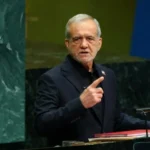

Khyber-Pakhtunkhwa Governor Faisal Karim Kundi on Friday urged the provincial government to abandon its planned long march towards Islamabad, claiming that the “ground reality is not in favour” of the protest and alleging that some people were either in hiding or had opted for voluntary arrests to avoid participating in it.
The PTI had announced last month that it would march to Islamabad on September 27 to press for the release of party founder Imran Khan. Today it said the party has postponed the march to take place on October 4 instead. The party had been preparing a central convoy from K-P, with caravans from other parts of the country expected to join before proceeding towards the federal capital. The federal government warned the party against going ahead with the march.
“I would recommend the provincial government to abandon the long march,” Kundi said while addressing a press conference in Peshawar.
“The ground reality is not in favour at all. Some people are in hideouts, while others have offered voluntary arrests to skip joining the long march,” he alleged.
He also said that the chief minister had failed to gather support during his recent visit to Punjab and that should have made him course-correct.
The governor accused the PTI-led provincial government of diverting its attention and resources towards the planned march instead of addressing the issues confronting K-P.
Read: PTI postpones Islamabad march to October 4: party sources
He said the provincial government should focus on the deteriorating law and order situation, particularly in southern K-P, the merged districts and Malakand division, along with problems related to healthcare, education, electricity, potable water, tourism and the mining sector.
“All resources have been channelled towards the long march,” Kundi lamented.
He also questioned the purpose of the proposed protest, saying that PTI had repeatedly changed its demands. According to Kundi, the party initially sought relief for its incarcerated founder, claiming that he had been wrongfully punished, but later changed its demands to judicial issues and, subsequently, quicker hearings and access to healthcare for him in custody.
He warned the provincial government against using state resources and officials for what he described as a political agenda.
“You cannot use state machinery for forwarding personal agendas,” he said. He asserted that the provincial government planned to keep the police at its disposal during the long march towards Islamabad.
The governor said he supported the constitutional right of citizens to hold peaceful protests but stressed that it was necessary to determine whether a particular demonstration remained peaceful.
“I second the right of the people to protest under the democratic right ordained to them under the Constitution, but it is important to see if the protest is actually peaceful or not,” he said.
Kundi highlighted that PTI leaders had previously caused disruptions in Islamabad, damaged government property and harmed military installations during protests.
He also referred to remarks by a PTI president and an MNA about politics involving casualties, saying such statements did not correspond with peaceful political activity. He criticised a recent speech by the K-P chief minister in the provincial assembly, saying the provincial government should concentrate on governance rather than political confrontation.
Citing previous long marches organised by the Pakistan Peoples Party (PPP), Kundi said his party did not use government officials or departments for political demonstrations.
“We neither took government officials, cops, fire department staff or any other state official to back our protest.”
The governor also praised the Jamaat-e-Islami for what he described as peaceful protests, saying the party had not damaged state or government property.
Speaking on the imposition of governor rule in K-P, Kundi said the president and the federal government ought to decide on it. He said the constitution provides for its imposition under special circumstances that need to be assessed by the relevant authorities.
“It was imposed in the past as well. It is not unconstitutional,” he said about the governor rule, but refrained from announcing its imposition in the province.
The new police act
A major part of Kundi’s criticism centred on the proposed K-P police law.
The governor said the provincial government was seeking to increase its control over the police department, despite what he described as a February ruling of the Peshawar High Court (PHC) concerning the command structure of the force. He said the court had made it clear that the police department was headed by the inspector general of police and that transfers and promotions should be based on merit rather than political considerations.
“PTI always sloganeered against politicisation of police, but now they themselves wish to convert the police force into PTI’s Tiger Force,” the governor remarked during the press conference.
Read more: Police hunt PTI leaders, activists
Expressing concern over provisions in the proposed police legislation, Kundi said it would give the provincial government unfair control over police affairs. According to him, the draft reserves 25% of the quota for direct DSP appointments for the chief minister.
He also questioned the proposed police policy board, saying that if all matters relating to the police were brought under the control of the K-P government, there would be little purpose in maintaining an independent police department.
Kundi also assailed the proposal to place the finances of the police department under the provincial finance ministry.
“The ministry of finance always says that the treasury is empty,” he said, arguing that a force fighting terrorism and crime should not be subjected to excessive political and administrative interference.
“The force which is fighting [terrorism and crime] and laying down lives is being tossed around in the province — under the cabinet, home secretary and chief minister,” he lambasted the provincial government's approach.
Kundi further highlighted that the proposed police law would bear negative consequences on judicial processes, outlining, “They have even directed the reports submitted to courts by police to go through them [provincial government].”
“The proposed system would allow the government to manipulate police reports for political purposes,” he expressed concern.
“Everyone knows PTI is behind the May 9 attacks and yet the new law will allow them to manipulate reports to suit their politics,” Kundi claimed.
He further alleged that under the proposed law, police officers could be rewarded or punished on the basis of their willingness to comply with political demands.
“They will award promotions to those cops who give in to their demands and punish those who don’t.”
‘Illegal and unconstitutional’
Governor Kundi also declared the proposed police legislation “illegal and unconstitutional”, while clarifying that he would examine the legislation formally once it had been passed by the provincial assembly.
“I will scrutinise the act when I receive it after it gets passed by the assembly,” he said, adding, “The current provisions of the act that I have come across are absolutely unacceptable.”
The governor remarked that he would not assent to the new police legislation unless relevant amendments were incorporated.
He also predicted that the legislation could face a legal challenge, saying he expected the court to strike it down if the federal government approached the judiciary for relief.
The governor urged the K-P lawmakers to “not pass the act through the assembly”, stressing previous court decrees against the use of state assets for personal or political agendas.
Law and order concerns
Kundi said the debate over police administration could not be separated from the security situation in K-P and recalled the sacrifices made by police personnel in the province.
The governor also referred to a recent Counter-Terrorism Department operation in which a suicide bomber allegedly planning an attack in Peshawar was eliminated. He said the sacrifices of security personnel should be recognised and their families provided with the facilities and benefits they deserved.
“Previously, our military officers and sepoys were killed in Kohat, following a recurring pattern,” he said.
Kundi urged the provincial government to look at the security situation in southern K-P, the merged districts and Malakand division, where, he said, law and order remained a major concern.
He also criticised the provincial government for, in his view, devoting political energy to the long march while neglecting the demands of families of police personnel killed in the line of duty.
Instead of providing facilities to the families of those who had sacrificed their lives for the country and helping them secure their right to receive presidential awards, he said, the government had focused its attention elsewhere.
Governor Kundi further stressed that the provincial government should concentrate on problems affecting ordinary citizens rather than the planned political campaign.
He took a jab at the government for overlooking protests by members of the medical community seeking an increase in remuneration. He also raised concerns over the reported increase in dengue and polio cases, the condition of the education sector, electricity-related problems and the availability of potable water.
The governor also pointed to what he described as the decline of the tourism sector and the underdevelopment of mining in the province.
He alleged that financial allocations meant for the former FATA and PATA regions had not been properly utilised for the benefit of local communities. Kundi said police personnel in these areas were protesting.
“If they are protesting, who will look after law and order?” he asked.
Kundi also took apart the provincial government for failing to secure what he described as the province’s due share of oil and gas royalties from the federal government.
“K-P produces the most oil and gas for the country, but we have failed to acquire royalty for it,” he stated during the press conference.
“We have failed to seek relevant resources from the centre to uplift our people,” he added.
Support for police
Despite his criticism of the proposed legislation, Kundi said the provincial police had received equipment and vehicles required to improve its operational capabilities. He said several items requested for the K-P police had already been provided to the province, while additional equipment would be delivered according to the government’s commitments.
“We will receive 23 anti-drone guns in October, and the rest will be given in December,” he said.
Kundi maintained that strengthening the police and addressing the province’s security challenges should be prioritised over political mobilisation.
He urged the PTI-led administration to focus instead on overcoming what he described as provincial governance lapses.