





Shaza Fatima says motorcycles, rickshaws, Chingchis and vehicles up to 800cc will be eligible for subsidy
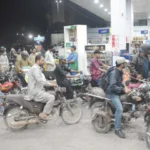
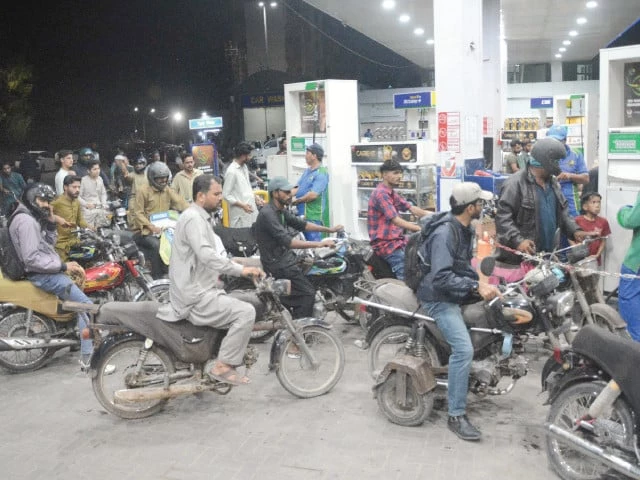
As the city runs on fumes, motorcyclists line up at a petrol pump in Karachi, waiting their turn amid surge in fuel prices. Photo: Jalal Qureshi / Express
The government on Monday detailed the process for applying for its targeted petrol subsidy, announced by Prime Minister Shehbaz Sharif amid rising fuel prices as the war in the Middle East widened the energy crisis.
A day earlier, PM Shehbaz had announced a special relief scheme offering a Rs100-per-litre reduction in petrol prices for motorcycles, rickshaws, Qingqi rickshaws and cars with engines of up to 800cc. The move came as the widening US-Iran conflict in the Middle East pushed global oil prices higher, while attacks from Yemen on Saudi energy facilities introduced a fresh source of market risk, adding to concerns over potential disruptions beyond Iran and the Strait of Hormuz.
While sharing the details of the procedure during a press conference, the Information and Technology (IT) Minister Shaza Fatima said the scheme had been launched by the prime minister after consultation with all relevant agencies and was aimed at providing targeted relief to vehicle users.
She said that under the special relief scheme, users of motorcycles, rickshaws, Chingchis and vehicles with engines up to 800cc would receive a Rs100-per-litre subsidy on petrol, adding that two- and three-wheeler users would be eligible for 20 litres of subsidised petrol per month, while owners of vehicles with engines up to 800cc would be eligible for 30 litres per month.
Shaza said that the scheme would be implemented in two phases, beginning with registration and followed by the process of obtaining subsidised fuel.
“Registration can be completed from home by sending an SMS to 9771. Applicants will need to send their 13-digit CNIC number, the vehicle registration number, the first letter or full name of the province where the vehicle is registered, and the vehicle’s registration date,” she said.
She added that the CNIC provided must be registered against the SIM being used for the application, as the information would be verified against Pakistan Telecommunication Authority data.
Shaza said that the province entered in the SMS must be the province where the vehicle was registered, rather than the applicant’s province of residence or domicile, saying that this was necessary because the same registration number could be issued by different excise departments in different provinces.
“The registration date will be used to establish that the applicant had the vehicle’s documentation and to help prevent stolen vehicles from being registered in the scheme, she added.
Shaza said the government had changed the eligibility requirement for motorcycles and three-wheelers so that users, rather than only registered owners, could apply. She said this took into account the widespread use of vehicles under open transfer letters and informal ownership arrangements.
“For cars, however, only the registered owner will be eligible to register for the subsidy. Once the required information has been sent to 9771, applicants will receive a confirmation message if their registration is successful. Fatima said registration would be a one-time process,” Shaza said.
She further said that after registration, beneficiaries would be able to obtain subsidised petrol by sending TOK to 9771, and they would receive a token number that can be presented to a petrol station employee for verification.
“Motorcycle and three-wheeler users will receive tokens for five litres at a time, while car users will receive tokens for 10 litres. The five-litre transaction will carry a Rs500 discount, while the 10-litre transaction will carry a Rs1,000 discount,” she said.
Shaza urged beneficiaries to check the quantity of fuel they received and ensure the applicable discount had been deducted from the total bill.
She also warned people against scams, saying the government would not contact beneficiaries by phone, WhatsApp or SMS to demand money, an OTP, a code or additional registration information.
“The Government of Pakistan will not in any form ask you for any data or any charges,” she said, urging people to remain vigilant.
Shaza said the scheme had been designed with checks and balances because it involved public funds, while the government would continue improving the system as it was rolled out.
Petroleum minister says govt prepared for coming months
Speaking after Shaza, Petroleum Minister Ali Pervaiz Malik said the government was working with refineries to ensure fuel supplies remained uninterrupted in the coming months.
He said he had held a one-hour consultation with private-sector refineries on Monday to discuss petroleum availability in September and October, including contingency planning in case of a problem in Bab al-Mandab.
The meeting also focused on how the burden could be shared to help the country through the difficult period, Malik said.
“The government is making efforts to ensure that, just as there was not a single incident of fuel shortages at petrol pumps during the previous crisis, the same is ensured this time as well,” he said.
Malik said the government was not only trying to provide immediate relief but was also working to build systems and capacity that would allow it to respond if a similar crisis occurred again.
“We are not only trying to provide temporary relief but are also working to build permanent systems and capacity within the government,” he said.
He said Pakistan imported around 90 per cent of its petroleum requirements, meaning the government had to manage its resources according to its means while protecting as many people as possible.
Malik said Prime Minister Shehbaz Sharif had followed a similar approach during the previous oil crisis, first arranging resources before providing a blanket subsidy of Rs100 billion to protect the public.
The prime minister had subsequently directed Malik and the finance minister to coordinate with the provinces and seek their help in mobilising additional resources.
As the war showed no signs of ending, they met the prime minister, while President Asif Ali Zardari also brought everyone together, Malik said. Additional resources were then mobilised and a targeted relief system was put in place, which continued until June 30.
He said the situation between March 1 and June 30 had been unprecedented, with diesel prices rising from around $90 per barrel to $280-$290 per barrel. Crude oil prices rose from around $70 to $170 per barrel, while petrol prices increased from $76 to $135 per barrel.
“I do not think an oil shock of this kind has any precedent in history,” Malik said.
The government had used all available resources to protect the public from the impact of the oil shock, he said, while private-sector refineries had also responded to the prime minister’s call.
The refineries changed the refined-product formula and temporarily shifted to the crude-oil formula, allowing diesel, which Pakistan produced locally in greater quantities, to be sold at a lower price in line with production costs.
Malik said the refineries had again responded to the prime minister’s efforts as the need arose.
Turning to the government’s decision to provide targeted relief rather than reduce the petroleum levy, Malik said the levy currently stood at Rs78 per litre, with an additional Rs5 carbon surcharge.
The prime minister had decided to provide Rs100 per litre in monthly relief to the most vulnerable sections instead, he said.
The relief covered two-wheelers, three-wheelers and vehicles with engines up to 800cc, which Malik said were commonly used by salaried and lower-middle-income people facing particularly difficult circumstances because of inflation.
“They will be able to register from home, generate a token from home and take it to any petrol pump to receive petrol at Rs100 less per litre,” he said.
Malik said this could bring the effective price closer to what it had been before the war, even though the government was purchasing fuel at almost twice the price.
He said the initiative was also linked to the prime minister’s commitment that if global oil prices fell and fiscal space was created, the entire reduction would be passed on to the public transparently.
Since July 1, every component contributing to the petrol price at the pump had been published by OGRA on its website in both English and Urdu, Malik said. Data on crude oil and other relevant components had also been made available.
“The government fully understands the scale of the crisis that has hit the region,” he said.
Although Pakistan might not have had a major role in creating the crisis, it had a responsibility to play its part in resolving it, Malik said.
He said the prime minister, deputy prime minister and Field Marshal were working day and night towards a permanent end to the war, adding that a lasting solution would ultimately come from there.
Alongside those efforts, the government was working to strengthen the country’s refining sector, Malik said.
He said refineries had been criticised for producing expensive fuel rather than processing cheaper crude oil, but the basic problem was that there had not been sufficient investment in the refining sector.
The Economic Coordination Committee had approved resources for the scheme as well as agreements to be signed with the refineries, he said.
Malik said the government expected progress by October 1 on a planned $5 billion investment in the country, which would increase the refineries’ capacity to process crude oil from different sources, including neighbouring countries.
The prime minister was personally overseeing the work, including efforts relating to strategic reserves and the gas sector, he said.
Malik described the targeted subsidy scheme being implemented under the IT ministry as a small initiative, but said it reflected the government’s commitment to protecting the most vulnerable despite limited resources.
The scheme was being launched at around 150 petrol pumps in Islamabad before being rolled out across Pakistan.
He said that a war room had also been established to deal with problems faced by petrol pumps, he said, adding that any pump facing an issue would be able to contact the relevant authorities for immediate resolution.
The funds would not remain parked in the system as circular debt, Malik said. With the support of the State Bank and the finance minister, daily settlements would be made to ensure petrol pumps received their funds.
“The State Bank has already obtained the relevant account details,” he added.