KARACHI:
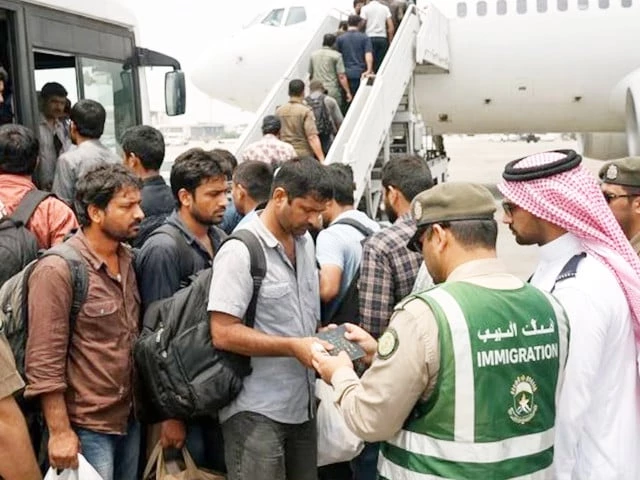
For Pakistani families, a job in the Gulf can mean the difference between financial security and economic hardship. But the sudden loss of that job can send a worker back to the same weak labour market that pushed him abroad in the first place – exposing a vulnerability that is increasingly visible as thousands of Pakistanis are deported from Gulf countries.
The recent deportations of 21,951 Pakistanis have also brought into focus a larger economic dependence that Pakistan relies heavily on overseas jobs to absorb its workforce and on the resulting remittances to support its external account.
The immediate financial impact of the latest deportations may be limited, but economists warn that the country’s dependence on labour markets and policy decisions beyond its control leaves millions of households exposed.
Pakistan relying on jobs it does not control
“The immediate UAE impact remained limited, with deported workers’ estimated annual transfers at about $42 million, or less than 0.1% of total remittances,” said Dr Abid Qaiyum Suleri, an economist at the Sustainable Development Policy Institute (SDPI).
He said remittances carry major advantages. They create no public debt, demand no profit repatriation and reach households directly. The weakness arises because Pakistan uses them to compensate for weak exports and low investment, while millions of workers remain subject to rules over which we have almost no influence.
“Remittances exceeded all export earnings in FY26, while Saudi Arabia and the UAE supplied nearly 45% of the total. The UAE deportations have not yet reduced national inflows materially. However, in a geopolitically fragile world, visa policies or other geopolitical decisions taken abroad can affect a Pakistani family’s income overnight,” Suleri said.
Remittances reached a record $41.6 billion in FY26. Goods exports earned $30.84 billion, while combined goods and services exports earned $40.88 billion. Remittances also offset a trade deficit exceeding $35.5 billion. Without them, and holding other flows constant, the current-account deficit would have approached $41.7 billion. At the macroeconomic level, Pakistan has become overdependent on jobs it does not control, he said, noting that remittances were 9.9% of GDP in 2025.
Joblessness pushing young workers abroad
Pakistan Institute of Development Economics (PIDE) Professor of Economics and Registrar Dr Nasir Iqbal linked the vulnerability primarily to Pakistan’s domestic labour market, particularly joblessness among young people.
“It is primarily joblessness in Pakistan that forces people to seek fortune abroad. We have high unemployment, especially among the young. There is no growth in the economy that led to a decline in real wages. All these factors push young workers to go abroad,” he explained.
Iqbal described deportation as “a normal phenomenon,” adding that “the number is not as high as it seems.” He nevertheless called for better laws and enforcement mechanisms to prevent such incidents.
He also stressed the need to focus on future labour demand in Gulf countries and prepare Pakistan’s workforce accordingly. “We need to focus on future labour needs in the Gulf Cooperation Council (GCC) and prepare our workforce accordingly,” he added.
Report warns of wider Gulf labour-market shock
A recent report by PIDE Professor of Economics Dr Shujaat Farooq warned that Pakistan’s heavy reliance on the Middle East for labour exports and remittances remained a critical vulnerability.
In his Policy Viewpoint, “The Middle East Conflict and Its Implications for Pakistani Migrant Workers,” Farooq noted that around 0.7 million to 0.8 million Pakistanis enter the Middle East each year, while around 6 million Pakistanis currently work in the region, which contributes 54% of Pakistan’s total remittances.
The report found that around 8 million workers were placed in the Middle East during 2010-24, nearly one-third of the 25.9 million new entrants to Pakistan’s labour market during the period.
Farooq warned that a prolonged regional conflict could prevent around half a million Pakistani workers from going to the Middle East in 2026, while more than half a million could be forced to return, placing serious pressure on the domestic labour market, particularly in Punjab and Khyber-Pakhtunkhwa.
The report estimated that remittances could fall by $3 billion to $4 billion annually, potentially putting pressure on the exchange rate and widening the current-account deficit.
When an overseas job disappears
The vulnerability is most visible in the lives of workers who return. Sajid, a refrigeration technician from Karachi, moved to Dubai hoping to earn a better income. For months, he said, everything went well and he performed his job without any major problems. Then his circumstances changed suddenly when his supervisor noticed a small wire hanging from an air-conditioning system and fired him with immediate effect.
Sajid said his ordeal did not end with the loss of his job. The company subsequently reported him to the relevant authorities, leading to his deportation. Back in Karachi, Sajid had to start again from scratch, moving from shop to shop looking for work and providing home services, trying to rebuild the livelihood he had established abroad.
His case shows how quickly the loss of overseas employment can turn into a domestic livelihood crisis. A worker may leave Pakistan seeking better earnings, but after deportation he returns to an economy where comparable employment may not be readily available.
Abdullah’s experience offers a different outcome. He travelled to Dubai after a friend assured him that he would find a good job, but domestic issues in that household shortened his stay.
During his time there, he came across an old glue-making machine. He bought it and brought it back home, where he started his own small operation. He has turned his brief overseas experience into an opportunity for entrepreneurship at home.
The contrasting experiences of Sajid and Abdullah show that overseas migration can produce both vulnerability and opportunity. For one worker, returning home meant rebuilding a lost livelihood; for another, exposure abroad helped generate an idea for a domestic business.
Deportation data shows a mixed picture
The data presented in the National Assembly recently and seen by The Express Tribune showed that 21,951 Pakistanis were deported from Gulf countries between March 1 and July 13, 2026. Saudi Arabia accounted for the largest share at 15,495, followed by the UAE with 3,803 and Oman with 1,606.
Among the main reasons were “Other” cases (6,662), absconding (4,628), overstay/illegal entry or stay (2,811), jail cases (1,294), lost passports (1,155), blacklist cases (968), drugs (728) and visa violations (689).
The government has also rejected the impression that Pakistanis are being subjected to a blanket, country-specific deportation campaign, maintaining that deportations are linked to violations of host-country laws and immigration regulations.
The highest reported category of “Other,” though not specified, could be the cases of bounced rental cheques – a serious offence which can trigger legal cases, travel bans and visa problems, potentially leaving Pakistanis unable to return, facing detention or, separately, deportation.
However, questions remain about the legal status of returnees, including whether some individuals remain in Federal Investigation Agency (FIA) custody and whether particular cases require further legal proceedings. The Ministry of Interior was approached for clarification but had not responded.
The FIA could not be reached due to the end of working hours. “Questions pertain to the Ministry of Foreign Affairs and FIA,” said an official at the Ministry of Overseas Pakistanis and Human Resource Development. The Ministry of Foreign Affairs also did not respond.
The bigger economic question
For Pakistan, overseas employment remains indispensable. It provides jobs to workers who might otherwise struggle to find employment, supports millions of households and generates foreign exchange without creating public debt or requiring profit repatriation.
The figures therefore tell only part of the story. Some Pakistanis seek opportunities abroad after prolonged financial hardship, hoping to escape mounting debts and repay borrowers by earning better wages.
For many, overseas employment is seen as a way to rebuild their finances and support families back home. In this pursuit, some, lacking sufficient resources or legal avenues, end up taking irregular routes or violating local laws, often driven by financial pressures and difficult circumstances.
The cost of dependence
As Suleri pointed out, Pakistan is relying on jobs it does not control. As Iqbal said, domestic joblessness and declining real wages are pushing young workers to seek those jobs in the first place. And as Farooq’s PIDE report warns, a wider disruption in the Middle East could prevent hundreds of thousands of Pakistanis from leaving for work while forcing hundreds of thousands of existing workers to return.
The immediate deportation figures may not threaten Pakistan’s remittance inflows materially. But they offer a glimpse of what could happen if the underlying dependence is tested on a much larger scale.
The policy response, therefore, cannot be limited to stopping deportations after they occur. Pakistan needs better recruitment oversight, stronger enforcement, clearer information for workers before departure and protection mechanisms for those already abroad.
At the same time, Iqbal’s point about future GCC labour needs suggests that Pakistan must prepare workers for the jobs Gulf economies are likely to demand rather than simply sending more people abroad. And when workers return, their skills, savings and overseas experience need to be converted into productive activity at home.
Sajid is still looking for work from shop to shop. Abdullah, by contrast, brought back a machine and turned it into a business. Their stories capture the two possible outcomes of Pakistan’s migration model. For now, the Gulf continues to provide an essential escape valve for Pakistan’s labour market.
But the more Pakistan relies on jobs it does not control, the more vulnerable its workers – and the economy that depends on their earnings – become to decisions made elsewhere, at the mercy of their paymasters.
Source link