
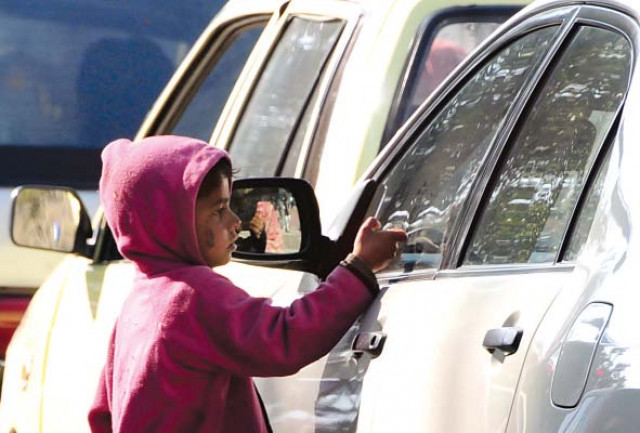
While street vending provides livelihoods, children, women and elderly people are increasingly used to evoke sympathy
When children approach motorists at traffic signals with flowers, pencils or toys, they appear to be selling small items to earn a living. But in many cases, the transaction is less about the product and more about appealing to the buyer’s sympathy — a practice experts describe as disguised begging.
Across Lahore’s busy commercial areas, including Liberty Market, Main Market, Anarkali, Ichhra, Mall Road and Hall Road, children, women and elderly people can frequently be seen offering low-cost goods. While some genuinely appear to be street vendors, in several cases the emphasis is on describing poverty and hardship rather than selling the product at its actual value.
The trend has raised concerns among child protection experts and researchers, particularly over the use of children to generate sympathy and collect money in crowded public places.
Read: Beggar’s daily ‘income’ tops skilled wages
According to a 2024 UNICEF report, the issue of children associated with street life remains largely undocumented in Pakistan, although such children are present in major urban centres including Lahore, Karachi, Peshawar, Rawalpindi and Multan. The US Department of Labor’s 2024 report also identified begging, street vending and forced begging among risks associated with child exploitation.
A study by researchers from the University of Okara, covering 45 beggars across 15 districts of Punjab, found that seeking public sympathy through children, portraying poverty and using emotional appeals were among key begging strategies. The research also found that methods varied according to age and gender.
A 2025 study by the University of Management and Technology (UMT), Lahore, similarly linked child begging to broader economic and administrative problems. Researchers found that in some cases adolescents had little control over their earnings, with money being handed over to parents or guardians.
Dr Ayesha Imran Murtaza, a psychologist at Fountain House Lahore, said emotional appeals centred on suffering and hardship can increase people’s willingness to donate.
According to her, people may pay more than an item’s actual value because they are influenced by the seller’s circumstances rather than the product itself.
Iftikhar Mubarak, head of an NGO and a board member of the Child Protection and Welfare Bureau Punjab, cautioned against labelling every street vendor as a beggar.
“Not every street seller should be considered a beggar,” he said, adding that using children to sell inexpensive items and obtain money through sympathy was nevertheless concerning.
Mubarak said some organised groups may use children at crowded locations, making it necessary for state institutions to determine whether a child is genuinely earning a livelihood or is part of an organised begging network.
Syed Kausar, head of the Sustainable Social Development Organisation (SSDO), said the issue was not simply whether people should give a few rupees, but distinguishing between poverty, child labour, organised begging and emotional exploitation.
He advised people to support needy individuals through credible welfare organisations rather than responding directly to emotional appeals.
The Punjab Social Welfare and Bait-ul-Maal Department says a welfare home in Lahore provides rehabilitation, medical care and vocational training to beggars, while children are referred to the Child Protection and Welfare Bureau.
Officials claim many beggars now seek money by selling goods or cleaning windscreens. Punjab law provides strict punishment for forcing children into begging, while the Lahore High Court in May directed the government to act against the begging mafia.
This emerging trend highlights the challenge of curbing organised begging without criminalising legitimate street vending.Bottom of Form

