






Orders immediate measures to make newly established Sky47 AI national data centre available to all govt institutions
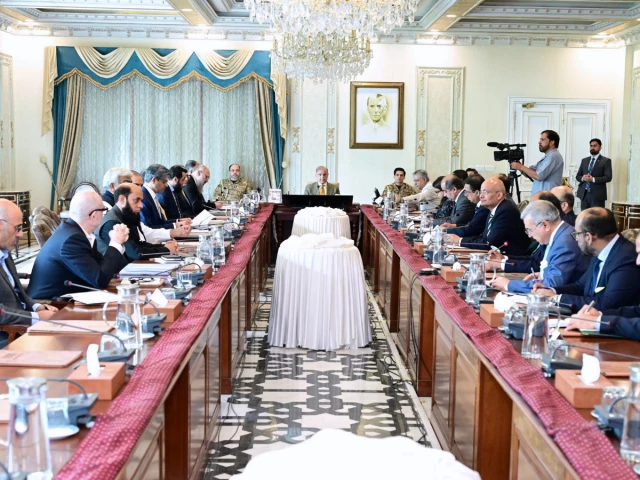
Prime Minister Shehbaz Sharif chairs a progress review meeting on implementation status of National Digital Vision in Islamabad. PHOTO: PMO
Prime Minister Shehbaz Sharif on Wednesday directed the Federal Board of Revenue (FBR) to develop a comprehensive and scientific methodology to assess tax potential across various sectors, aiming to strengthen revenue generation and improve tax administration, according to a statement issued by the Prime Minister’s Office (PMO).
Chairing a weekly review meeting on FBR reforms, the prime minister instructed authorities to work with the power sector to identify businesses and individuals involved in the informal economy and tax evasion and initiate legal action against them.
He said that, for the first time in Pakistan’s history, production data from the sugar industry matched FBR records, calling it clear evidence that the FBR’s tracking system was functioning effectively, praising FBR Chairman Rashid Mahmood Langrial and his team for their efforts.
PM Shehbaz also commended taxpayers and businesses that complied with tax laws, calling them “a valuable national asset.”
He said the government had extended as much facilitation as possible to both export-oriented and domestic industries on taxation and would continue to do so.
The prime minister directed the FBR chairman and senior officials to spend the first week of every month in Karachi to hear and resolve the concerns of the business community.
وزیراعظم محمد شہباز شریف کی زیرِ صدارت ایف بی آر اصلاحات پر ہفتہ وار جائزہ اجلاس ہوا، جس میں محصولات میں اضافے اور ادارہ جاتی اصلاحات پر پیش رفت کا تفصیلی جائزہ پیش کیا گیا۔
وزیرِ اعظم نے ہدایات دیں کہ مختلف شعبوں میں ٹیکس کی استعداد کے تخمینے کیلئے ایک جامع و سائنٹیفک طریقہ کار… pic.twitter.com/alEypc0soj
— Prime Minister’s Office (@PakPMO) July 29, 2026
He also ordered that the digital production monitoring system for the textile, beverages, steel, poultry, edible oil and ghee, and tyre sectors be made operational by December, and reiterated that appointments and transfers within the FBR would be made strictly on merit.
Calling the new officer evaluation system commendable, PM Shehbaz said merit and transparency would remain the government’s top priorities. He directed authorities to prepare a list of high-performing officers so they could be recognised with awards on Independence Day.
The prime minister further ordered an immediate third-party audit and validation of customs bonded warehouses to identify and address any irregularities.
During the briefing, officials updated the meeting on the installation of production tracking systems, human resource reforms and measures to improve the FBR’s operational capacity.
Read More: PM directs faster implementation of government right-sizing reforms
They said tracking systems were already fully operational in the sugar, cement, tobacco, tiles and fertiliser sectors, while implementation in five additional sectors, representing tax potential of more than Rs700 billion, was in its final stages.
The meeting was informed that work was also under way with industry stakeholders to implement tracking systems across nine production sectors, unlocking an estimated Rs560 billion in additional tax potential. The prime minister directed that implementation of indirect tax tracking across the production sector be completed by the end of the year.
Officials said newly recruited officers were receiving training at one of Pakistan’s leading universities under programmes designed around merit and performance, while serving officers were also undergoing training. The modules had been aligned with international standards and the requirements of Pakistan’s tax system.
The meeting was told that following the introduction of peer review and evaluation mechanisms, officers with strong professional reputations were being appointed to key customs and inland revenue posts. A new system had also been introduced to reward high-performing officers and penalise poor performers.
Officials said 957 third-party auditors had been appointed to strengthen transparency, while recruitment of 280 goods evaluators under the customs faceless assessment system was under way on the basis of merit and transparency.
The meeting was further informed that a Case Scrutiny Committee was being established to reduce unnecessary tax litigation by deciding, on merit, whether tax-related cases should proceed. Under the Alternative Dispute Resolution Committees (ADRCs) framework, 152 of 377 applications had been resolved within 90 days by June 2026, resulting in the recovery of Rs54 billion in tax revenue.
According to the PMO, PM Shehbaz also chaired a meeting to review implementation of the national integrated digital policy framework and ordered immediate measures to make the newly established Sky47 AI national central data centre available to all federal government institutions.
He said citizens would be able to access government document verification, banking, healthcare, transfers and other public services through a single digital identity once Pakistan’s national digital vision was fully implemented,
The prime minister said a single national data centre would provide a central repository for data held by federal institutions, eliminating the need for separate data centres and resulting in savings of public resources.
“The Pakistan Digital Authority is determining an active, efficient and transformative direction for government services, the social system and, in particular, the delivery of citizen services,” he said.
اسلام آباد:29 جولائی ،2026.
وزیراعظم محمد شہباز شریف کی زیر صدارت قومی سطح کی مربوط ڈیجیٹل پالیسی فریم ورک پر عمل درآمد پر جائزہ اجلاس آج اسلام آباد میں منعقد ہوا.
وزیرِ اعظم نے ہدایت کی کہ وفاقی حکومت کے زیر انتظام نئے قائم کردہ قومی سطح کے مرکزی ڈیٹا سینٹر sky 47 کی سہولیات… pic.twitter.com/g5jKdYjf42
— Prime Minister’s Office (@PakPMO) July 29, 2026
PM Shehbaz said that implementing the national digital vision in line with modern requirements was key to building an integrated society, adding that work under its three pillars—the digital economy, digital citizen services and digital government services—was commendable.
He said effective implementation of the national digital policy would strengthen global partnerships and ensure Pakistan’s effective representation at international forums, while consultation with all relevant institutions and the federal and provincial governments would align decision-making, institutional performance and transparency with international standards.
The prime minister directed that the national digital vision should first be implemented in health, agriculture, utilities, housing and small and medium-sized enterprises (SMEs) to ensure citizens receive improved services as quickly as possible, the PMO added.
He said that once fully implemented, citizens would be able to access a range of public services through a single digital identity, including government document verification, banking services, healthcare, transfers and other public services.
Read: PM Shehbaz inaugurates Sky47 AI data centre, calls it step towards a ‘forward-looking Pakistan’
According to the statement, PM Shehbaz also ordered that a meeting of the National Digital Commission be convened soon to take all stakeholders, including the provinces, into confidence over the policy. Established under the Digital Nation Pakistan Act 2025, the commission is chaired by the prime minister and includes all provincial chief ministers as members.
Officials told the meeting that implementation of the digital vision was already underway in agriculture, food, health, energy, housing and SMEs, while work had begun in 14 additional priority sectors in line with the prime minister’s directions to improve sectoral performance and support economic, industrial and commercial growth.
PMO said the meeting was informed that implementation in the housing sector would introduce a single central identification number for all public and private properties, while the SME component would establish an integrated system of unique legal business identities, helping boost economic output.
Officials added that legal, administrative and institutional measures required for full implementation were being completed at pace, drawing on international expertise and global best practices.