







Central bank governor says inflation has declined gradually during the first six months of the year
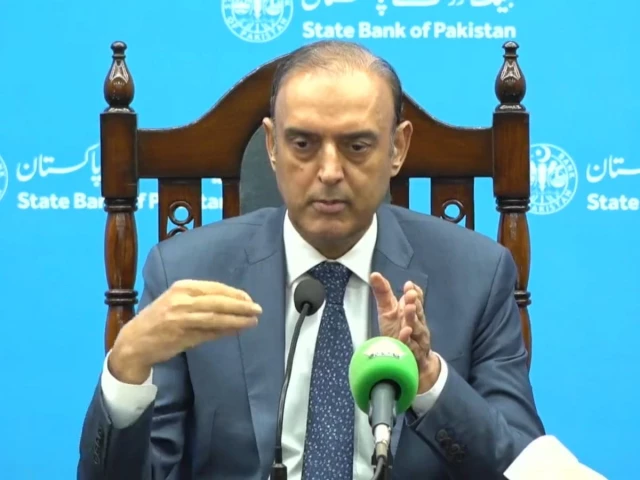
SBP Governor Jameel Ahmed during a press conference. Photo: SBP Meta
The State Bank of Pakistan (SBP) on Monday kept its policy rate unchanged at 11.5%, maintaining its current monetary policy stance following a meeting of the Monetary Policy Committee (MPC).
In June, the SBP also decided to keep the policy rate unchanged at 11.5%. The decision came after the central bank had raised the rate by 100 basis points in its previous meeting on April 27, against the market expectations at the time. Monday’s announcement reflected a cautious approach amid mixed signals on inflation and external risks.
While announcing the decision during a press conference, SBP Governor Jameel Ahmed said inflation had declined gradually during the first six months of the year, averaging 5.5% between July and February, remaining at the lower end of the SBP’s target range.
He said the conflict in the Middle East had pushed up petroleum and global commodity prices from early March, increasing inflationary pressures through higher fuel prices and shipping costs.
As a result, inflation accelerated to 11.7% in May before easing to 11.1% in June. The SBP expects inflation to decline further in July and continue moderating after September, he added.
He added that higher wheat prices had also contributed to inflationary pressures.
On the external sector, Ahmad said Pakistan recorded a current account deficit of $139 million during the last fiscal year, compared with a $17.5 billion deficit a year earlier. He said the current account balance was expected to remain between 0% and 1% of GDP during the current fiscal year, although the outlook would depend on developments in the Middle East.
The governor said the country’s foreign exchange reserves stood at $20.2 billion at the end of December 2026 and were expected to remain around that level through next December, with further improvement anticipated over time.
He also projected workers’ remittances to increase from $41.6 billion in the previous fiscal year to around $44 billion during the current fiscal year.
With inflation cooling but still refusing to settle, and an uneven economic recovery leaving little room for another monetary squeeze, economists have recommended that the SBP keep its policy rate unchanged at 11.5% at its July 27 monetary policy meeting.
The recommendation came as policymakers face a delicate balancing act. Headline inflation has eased, but underlying price pressures remain elevated, while improved external conditions provide some breathing space without shielding the economy from fresh shocks.
According to the July 2026 Monetary Policy Assessment by the Macro Policy Lab, a research centre at the Pakistan Institute of Development Economics (PIDE), headline Consumer Price Index (CPI) inflation eased to 11.1% in June, while urban and rural core inflation remained elevated at 8.7% and 7.9%, respectively.
The report titled “Market Expectations, Macroeconomic Conditions and Policy Assessment,” prepared under the PIDE Monetary Policy Tracker, observed that much of the recent inflationary pressure had originated from food, energy, transport and administered prices, which monetary policy cannot directly reverse. However, it cautioned that the recent rebound in the weekly Sensitive Price Indicator (SPI) warranted vigilance against assuming that disinflation had become firmly entrenched.
Market signals broadly support maintaining the status quo. Short-term Treasury bill yields remain close to the policy rate, while the overnight rate is also aligned with the existing monetary stance. Higher six- and 12-month yields point to medium-term caution rather than an immediate case for easing or further tightening, it noted.
The story is being updated….