Malik says daily fuel pricing will ensure transparency, reduce political intervention

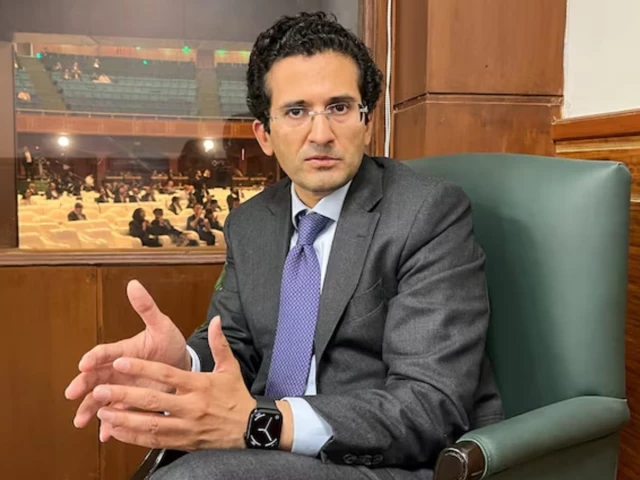
Minister for Petroleum and Natural Resources Ali Pervaiz Malik speaks during an interview with Reuters, during the Pakistan Minerals Investment Forum 2025, in Islamabad, Pakistan April 8, 2025. Photo: Reuters
Minister for Petroleum Ali Pervaiz Malik on Saturday defended the government’s decision to introduce daily petroleum price adjustments, saying the new mechanism would help curb market abuse, eliminate opportunities for windfall gains and ensure greater transparency by reducing the scope for political intervention.
The remarks came a day after the federal government announced that petroleum prices would now be reviewed and notified daily, replacing the weekly pricing mechanism, amid heightened volatility in global oil markets driven by renewed tensions between the United States and Iran.
Malik made the remarks while chairing a meeting with key stakeholders in the petroleum sector to discuss the transition from weekly to daily petroleum pricing. He said the reform would promote transparency, strengthen competition, and ensure fair, market-based prices for consumers.
Read: Govt shifts to daily POL pricing amid global headwinds
The meeting, convened to brief industry stakeholders on the new pricing mechanism, was widely welcomed by participants, who described it as a positive step towards deregulating Pakistan’s petroleum sector. Stakeholders also highlighted implementation challenges to facilitate a smooth transition to the daily pricing regime.
“The reform has been introduced on the directive of the prime minister and approved by the federal cabinet as part of the government’s commitment to establishing a rules-based petroleum pricing regime,” the minister was quoted as saying.
Under the new mechanism, retail petroleum prices will be determined through a transparent, formula-based system driven by market fundamentals, reducing the scope for political intervention and shielding consumers from abrupt price distortions.
Addressing the participants, Malik said the daily pricing regime represented a fundamental shift towards a competitive, market-driven economy by ending dependence on the weekly price announcement cycle and mandatory government approval.
“The new system would help curb market abuse and eliminate opportunities for windfall gains,” he said, adding that it would ensure greater transparency and fair pricing for consumers.
Also Read: Govt raises petrol by Rs5.44, HSD by Rs31.05 till Monday
Officials told the meeting’s members that the daily pricing mechanism formed a key component of the government’s phased deregulation strategy, aimed at gradually reducing state intervention and allowing market forces to determine petroleum prices, similar to the daily movement of exchange rates.
The minister said the Petroleum Division, in consultation with the Oil and Gas Regulatory Authority (OGRA) and industry stakeholders, was finalising comprehensive standard operating procedures (SOPs) to facilitate the transition.
He added that technical matters, including the Inland Freight Equalisation Margin (IFEM), refinery adjustments and true-up mechanisms, were being addressed through close coordination with stakeholders.
OGRA informed the meeting’s participants that it had aligned its internal systems to implement the new regime and was upgrading its data dissemination mechanisms to publish daily petroleum price information for greater public transparency.
The members also reviewed operational issues relating to supply chain logistics, inventory management, and the availability of real-time data.
The government assured stakeholders of its full support in addressing operational challenges and said a dedicated committee had been constituted to oversee the transition and resolve implementation issues through consensus.
Malik stressed that OGRA, district administrations, oil marketing companies, dealers, the Oil Companies Advisory Council (OCAC), and the Oil Marketing Association of Pakistan (OMAP) all had important roles in ensuring the success of the reform.
Read More: Sindh on high alert against fuel hoarding
He acknowledged that major reforms often presented implementation challenges but reiterated the government’s commitment to protecting consumers’ interests while ensuring the long-term sustainability of the petroleum sector.
Representatives of OCAC, OMAP, refineries, and oil marketing companies shared their views and highlighted operational concerns regarding the implementation of the daily pricing mechanism.
“All genuine issues would be addressed through continued consultation and collaborative engagement,” Malik assured the participants.
He directed the Petroleum Division and OGRA to hold follow-up meetings with industry representatives to further refine the pricing formula, resolve outstanding technical issues, and ensure the successful rollout of the daily petroleum pricing regime.
The meeting was attended by representatives of OGRA, OCAC, OMAP, refineries, oil marketing companies and senior officials of the Petroleum Division.
Source link