
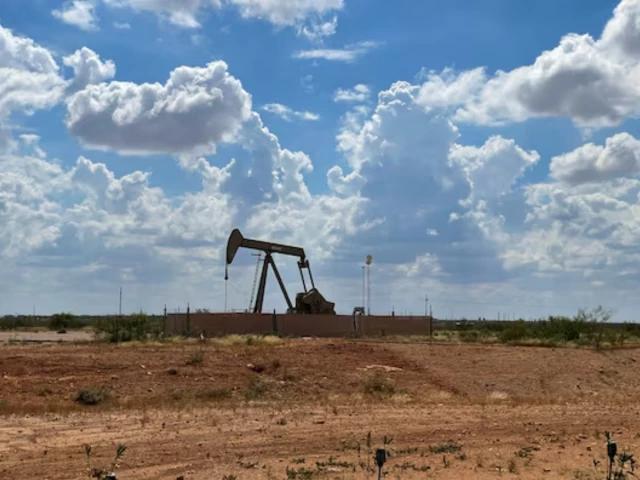
A pumpjack, used to help lift oil from a well, in the Permian basin near Midland, Texas, U.S., October 8, 2025 PHOTO: REUTERS
Oil prices rose more than 1% on Thursday after the US carried out fresh strikes on Iran, denting hopes for talks to end their war and for the full reopening of the Strait of Hormuz, a chokepoint for one-fifth of pre-war global oil supplies.
Brent crude futures rose 86 cents, or 1.1%, to $78.88 a barrel. US West Texas Intermediate crude futures were up 85 cents, or 1.2%, at $74.37 a barrel.
Both crude benchmarks, WTI and Brent, rose more than a dollar in post-settlement trade on Wednesday after the US military began launching fresh strikes on Iran.
Before that, the benchmarks had settled at their highest in over two weeks after US President Donald Trump threatened new attacks on Iran.
“Fresh US strikes on Iran pushed oil higher this morning, with the latest escalation undermining confidence in the fragile ceasefire,” said ING analysts in a client note.
The US military said it completed strikes on Iran aimed at keeping the critical Strait of Hormuz open to traffic, hours after President Donald Trump declared that an interim agreement to end the war was “over”.
US forces struck approximately 90 Iranian military targets, which included air defense systems, coastal surveillance assets, missile and drone storage sites, naval capabilities, and military logistics infrastructure along Iran’s coastline, US Central Command said.
Read: Oil rises as US strikes on Iran raise fears over shaky truce
Iran earlier said on Wednesday it attacked US military sites in Bahrain and Kuwait in response to earlier US strikes on infrastructure.
A fifth of global oil and liquefied natural gas supplies traversed the Strait of Hormuz before the Iran war, and Tehran’s control of the waterway has been its main leverage in a conflict that started with US and Israeli airstrikes against Iran on February 28.
The rush of oil that passed through the strait in recent weeks is over for now, with shipowners expected to take a more cautious stance, IG analyst Tony Sycamore said in a note.
Despite the interim peace deal between Washington and Tehran, “significant geopolitical risks remain,” said DBS Bank’s head of energy research Suvro Sarkar, expecting conflict uncertainty to support prices in the near term.
“We believe Iran has every incentive to prolong these discussions, suggesting that the war risk premium in oil prices may not fully dissipate for several months, leading to continued volatility despite an overall downward price trajectory in the medium term”.

